TopNewsOn

Results for “white house”

This supernova is 50 million light-years away, but that's close enough for astronomers

A new supernova has been spotted in NGC 1433, a spiral galaxy about 50 million light-years away. That's pretty close for supernova observations, and it's an opportunity for detailed follow-up study. It's not a core-collapse supernova, in which a massive star burns through its fuel, collapses and explodes. It's a Type Ia supernova. That means it's happening in a binary star system, where the exploding star is a white dwarf.

Phys.org · Nov 17
The sun, Earth, Jupiter and white dwarfs: Potential traps for dark matter

Dark matter continues to evade direct detection. Its slower-moving particles might leave signals too faint for detectors to register, yet be more easily captured by planets and stars. As they accumulate inside these bodies, they could produce effects that existing instruments would allow us to search for.

Phys.org · Nov 17
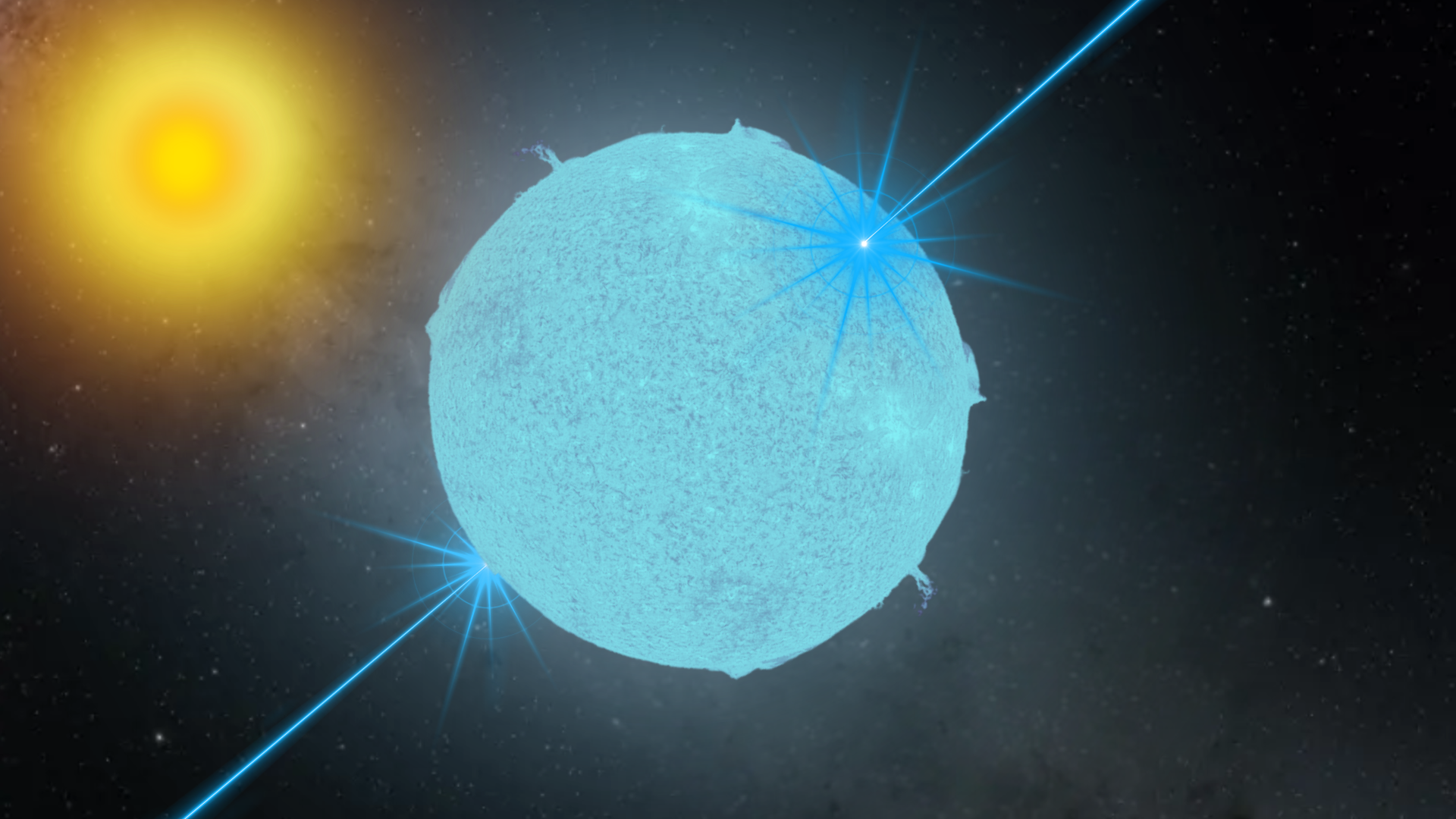
A dead star is flashing radio waves every 8 minutes, and its partner looks a lot like the sun

Since 2022, astronomers have been puzzling over a new kind of cosmic object called long-period radio transients. These are objects that emit bright flashes of radio waves into space every few minutes to every few hours. Some have been traced back to binary systems consisting of a small, dim, cool star called a red dwarf in orbit with a stellar remnant called a white dwarf.

Phys.org · Nov 14
The space rocket I could have been aboard explodes: Rhiannon Adam’s best photograph

‘I was chosen to go around the Moon on a SpaceX starship. Preparations took over my life. Then, four minutes into watching a rocket on a test flight, it broke apart. And that was the end of my adventure’ This photograph was taken on 20 April 2023 from the VIP section of SpaceX’s launch viewing area, looking out from South Padre Island, Texas, towards Boca Chica, a nature reserve near the Mexican border which is home to SpaceX’s Starbase launchpad. In 2021, I and seven other civilians were selected from an open call to go around the Moon on a free SpaceX Starship flight funded by the Japanese billionaire Yusaku Maezawa. The dearMoon Project included myself and another photographer. For me, the story also became about being plucked from obscurity and planted in this very surreal world I could never have imagined being a part of in a million years. At the time, only 24 white American men had orbited or landed on the moon. Being selected for something like that changes your life and your perception of your worth in the world. The flight, originally scheduled for 2023, completely took over my life. It took the air out of every room – I couldn’t talk about anything else. People stopped commissioning me because they assumed I was busy going to space; every conversation I had was about it. This was going to be the rest of my life. That day in April was pivotal. We were there to watch SpaceX’s Integrated Flight Test 1. After four minutes, following a relatively successful liftoff, the vehicle experienced what they call in space terms an “RUD” – Rapid Unscheduled Disassembly – and broke apart in the air. We put on a brave face but secretly I was thinking: “Wow, the risks are no longer theoretical. I could have been on that.” The dust cloud in the image emerged from the concrete launchpad and tower – obliterated by the power of the raptor engines. The debris ended up all over the local houses and SpaceX closed the launch facility for reconstruction for four months while they c

The Guardian · Nov 11

Archaeological trap: Fish can make skeletons appear hundreds of years too old

The Danish town of Svendborg was once home to a Franciscan monastery. As at other monasteries in Denmark, it was considered highly prestigious to be buried as close to the monastery church as possible, preferably inside the church itself, for instance near the chapter house or along the cloister.

Phys.org · Nov 10
Dead stars could break one of physics' most famous limits

A surprising new discovery suggests that some dead stars can grow far more massive than scientists once thought possible. Computer simulations show that powerful magnetic fields could allow white dwarfs to reach 2.4 times the mass of the Sun, dramatically exceeding a famous limit that has stood for decades. The findings could help explain unusually bright supernova explosions that have long puzzled astronomers.

Science Daily · Nov 6
US midterm elections: Younger politicians could strengthen trust in democracy

It's no secret that American politics is dominated by older politicians. When 81-year-old Joe Biden withdrew from the 2024 presidential race amid concerns about his age, it was the then-78-year-old Donald Trump who ultimately entered the White House. The median age in the House of Representatives and the Senate was 58 and 65, respectively, while the average American was just 39 years old.

Phys.org · Nov 4
Park users reveal 5 factors shaping acceptance of wildlife management

Should an area be fenced off, should animals be sterilized or relocated—or, as a last resort, selectively culled? As the long-running controversy over white-tailed deer in the Montreal suburb of Longueuil's Michel-Chartrand Park has shown, managing wildlife in peri-urban parks isn't just about the science. Emotions, trust and how decisions are communicated also play a role.

Phys.org · Nov 3
A single sauna session sends immune cells surging through your body

A new Finnish study reveals that just 30 minutes in a sauna can temporarily flood the bloodstream with additional white blood cells, potentially helping the immune system patrol the body and detect threats. The surprising response resembles the immune boost seen during exercise and may help explain some of the health benefits linked to sauna bathing.

Science Daily · Oct 28