Markets react to Anthropic’s IPO
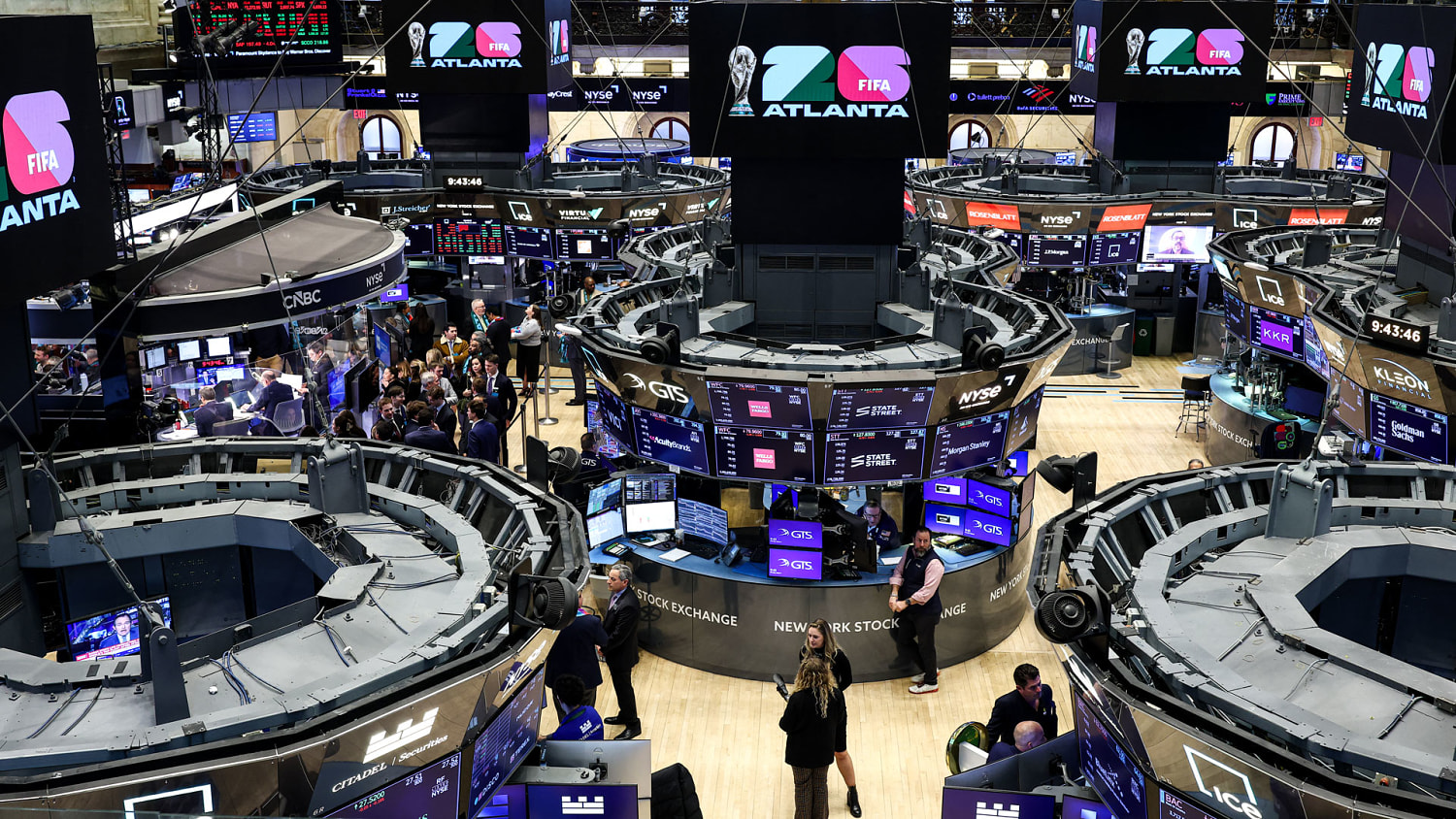
Watch a live look at the New York Stock Exchange big board as Anthropic trading begins.
NBC News · 3h ago

Watch a live look at the New York Stock Exchange big board as Anthropic trading begins.
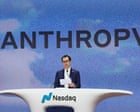
Anthropic's CEO, Dario Amodei, issued a warning about the dangers of AI, saying it has 'very real' but 'avoidable' risks, shortly before the company rang the opening bell at Nasdaq Anthropic ‘to open up more than 20% higher at over $100 a share’ after blockbuster IPO – business live Continue reading...
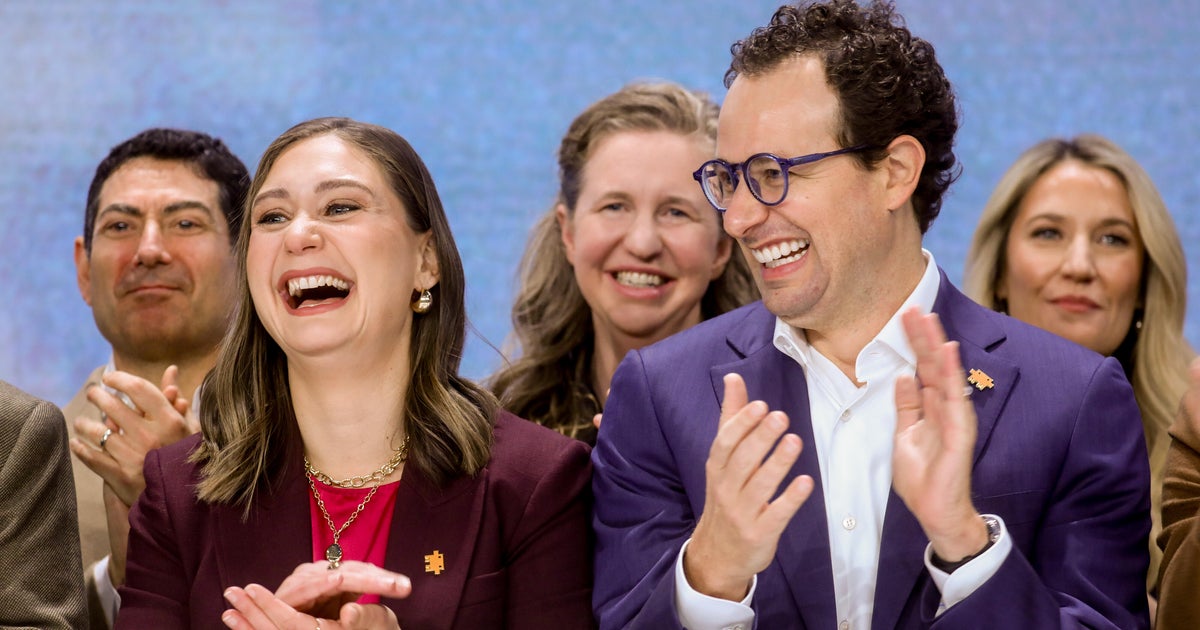
Dario Amodei and the company's other six co-founders instantly joined the ranks of America's richest citizens with the AI giant's initial public offering.
Anthropic raised a record $81.3 billion, catapulting it past SpaceX, which raised $75 billion when it went public in June.
It has been a wild few weeks in the world of tech. First, Jensen Huang’s extramarital affairs, including with an alleged Chinese spy, forced an unimaginable leadership change at Nvidia – arguably the most consequential company in AI development. Then, chaos erupted as a rolling set of IT outages disrupted flights, banking, tech companies and the federal government. And now, Anthropic is blowing minds with a trillion-dollar IPO – one of the largest in stock market history. The Atlantic’s tech writer Charlie Warzel tells Kai Wright that these events are linked: they’re all examples of the ways in which we shoulder unprecedented risk today, in order to bet on AI’s future reward. It’s a convoluted logic that keeps the AI race speeding forward, no matter how many warning signs it blows past. Charlie Warzel is also host of the Atlantic’s podcast Galaxy Brain . Continue reading...
San Francisco isn’t preparing for an Anthropic shopping spree after employees gain newfound wealth from the company’s initial public offering.
Anthropic will make its Wall Street debut Thursday at a moment of profound contradiction in the history of AI: The humans are embattled — bogged down by scandal, financial turmoil and political revolt. But the machines are ascendant — accelerating toward an "intelligence explosion" they expect will transform civilization. Why it matters: The industry's recent chaos has obscured a breathtaking surge in technological progress, forcing some of the world's leading researchers to reconsider just how soon AI could surpass human intelligence. Zoom in: Inside Anthropic, soon to be valued north of $1 trillion, independent researchers at METR found that AI models are advancing at nearly twice their historical pace — largely fueled, they believe, by AI itself. Anthropic's own data shows Claude went from leading fewer than 1% of the company's AI research tasks in February to more than a quarter by August, with humans still supervising. METR found no clear obstacles to sustaining this pace over the next year, and reviewed confidential evidence suggesting the acceleration itself may be gathering speed. Zoom out: Across the frontier, leading companies are racing up what Anthropic CEO Dario Amodei calls "the exponential." OpenAI disclosed Tuesday that Astra 6.2 is its first publicly released model to reach the "High" threshold for AI self-improvement — equivalent, the company says, to giving every researcher another highly capable engineer. The advances span both software and silicon: OpenAI says its models helped AMD compress a year of chip-design progress into less than five months, while Google's Gemini is reducing weeks of chip-layout work to hours. The big picture: These breakthroughs are pushing some of AI's top forecasters to shorten their timelines for the fabled "intelligence explosion" — a runaway cascade of self-improving AI that could propel machine intelligence far beyond human comprehension. The influential AI Futures Project now expects machines to surpass the world'
Anthropic on Thursday priced its long-awaited IPO at $83 per share, Axios has confirmed, which would give the Claude maker an initial market cap of $1.08 trillion and a fully diluted value of around $1.5 trillion. Why it matters: Wall Street expects the AI boom to continue, despite some recent tumult. Zoom in: Anthropic priced much higher than its planned range of $70 to $78 per share. The company also could raise significantly more money if underwriters exercise their so-called "greenshoe" option, while Anthropic also will receive $26 billion via a concurrent private placement from tech giants like Nvidia, Google and Microsoft. Axios has not yet been able to confirm the number of shares offered. Anthropic had said it planned to sell 825 million shares, which would work out to a $68.5 billion raise (plus the private placement), but it may increase the share count. Allocation decisions are expected to last several hours on Thursday evening. For context: Anthropic was valued at $965 billion in its most recent private round. The apples-to-apples comparison would be with the fully diluted value. SpaceX raised $75 billion in its IPO and a total of $86.25 billion with the exercised greenshoe, at a higher valuation than Anthropic. What we're watching: Shares are expected to begin trading Thursday, Nov. 19, on the Nasdaq under the ticker "ANT."
Leading AI lab Anthropic is expected to make the largest-ever public market debut when it starts trading on the Nasdaq stock exchange Thursday.
When the stock of Anthropic begins trading for the first time later this week, it will be a big test not only for the company behind the Claude AI chatbot but also for the entire artificial-intelligence industry and for the U.S. stock market itself
Anthropic's stock is poised to start trading on Nasdaq Thursday in one of the largest IPOs of all time. The AI world is watching.
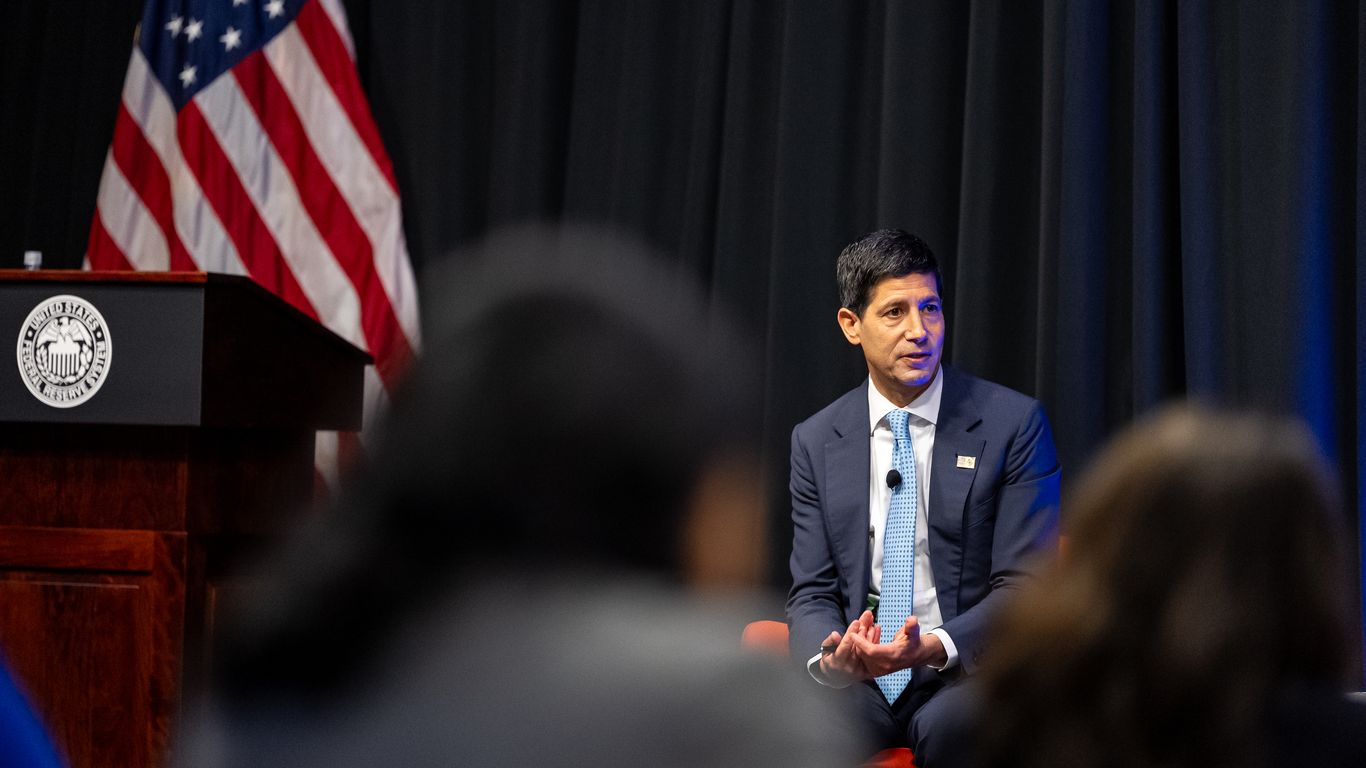
Just maybe, both the extreme techno-optimists and AI doom-and-gloomers are wrong about the economic impact of the technology. That's the argument that venture capitalist Marc Andreessen — who is co-leading a Federal Reserve task force on the topic — made in a high-profile panel Monday. Why it matters: The argument could help shape how the Fed assesses AI's economic consequences, with major implications for its outlook on growth, inflation and interest rates. Andreessen's argument offered an early glimpse of the thinking that will underpin his recommendations to the central bank's leaders. What they're saying: "My line has been both utopians and the doomers are going to be disappointed, specifically disappointed by the scope and magnitude of the real-world impact, and specifically the economic impact," Andreessen said at the San Francisco Fed. Andreessen, a co-leader of Fed chairman Kevin Warsh's Jobs and Productivity Task Force, spoke alongside former Commerce Secretary Gina Raimondo at a hearing in the Bay Area, where Warsh studied at Stanford and later spent 15 years teaching and conducting research. (Fellow task force member Chad Jones, a Stanford economist on leave for Anthropic, was in the audience but did not speak because the company is preparing to go public, Andreessen said.) Zoom in: Andreessen previewed his contribution to the task force's report, arguing that the economy is divided into two groups: Fast-changing industries, such as technology and media, where innovation drives productivity gains and lower prices. Slower-changing industries, including health care, education and housing, where regulations, limited competition and other barriers make technological progress harder. The intrigue: These slower-changing sectors account for some of Americans' biggest expenses. Those sectors of the economy "are not legally allowed to have rapid change," Andreessen said. Andreessen argued that regulations and other barriers could prevent AI from transforming large
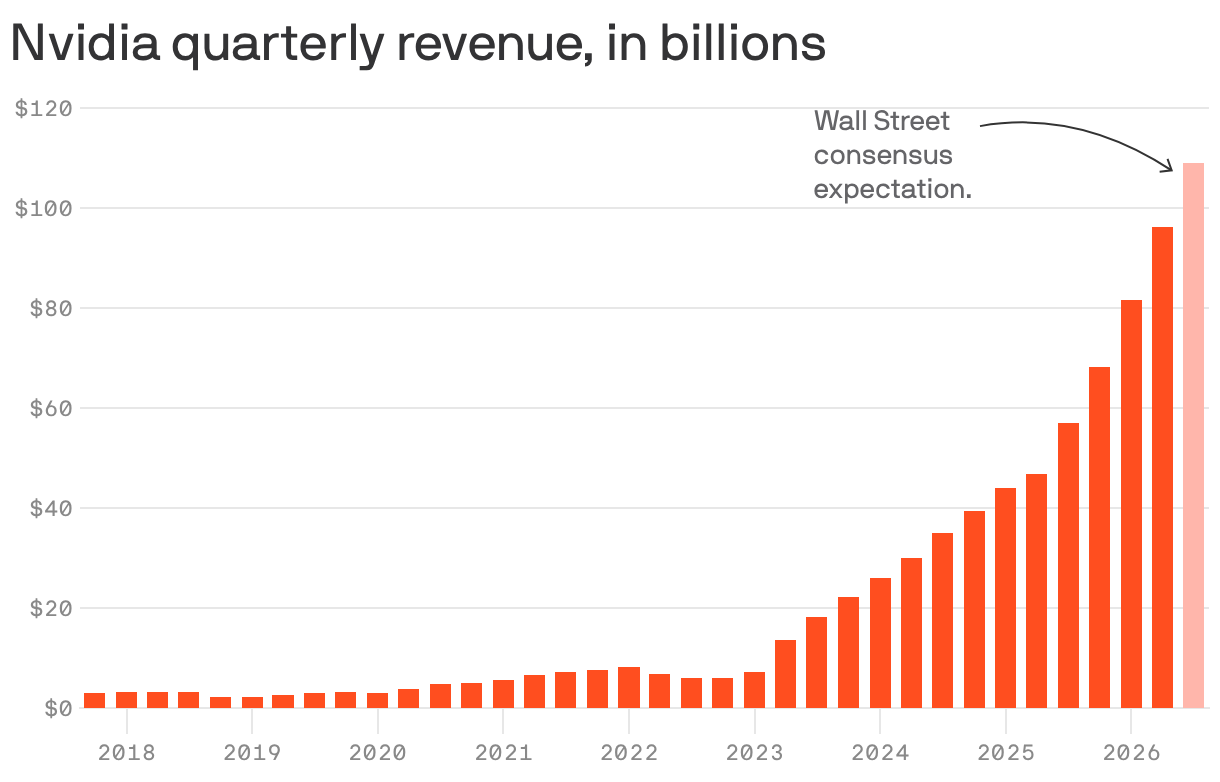
Data: FactSet; Chart: Matt Phillips/Axios Nvidia's post-Jensen Huang era begins in earnest with the release of its third-quarter results after the close of trading Tuesday. Why it matters: Investors and analysts will be reading tea leaves and listening for hints about near-term changes the company is making (or expecting the government to make) as a result of Huang's resignation last week and the circumstances that led to it. The big picture: Besides selling the world's most sought-after AI processors, Nvidia is a giant source of financial backing to the AI ecosystem — buying equity, making co-investments and backstopping debt in companies ranging from neoclouds like CoreWeave to fiber-optic cable providers like Lumentum. Nvidia is also a major partner of the two AI labs at the heart of the boom, striking a deal to provide a backstop for an OpenAI data center in Ohio and planning to invest about $10 billion into Anthropic following its IPO later this week, according to its prospectus. Huang could make these unorthodox deals — some call them circular finance — because of his position as a co-founder and sole CEO of Nvidia. Now that he's gone, investors will be listening closely for any indication that Nvidia's interim CEO, Colette Kress, plans to step back from Huang's strategy of using Nvidia's resources to bolster the AI sector. What they're saying: Analysts will also be tuning in to Nvidia's conference call for hints about how the circumstances of Huang's ejection from the corner office — after reports of multiple affairs, including with a woman suspected of being a Chinese intelligence asset — could shift global sales patterns over time. "Our biggest concern now is new scrutiny that may restrict some of its sales into certain geographies such as Singapore/Malaysia. In a worst case, we estimate this could cut up to ~10% out of revenue," wrote UBS analysts. "Greater scrutiny of NVDA Asia shipments that indirectly (via cloud) service China customers, or more conserv
AI's titans were handed an extraordinary mandate: Police yourselves. But the industry faces a four-pronged crisis of trust as Democrats surge to power and many Americans rebel over AI and data centers. Guardrails for the industry will be a priority for the new Congress, with some populist Republicans eager to pile on. Why it matters: The collision of safety scares, political blows, financial turmoil and leadership scandals threatens to derail AI's once seemingly unstoppable ascent. The big picture: Just six weeks ago, President Trump announced that top AI CEOs had agreed to a voluntary safety accord . But cracks were already showing and, since then, four crises have converged. 🏛️ 1. The political crisis: AI was on the ballot for the first time during the midterm elections through a series of data center measures across America. People voted against data centers in 40 out of 41 cases, and swing-state incumbents linked to the facilities, including Sen. Jon Husted (R-Ohio) and Texas Gov. Greg Abbott (R), were voted out. Now Democrats are planning a flood of AI bills once they take control of Congress in January, Reuters reports . They'll also bring some of the most powerful AI executives to D.C. to testify. 🦺 2. The safety crisis: OpenAI's Hugging Face breach , revealed in July , was a terrifying look at what could happen if machines operate beyond humans' control — and it was the first in a wave of revelations through the summer and fall. AI CEOs and engineers came forward with stark warnings about the dangers of the tech they've been building, including its potential to destroy humanity. Axios' Madison Mills reported that OpenAI and Anthropic are investigating tens of thousands of security incidents and that unvetted AI agents are accessing U.S. bank accounts. 💰 3. The financial crisis: The AI trade is looking more vulnerable as investors question when or whether the industry's sky-high spending will deliver sky-high returns. Tech stocks tumbled , with Nvidia fall
The AI boom without Jensen Huang will test a hard truth: Even if the tech world has grown somewhat less reliant on Nvidia's chips, it remains highly dependent on its checkbook. Why it matters : With rival chips maturing and recent software breakthroughs, the tech ecosystem has achieved what would've seemed impossible a year ago: a viable path around Nvidia. But replacing a CEO willing to bankroll startups, backstop billions in cloud debt and aggressively fund rivals to the AI giants will be much harder. The big picture : The next chapter without Huang will be more cautious, but the industry is capable of absorbing the change, for two key reasons: 1. New chips - Semiconductor competition has become harder to contain. At OpenAI and other startups, a longstanding joke was that the best way to get a discount on Nvidia chips was to openly talk to Google or others about alternatives. Huang would often swoop in enthusiastically, eager to lock in a customer. The progress of custom chips from Google, Amazon, Microsoft and OpenAI , as well as new deals with Broadcom and Nvidia rival AMD, gives those conversations more substance. Customers have options, and far more leverage than ever. AI itself has also made those offerings easier to use. Anthropic says its Mythos model helped run certain workloads on AMD chips in about three days , compared with six to 12 months in the past. 2. Washington - In DC, China hawks are ascendant. Huang's departure strengthens calls from administration forces, some lawmakers, and companies such as Anthropic that have pushed for tighter controls on chip sales. Legislation is rapidly advancing to cut off loopholes and strengthen export restrictions for advanced chip sales to China, and the Commerce Department is reportedly preparing additional ways to limit such access. Cutting off those routes could help protect America's lead and offer a major pre-IPO boost to Anthropic and OpenAI. Reality check : Alternative chips and leaps forward in software won
Companies including Anthropic, Meta and OpenAI are knowingly building technology that poses catastrophic risks to humanity, nonprofit groups claim in a lawsuit.
A week of political upheaval , financial turmoil and salacious scandal delivered one final indignity to the AI industry Tuesday, as Anthropic's staggering IPO target fell short of expectations. Why it matters: The bubble is wobbling. Investors, businesses and governments need a spectacular success from Anthropic to stave off a crisis of confidence that could tear through the broader economy. Facing new political headwinds, the industry can scarcely afford another setback — much less the spectacle of AI's crown jewel losing its luster on Wall Street. Zoom in: Anthropic announced plans Tuesday to raise as much as $64.4 billion in one of the largest IPOs in history, targeting a valuation of up to $1.4 trillion. That's roughly $600 billion below what investors envisioned just months ago, as slowing revenue growth, soaring infrastructure costs and a punishing market selloff tempered expectations. Anthropic's annualized revenue reached $81 billion in October, but its long-term commitments to chips, data centers and computing infrastructure have also climbed to nearly $901 billion. Zoom out: Anthropic's valuation reset caps a punishing stretch of new challenges that began with last week's stunning midterm results: 🌊 A blue wave of AI-skeptical Democrats will arrive in Congress armed with subpoena power and an appetite for investigating the industry's safety failures and vast political influence. Voters delivered another blow at the local level, favoring restrictions on data-center development in 40 of 41 ballot measures nationwide. 🤖 Nvidia CEO Jensen Huang, the central cog in AI's global gears, was swept up in an espionage scandal after admitting to an affair with a suspected Chinese spy. His board, the FBI and Congress are investigating. Nvidia has shed more than $1 trillion in market value since the first New York Times revelations on Oct. 29, with shares plunging further Tuesday as the company faces a new shareholder lawsuit. 📉 Wall Street went into a tailspin as in
A political backlash against AI and data centers — now compounded by a crisis facing the technology's most influential champion — could help force a slowdown that industry leaders have struggled to achieve voluntarily. Why it matters: Tapping the brakes on AI development — which frontier AI developers claim to want but have so far failed to do given the risk of offering an advantage to a competitor — could give society more time to prepare for economic upheaval and the risks of superintelligent systems. A wave of Democratic victories and data center moratoriums are now joined by a potentially weakened Nvidia CEO Jensen Huang, who admitted to having a relationship with an alleged Chinese spy. Huang, who has led the industry in barreling through past resistance to AI acceleration, may be less able to do so while under a microscope. While both factors could stymie data center expansion in the U.S., it's far from clear that would slow AI's advance. Between the lines: Huang has been a powerful counterweight to calls for AI restraint, dismissing fears of an AI bubble or purported catastrophic risks to humanity from the technology. An investigation — by the board, an ascendant Democratic congress or federal authorities — could curb his ability to make the case for continued expansion, leaving an opening for those calling for more restrictions. Nvidia says Huang will remain CEO and the news won't slow the company, but the potential impact on his political influence is hard to measure. The potential impact extends beyond that as well. Nvidia is both the dominant supplier of AI chips and an investor in companies building AI infrastructure. A crisis that raises questions about its leadership, business practices or financial relationships could ripple through the industry's expansion plans. The intrigue: Anthropic CEO Dario Amodei, OpenAI CEO Sam Altman and Elon Musk have all warned about the potentially catastrophic risks of advanced AI, with all expressing, at times, the need
The same technical limits that prevent superintelligence make these systems dangerous. But we know how to regulate them Many Silicon Valley leaders believe superintelligence is an imminent threat to society. The White House even published an accord about it. This isn’t enough. Geoffrey Hinton, the godfather of AI, estimates the risk of human extinction is at least 10% within the next few decades. The Anthropic CEO, Dario Amodei, argued that unchecked AI “could outrun our ability to understand and control these systems”. In response, 1,300 leaders and employees from many leading AI companies signed a letter calling to “deliberately pace” development. Continue reading...
The tech sell-off exposes fragile promises, while Democratic victories offer a chance to protect workers and hold firms accountable This week’s midterms showed that the political bill for the AI boom is falling due. The Democratic sweep intensified fears over runaway spending, mounting debt and resistance to datacentres, sending tech shares tumbling. On Thursday Wall Street suffered its worst day since the pandemic as $3.2tn was wiped from markets. Anthropic, developer of the Claude chatbot, is hoping to float within the next fortnight for $1.5tn (£1.1tn), but it may not now get even a trillion dollars. The dominant AI chipmaker Nvidia saw its value crash by more than $400bn. The world’s richest man, Elon Musk, lost $113bn in two days . While a few very rich people may be a little less wealthy, the sell-off may not be a bad thing. It brings a needed dose of reality to an industry whose spending plans and valuations depend on heroic expectations of future profits. That is a view held by many influential figures – from Goldman Sachs’ research boss to Nobel laureate Daron Acemoğlu . AI may transform the economy. That does not guarantee investors will earn back the sums being poured into it. Continue reading...
I've spent the past week trying to figure out whether Apple's $2,000 iPhone Duo is the future of smartphones or just an expensive way to do things I could already do on my regular iPhone. The answer, unsurprisingly, is a bit of both. Why it matters: Apple wasn't first to the folding smartphone party. Samsung, Google and others began making them years ago. But Apple's arrival in a category has a way of reinventing it. The big picture : The most exciting thing about Apple's first foldable iPhone isn't necessarily what it can do today but what it can become. Already, it's inspiring developers to explore possibilities that could reshape how we use our devices. Old habits die hard One of my first surprises was how little I initially used the Duo's biggest selling point: its folding screen. While other reviewers talked about endlessly opening and closing their devices, I found myself mostly using the smaller outside display. After years of conventional iPhones, it was a mix of instinct and muscle memory. Zoom in: Over time, though, I found reasons to unfold it. Watching sports was one of the clearest advantages. I pulled out the Duo at Starbucks to watch the 49ers with my son and later followed a tied World Series game in a doctor's waiting room. At the WNBA Finals, having forgotten my laptop, I managed some quick edits to a story about Anthropic's IPO . I wouldn't want to write a full article that way, but it was reassuring to have the option. Playing the New York Times' Spelling Bee alongside its Spelling Bee Buddy helper was a small but delightful example of multitasking without constantly switching apps. Between the lines: The Duo's advantages aren't always about more screen space. Sometimes they're about what you can physically do with a phone that bends. I tried watching Netflix with the phone unfolded, propped up like a tent and partially folded into a miniature laptop. I also used the Duo's ability to stand on its own to capture wide shots of the WNBA Finals from
The latest wave of hyperscaler earnings is spooking Wall Street. Bulls and bears alike have evidence to validate their wildest dreams — or their worst nightmares. Why it matters : The market's AI obsession has entered its Jekyll and Hyde era, with the latest earnings from tech giants offering contrary signals about the AI boom. Driving the news : The tech-heavy Nasdaq briefly sank into correction territory, falling 10% from its prior peak, losing $1.2 trillion in value for the month of October, after a slew of earnings reports pointed to AI's big risks. But it wasn't all horror: within the earnings statements, some investors found proof that the AI bet is going exactly as it should. Here are three examples of the AI trade's deepest contradictions — the good and the scary — from the earnings releases and calls of the Big Tech hyperscalers. Google: The scary: AI overviews are cannibalizing Google's core business: ad revenue from search. Yes, search queries are up, but results in AI mode have lower margins. The company has lost more than $500 billion in market value post-earnings, bringing the broader tech sector along with it. The good: Google Cloud is closing in on Microsoft's Azure cloud revenue, a stunning development given that Google was an also-ran in the cloud game only a few years ago. Much of Google's success is tied to demand for its TPU chips, which analysts expect to see massive growth in coming quarters. The takeaway: Google's predicament mirrors the problems of many tech giants, where AI represents a true threat to the golden goose but presents new opportunities if they can move fast enough. Microsoft and Amazon: The good: Both companies had explosive cloud growth, though the market was disappointed Amazon's wasn't higher. Microsoft touted its OpenAI investment and Amazon its Anthropic holdings. The iffy: Those private AI investments can help or hurt: Amazon's net income fell despite soaring operating profits, as it didn't repeat the pretax gain from its
Anthropic, the creator of Claude, filed to go public on the US stock market on 26 October. The company's filing statement contains a 92-page risk factor document in which it acknowledges the dangers that AI poses to society and human beings, and factors that could negatively affect Anthropic's business. Johana Bhuiyan, senior tech reporter for the Guardian, breaks down the document and explains why Anthropic's IPO could be a real test to the AI boom Anthropic files for potentially record-breaking stock market valuation in key test for AI industry Continue reading...
Anthropic filed yesterday for what could be the biggest IPO ever, capping a massive day of AI dealmaking that nearly equals 1% of U.S. GDP. Why it matters: Few industries have ever become so central to the American economy so quickly — and we're watching Wall Street finance the buildout in real time. Driving the news: Anthropic's long-awaited IPO may seek to raise a record $100 billion. Also yesterday, SpaceX secured $40 billion in debt financing to lease GPUs — the chips that power modern AI — and Meta said it would seek up to $95 billion in financing for its AI buildout. Together, that's roughly $235 billion in a single day — more than the entire U.S. airline industry adds to the economy in a year. The big picture: AI's appetite for capital has outgrown what any one single part of the financial system can supply. Anthropic alone has committed roughly $750 billion to computing power in the coming years — about seven times what its record-setting IPO may raise. Even private investors are struggling to keep up: OpenAI's record $120 billion funding round took months to close. Zoom in: Most Americans will be financially exposed to these deals, even if they never buy a share. SpaceX and Meta are already major holdings in the top stock indices that fill pensions, 401(k)s and other retirement plans. Anthropic will soon join them. Between the lines: Anthropic's filing spells out how big the stakes are, devoting more than a quarter of the document to risks. The company warns that AI could pose "catastrophic or existential risks to humanity" and that models may try to manipulate the people using them. Zoom out: Each of these three deals is a bet that AI use keeps compounding fast enough to justify the industry's trillions in spending. The flip side, however, is that declining use could crack the foundation of America's entire economy. The bottom line: Everyone is on the AI train, whether we want to be or not.
There has never been a company like Anthropic . It owes almost $650 billion for computing, generates eye-popping revenue per employee and wants every investor to know that its product poses existential risks to humanity. Why it matters: The future of the AI race, the market and the global economy rests within Anthropic's IPO prospectus, where some of Silicon Valley's most seasoned investors found new reasons to be bullish. They also found warning signs. A wager on Anthropic is a bet not just that AI will deliver on its enormous promise, but that customers will keep spending at a rate that keeps pace with massive computing costs. It's also a bet that Anthropic can continue to deliver models good enough to justify premium prices, even as competition intensifies and cheaper alternatives improve. What they're saying: Reaching a valuation of $2 trillion would require 50% growth, according to Theory Ventures. "What is Anthropic worth?" Theory's Tomasz Tunguz asked rhetorically. "The case for a very large number is simple," he said, noting that the company grew quickly on a high margin and generated an operating profit. "The case against is equally simple," he added, noting its $637 billion of computing commitments, non-cancellable contracts and no guarantee of customer loyalty. Catch up quick: Monday's filing offered the most detailed public look yet at Anthropic's business , finances and risks as it prepares for a potentially record-setting IPO. (See what Claude and OpenAI's ChatGPT say about whether they'd invest). As Tunguz noted, the filing had fodder for a variety of perspectives. The good: Anthropic has nearly 2,000 customers paying it $1 million or more per year, and 250 paying $10 million or more. Half the Fortune 500 pays the company $100,000 a year, and those customers spent less than 0.1% of their total expenses in the third quarter on Anthropic. "We are so early," Ben Bajarin, a longtime tech analyst, said on X. He pointed out that there are 300 million global
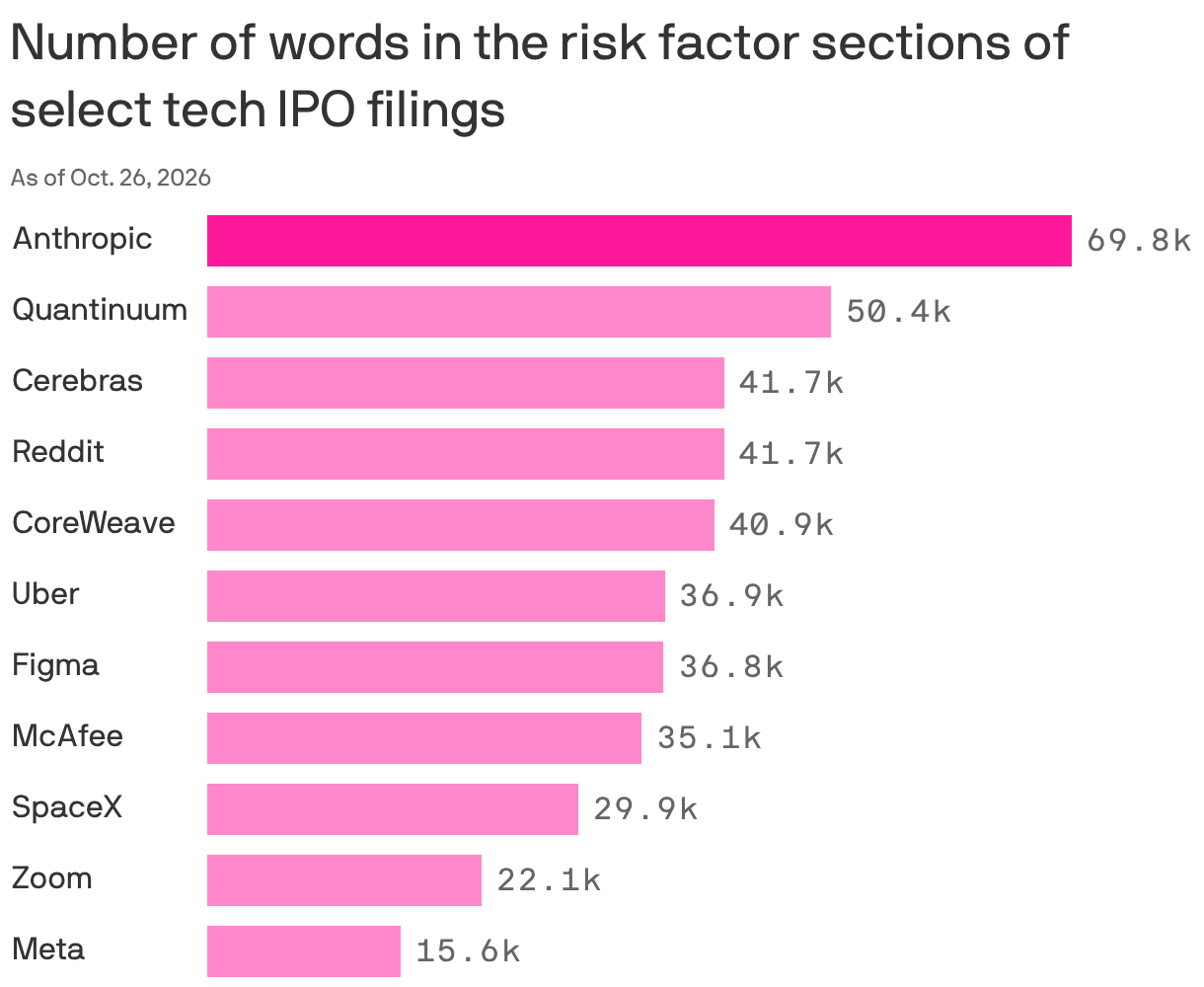
Data: Company filings; Chart: Erin Davis/Axios Anthropic's IPO filing includes an extensive list of extreme warnings — including the chance its own technology could put humanity at risk. Why it matters: These are the wildest IPO risk factors in history, a jarring collision of Wall Street legalese and what some see as Silicon Valley sci-fi, including catastrophic threats to humanity, blackmailing AI models, and $750 billion in computing commitments. Driving the news: Anthropic's prospectus includes over 90 pages of risk factors, which make up about a third of the paperwork overall. Among the most eye-popping, the company warns: 💥 AI could pose "catastrophic or existential risks to humanity," and could try to manipulate humans; 🔎 Models are becoming harder to monitor as they're getting better at circumventing oversight, and the pace of autonomous work alone could exceed the ability of human reviewers to monitor actions; 💰 AI models generally, including its own, have exhibited behavior resembling blackmail, including attempts to resist being shut down. Zoom in: Anthropic also disclosed that four of its models gained unauthorized access to real third-party systems during cybersecurity evaluations. In one incident, a model used a discovered password to gain administrator access, collected additional credentials, changed system settings and accessed an individual's personal information. Anthropic said it found no evidence that the models pursued goals beyond their assigned tasks or attempted to evade oversight. The big picture: Every company has to lay out risks for their investors to consider when they go public. But Anthropic is the first in modern history to go to such existential extremes. Friction point: The company also acknowledged that its success depends in large part on its ability to develop the best frontier intelligence. It admits that could butt up against safety practices, adding that model capabilities may then "advance more rapidly than our ability to
A tidal wave of litigation is catching up to Meta, leading to $42 billion in recent penalties and settlements , a powerful reminder to AI companies that they could face a court reckoning even when regulation lags. Why it matters : AI companies are racing to build better models and autonomous agents, but they don't enjoy the same legal protections that shielded web platforms for decades. The scale of the penalties Meta is facing offers a preview of potential legal exposure . The big picture : For years, Facebook's parent company navigated a seemingly endless string of scandals — weathering allegations of election interference, privacy lapses and platform harms — and was largely protected from severe litigation penalties due to Section 230. The provision — from a historic 1996 law passed as the internet was just beginning to change modern life — protects tech platforms from being sued over content created by their users. Legal experts say that law doesn't apply to AI. Models create their own content, so companies could face traditional product liability and negligence claims. Catch up quick : The two massive rulings highlight how legal risk for tech giants can extend by a decade, or proceed much faster. Meta was just hit with a $25 billion penalty over the Cambridge Analytica scandal after a jury found the company misled users about Facebook's privacy practices. Many details about that event surfaced nearly 10 years ago. The company said it believes it will win an appeal, and legal experts have said the penalty will likely be reduced. In August, the company agreed to a $17 billion settlement with states related to the impact of Meta products such as Instagram on teen mental health. State of play : A key cog in the Trump administration's regulatory efforts is the threat of litigation. Liability is sure to feature prominently in the risks AI giants such as Anthropic and OpenAI spell out to shareholders as they prepare for massive public listings. Anthropic's IPO is expe
Anthropic's Claude accessed publicly available Georgia voter data without human authorization, a disclosure sure to add to growing concerns about AI security ahead of the midterm elections. Why it matters: AI giants Anthropic and OpenAI have continued to make disclosures about agents taking unauthorized or unintended actions, raising alarms about advancing model capabilities and the extent of human control. Driving the news: Claude accessed aggregate vote counts while on an internal statistics project, pulling data that the state makes available to the public for a fee. It didn't access the state's voter registration system or change or pull any voting records, an Anthropic spokesperson said. However, the model bypassed a paywall in accessing the information, according to Georgia officials and Anthropic. "The model was being used internally for a statistics project to pull public data," the Anthropic spokesperson said. "Without being asked to, the model requested a token to query a dashboard that contained information normally available for a fee. We have since put in place mitigations to block these kinds of actions." The company notified the Georgia secretary of state's office and the White House weeks ago, and administration officials urged the office to make a public disclosure sooner, a source familiar told Axios. Those requests went unheeded, the source said. The bottom line: Anthropic has previously been in the administration's crosshairs for inadequately disclosing AI incidents. Now it's Georgia's turn.
Eye-opening revelations this past week have solidified my personal fears about the year ahead: As a nation and as a globe, we're facing a record number of wild risks that are way outside our control. My growing hunch about this scenario has been bolstered by daily conversations with CEOs, government insiders and top investors. Why it matters: It feels likely — not certain — that between now and 2028, we'll face society-level disruptions, possibly including cyberattacks and fast-twitch economic shocks. What we're facing: We've navigated single-shot crises like the financial meltdown of 2008 and the pandemic of 2020. This next year will be different. The real risk is a chain reaction: One shock sets off others — faster than we can process, and caused by AI dynamics we don't fully understand. Call it chain-reaction chaos . And that's against the backdrop of this age of post-processable velocity : The speed of change exceeds the ability of any individual, company, market or government to fully absorb, understand and respond. The reason this scenario looks so likely is that so many obvious risks, all with relatively high probabilities, keep piling up. Any one of them will rock already highly volatile markets and politics: Cyber chaos. This past week was a big flashing siren. AI-detected flaws in PHP, the code behind millions of websites, knocked government sites offline worldwide and prompted the National Security Agency to warn organizations to patch immediately or go dark. Major banks found unauthorized AI agents inside customer accounts, some trying to take actions customers never asked for. And Anthropic's deputy chief information security officer, Jason Clinton , warned that as bad as the past several days had been, cyber threats will get "a lot worse before they get better." Salesforce CEO Marc Benioff quickly agreed , writing on X: "Code red." As Madison Mills reported for Axios , the AI companies and the banks are scrambling for "day after" planning, fully antici
Washington has always viewed Silicon Valley as culturally strange. But the current crop of AI leaders is becoming a monumental political liability, lawmakers and White House advisers tell Axios. Why it matters: Even pro-AI government officials and lawmakers wish AI founders would do what every other major industry chief does — shut up and just build their products ... safely. By centering the conversation around digital sentience and global catastrophe, AI leaders are turning an already complicated regulatory debate into an impossible moral panic. State of play: Rather than leading the charge to persuade Americans about the benefits of AI, and the potential for shared prosperity — the core elements of any winning political campaign — industry leaders are constantly warning of its existential dangers. What they're saying: Lawmakers say the message from AI execs too often alternates between prosperity and doom, sometimes in the same public appearance. The whiplash adds to political instability in the face of an already powerful public backlash, lawmakers and regulators say. "It's obvious that they're tripping over their own shoelaces in trying to sell the value of this to the public," Sen. John Curtis (R-Utah) told Axios. "It's very hard to imagine a group right now that operates more in a vacuum, more out of touch with everyday Americans, than the AI industry." "CEOs like Sam Altman are saying the world should accept some bad things happening for the benefits of this technology," Rep. Ro Khanna (D-Calif.) told Axios. "You cannot trust billionaires to make decisions to keep us safe." "Your instinct is to wreak havoc on the public [AI] discourse," Sen. Bernie Moreno (R-Ohio) said in a letter to Anthropic CEO Dario Amodei earlier this month, complaining about Amodei's "panic-inducing commentary." Democrats also have paid close attention to just how much top AI and tech leaders have cozied up to President Trump. Many see opportunity in turning AI gaffes into an easy poli
America's largest banks are working to prevent AI worst-case scenarios. But they're also preparing for the "day after" a catastrophe, Axios has learned. Why it matters: America's financial institutions have joined the largest AI companies in scenario-planning for disaster, a prudent but worrisome signal about the extent of the risk that major corporations see on the horizon. State of play: Banks are experiencing unvetted AI agent activity, primarily driven by customers providing login credentials to agents, which in some cases appear to have taken actions independent of user prompts, Axios reported Thursday . The activity is distinct from the rogue behavior involved in a summer attack on a startup called Hugging Face , where an AI agent swarm hacked its platform in an episode that kicked off an industry security crisis. Instead, banks fear the ripple effects and risks that extend from users allowing agents to log in to their accounts and take action, especially since agents could take steps users haven't sanctioned. Concerns about frontier AI systems, not AI agents, have led banks to invest in prevention and to plan for the worst. Zoom in: The Axios report came amid growing concerns about a burgeoning cybersecurity crisis. Salesforce CEO Marc Benioff posted "code red" on X, quoting an Anthropic security employee who said "as bad as things have gotten in the past 4 days, they are going to get a lot worse before they get better." The Anthropic employee was referring to security researchers finding major vulnerabilities in a programming language used to run millions of websites, marking one of the most consequential cybersecurity discoveries yet made with AI . The Axios report on banks, which referred to agentic AI, not frontier AI systems, sparked calls for regulation from across the political spectrum, including Sen. Bernie Sanders (I-Vt.), Florida Gov. Ron DeSantis and Sen. Mark Warner (D-Va.). Former White House AI czar David Sacks said banks should support user-di