Israel’s president officially gives opposition leader Gadi Eisenkot the first chance to form the next government
Israel’s president officially gives opposition leader Gadi Eisenkot the first chance to form the next government
ABC News · 30m ago

Israel’s president officially gives opposition leader Gadi Eisenkot the first chance to form the next government
Israeli President Isaac Herzog announced Saturday that he will task Gadi Eisenkot , leader of the opposition Yashar party, with forming a new government, dealing a major setback to Prime Minister Benjamin Netanyahu . Why it matters: Eisenkot will have 28 days to establish a new government. This is the closest Netanyahu has been to losing power since 2021, but deep divisions could still prevent them from forming a government. Driving the news: Netanyahu's Likud party won the most seats in the Oct. 27 election, but his coalition lost its majority, winning just 53 of the 120 seats in parliament. Eisenkot's bloc won 48 seats, but the two Arab parties, which won 19 seats, backed his bid to form a government. During consultations held earlier this week, 67 members of the Knesset recommended Eisenkot to form the new government, while only 46 recommended Netanyahu. United Torah Judaism, an ultra-Orthodox ally of Netanyahu, declined to endorse him and signaled it could join an Eisenkot-led coalition. This is a breaking news story. Check back for updates
TEL AVIV, Israel — Israeli Prime Minister Benjamin Netanyahu's electoral coalition opened a sizable lead over Gadi Eisenkot's opposition bloc with 85 percent of the vote counted. But while Netanyahu outperformed exit polls, which had Eisenkot's opposition coalition ahead, neither bloc will clear a 61-seat majority. That sets the stage for weeks of wrangling over the country's next government. Why it matters: Netanyahu will emerge from the election down but not out. His bloc is on pace to secure 53 seats — 11 fewer than he currently commands. But Eisenkot's bloc trails with 48 seats, leaving both men without a clear mandate to lead a government. While Eisenkot could theoretically swear in a government with the support of Arab parties — which are on track to secure a record-breaking 19 seats — such a scenario is highly unlikely. The intrigue: The actual vote count significantly boosted Netanyahu's standing compared to initial exit polls, which showed Eisenkot's bloc ahead. President Trump told Axios in a brief interview Wednesday that at first he received "horror reports" about Netanyahu's prospects. But "he's in pretty good shape now," Trump said. "I heard my endorsement made a big difference for Bibi," he added. Asked whether he is going to get involved in an effort to form a Netanyahu-led unity government, Trump said he hadn't thought about it. "I will take a look," he said. State of play: There are 500,000 votes left to be counted, from soldiers, diplomats, prisoners and others who voted outside their designated area. These votes could slightly shift the blocs' seat totals or the allotment of seats within each bloc. But they are unlikely to change the overall balance of power. Driving the news: Israeli President Isaac Herzog will begin consulting next week with the different parties before issuing a mandate to either Netanyahu or Eisenkot to form a government. "We must do everything possible, especially after yesterday, to avoid another round of elections. So I ex
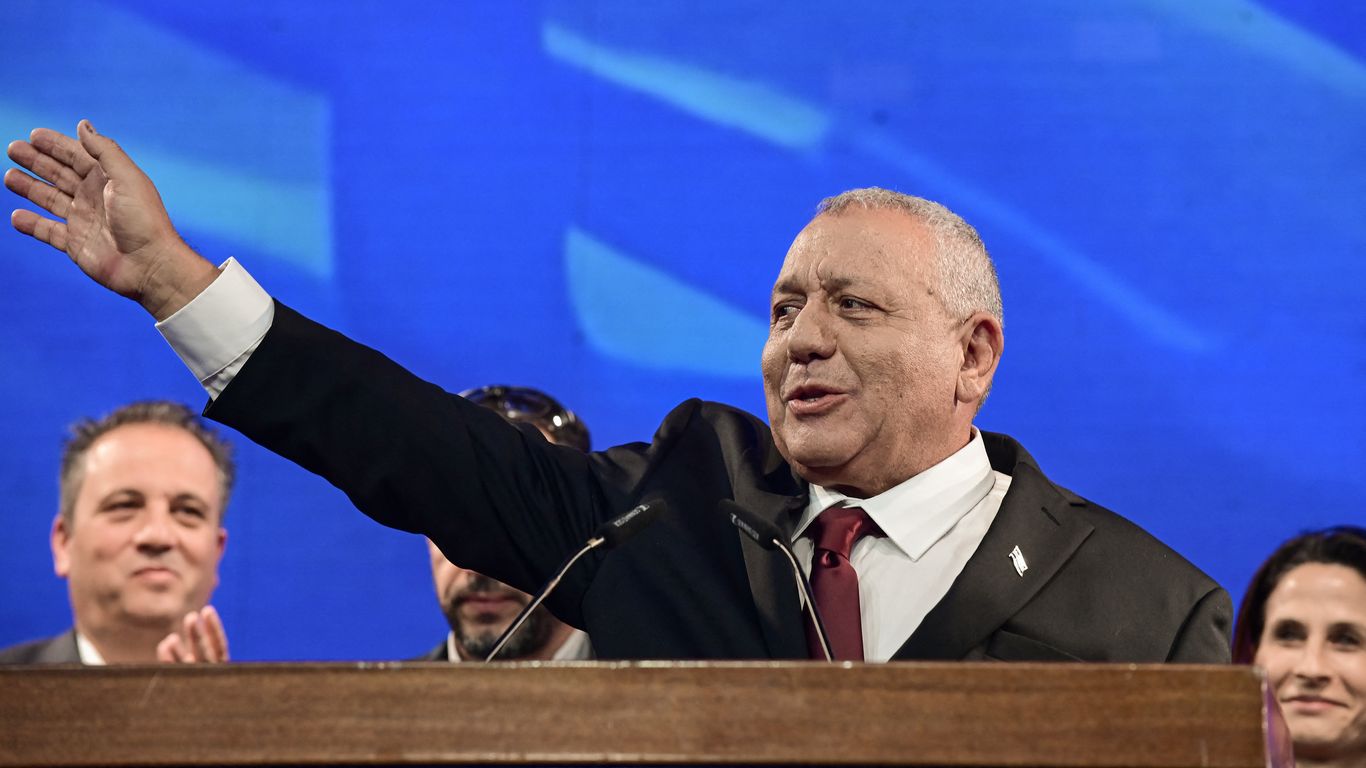
TEL AVIV, Israel — Prime Minister Benjamin Netanyahu's far-right coalition is running nearly even with Gadi Eisenkot's opposition bloc in Tuesday's historic election — but both are short of a 61-seat majority, according to Israeli exit polls. Why it matters: Political stalemate is the most likely outcome of the election, with Netanyahu weakened but neither side having a clear path to forming a coalition government. Arab parties are poised to win 18 to 19 seats in what would be an unprecedented electoral achievement. While theoretically Eisenkot's bloc could try to swear in a minority government supported by the two Arab parties, that scenario looks unlikely. The numbers: Eisenkot's bloc emerged with a small lead in early exit polls, but Netanyahu's coalition closed the gap as the night wore on. The exit polls show Netanyahu's bloc with 51-52 seats and Eisenkot's bloc with 49-51 seats. Netanyahu's Likud party is projected to win 27 seats versus 21 seats for Eisenkot's Yashar party. State of play: A close outcome could leave the country in a state of limbo, with Netanyahu likely staying on as a caretaker prime minister at the helm of the executive branch and the opposition led by Eisenkot controlling the Knesset. That scenario could last until new elections are held as early as April. The two sides could try to break the deadlock by forming a unity government between Netanyahu and Eisenkot. But such a scenario is also improbable considering that none of the opposition parties will agree to sit in a Netanyahu-led government. What they're saying: Eisenkot claimed victory in a speech after midnight Israeli time. He said if Netanyahu was a "decent leader," he would exit the political stage after the public voted for change. During the speech, Eisenkot alluded to the possibility that the prime minister would launch military action before a new government is seated. "Netanyahu: don't dare use Israel's security for your political needs," Eisenkot said. He emphasized that the
TEL AVIV, Israel — Gadi Eisenkot is as low-key as Benjamin Netanyahu is bombastic. He's a political novice up against the longest-serving, most politically savvy prime minister in Israel's history. And yet, on the eve of Tuesday's elections , Eisenkot poses the most serious threat to Netanyahu's hold on power in years. Why it matters: A victory by the Yashar party leader would upend Israeli politics and could reset the country's strained relationships abroad. The intrigue: The contrast between the two top contenders could hardly be sharper. Their roots: Eisenkot, the son of Moroccan Jewish immigrants, grew up in Eilat, Israel's southernmost city. If he wins, Eisenkot will be the first prime minister of Moroccan descent in Israel's history. Their military backgrounds: Netanyahu served in the Israel Defense Forces' elite special forces unit "Sayeret Matkal" and later went into business and politics. Eisenkot joined the IDF Golani infantry brigade and rose through its ranks as a combat commander until becoming IDF chief of staff. He arrived at his rally on Sunday to the tune of the Golani brigade song from 1974. Their ties to America: Netanyahu is better versed in American politics — and more articulate in English — than many American politicians. Eisenkot is not an "American" politician at all, let alone a professional one. He speaks English with a heavy Israeli accent and doesn't deliver catchy soundbites. He does not enjoy being on TV. At his final campaign rally Sunday before about 1,000 supporters, Eisenkot was visibly uncomfortable being in the spotlight, even when the crowd cheered him on. Their trustworthiness: Netanyahu's credibility with the Israeli public has been battered by his long-running corruption trial, his political tactics, his refusal to take responsibility for the failures that led to October 7 and accusations of duplicity in his handling of the Iran war. Eisenkot is seen as a straight shooter, even among many of his opponents. Zoom in: The failur