
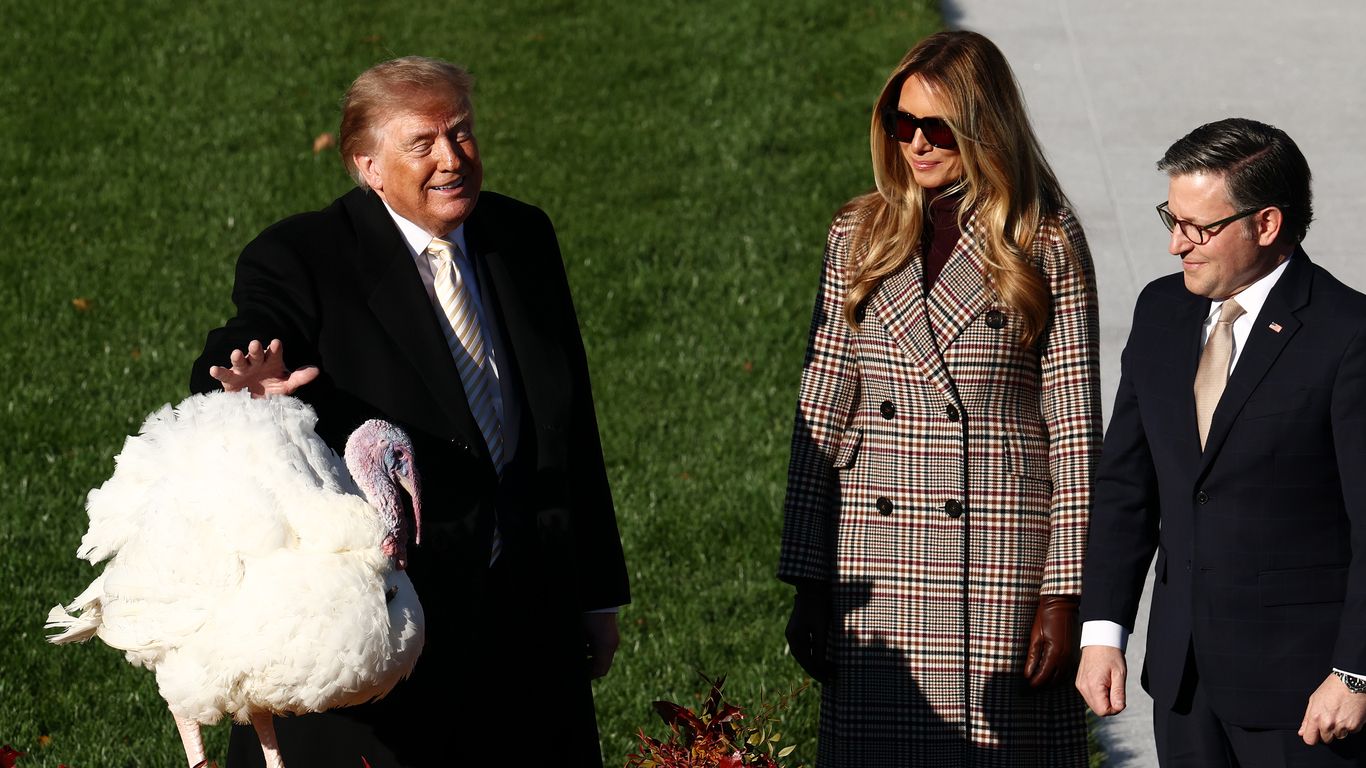
President Trump honored a time-worn Washington tradition Tuesday: pardoning poultry — after using the pulpit to praise his White House ballroom and deliver a rally-reminiscent speech. The big picture: Freedom and Feathers, this year's honored birds, continue a bizarre American tradition officially dating back to 1989 — but building on far older presidential lore. Driving the news: "Unfortunately, for 200 years, the White House lacked appropriate accommodations to host such distinguished guests," Trump said at the event, held on the White House's South Lawn. He continued, "I'm pleased to announce that next year we'll be able to have a special location right over there in that rather small ballroom being built." Trump's hotly contested project will be a 90,000-square-foot addition, far larger than the main White House. "I've heard better," he said about the birds' names, though they still earned presidential pardons. Both birds will dodge the oven and retire at Texas A&M University. State of play: The collective 82 pounds of white-feathered flamboyance traveled from West Virginia's Deans Gap Farm for the event. Pointing to his large 2024 election win in West Virginia, Trump said Tuesday, "I won it by a lot. I don't know what the hell happened with this last election. Somebody, please explain it to me." The pair are just four months old. Per a White House fact sheet , Freedom's favorite treat is Dr. Pepper. Feathers prefers to snack on Golden Delicious apples, which — like the turkeys — hail from West Virginia. Between the lines: Trump has never shied away from using the event to ruffle feathers. Last year, he jabbed at former President Biden and attacked Chicago leadership, derailing the focus on his feathered guests by calling Gov. JB Pritzker (D) a "fat slob." During his first term, he joked that the turkeys trotting before him had were slated to "appear in Adam Schiff's basement," a nod to the Democrat who led the 2019 impeachment inquiry into Trump. While Trump ha
Results for “presidential medal”

Possible presidential hopeful Ruben Gallego warns of a ‘bad lesson for corporate America’ while Ro Khanna says ‘rules should apply to everyone’ Congress to grill Huang over ties with China and Trump’s intervention Sign up for the Breaking News US email Hello and welcome to the US politics live blog. Nvidia’s decision to reinstate Jensen Huang as CEO sends a message “that the national security of this country is not as important as your relationship with president Trump,” Democratic senator Ruben Gallego said. US smbassador to Israel Mike Huckabee has cast doubt on whether Washington would end its $3.8bn in annual military aid to Israel by the end of this year, as promised by Trump on the day of this month’s midterm elections. In his surprise announcement as voters headed to the polls on 3 November, Trump said he had made a deal with prime minister Benjamin Netanyahu several months earlier to stop providing Israel with around $4bn in annual US funding. Speaking at the US Department of Justice, Trump railed against the commutations of death row inmates’ sentences by California’s governor, Gavin Newsom. Newsom responded by criticizing Trump for “selling” pardons and for demanding the execution of five wrongfully convicted young New Yorkers of color in 1989. Jimmy Gomez will resign from Congress after a House ethics report released on Monday found “substantial evidence” that the California Democrat had “engaged in sexual misconduct”, including by “making unwelcome sexual advances and sexual contact toward a House staffer”. The 19-page report from the House ethics committee found that Gomez “made unwanted sexual advances” toward a House staffer on two occasions, “including an incident in which he made sexual contact with her and another in which he was ‘forceful’ with her in his congressional office”. Continue reading...

We naturally assume people in business and power are slightly full of it, spinning us wildly to exaggerate their achievements or capabilities. In the case of AI and its ability to do irreparable damage to society, it's time for all of us — the media, the White House and Congress — to believe them: They've truly built something we don't understand and soon, if not already, can't fully control. Why it matters: This is no longer a future problem. It's a today problem, if not a crisis. You see this with near-daily glitches at airports or banks. You see this in our reporting about two dozen researchers inside these companies claiming their AI is too powerful and uncontrollable to release. And you see this in AI execs' own on-the-record warnings that we're at or near the point of the technology surpassing comprehension or control. Just believe them. If we wait for a cyberattack on the U.S. electricity grid or some bad actor to release a pathogen at an elementary school, it's too late. We'll panic and make rushed, emotional decisions and bad policies. It's not too late to prevent this, while still getting the upside benefits of AI. In our conversations with hundreds of people involved in building and regulating AI, there's shockingly wide agreement about the dangers ahead — and ways to protect against the worst outcomes. There's just no mechanism or urgency to bring the right mix of people together to do this. The steps seem clear: Make this a society-wide, urgent call to action. This should be an all-hands-on-deck moment, the only topic Congress prioritizes short-term. Yes, it probably requires presidential leadership, and Trump is reluctant to slow things down. But his top cyber officials privately agree with us: This demands fast, smart, bipartisan action with heavy private sector involvement. Let 'er rip no longer feels like a plausible plan. Focus on safety and cyber first. Most leading AI companies would gladly slow down a bit, prioritize verifiable safety standards,

A euphoric Wall Street erupted Monday as President Trump personally secured Jensen Huang's return to Nvidia, trading on the end of a scandal that — in reality — has only just begun. Why it matters: By assuring Nvidia's board that Huang poses no national security risk, Trump has staked the credibility of the U.S. government on a CEO who lied about his relationship with a suspected Chinese spy. It's among the most extraordinary presidential interventions in corporate history — a de facto bailout of the AI industry that will be scrutinized, in excruciating detail, by a hawkish and hostile Congress. Zoom in: Six days after Nvidia's chairman publicly ruled out Huang's return, the board unanimously reinstated him after a secretive White House operation that blindsided even the company's top executives. Trump joined Sunday's board meeting by phone, with one source telling Axios that the president pushed harder for Huang's reinstatement than Huang himself. Nvidia acknowledged relying on assurances from "senior levels" of the U.S. government, even as its own investigation into the suspected Chinese espionage operation remained unfinished. The market reaction was staggering: Nasdaq 100 futures surged to their 7% overnight trading limit, following a brutal week that had raised fears of a broader collapse in AI stocks. Nvidia shares rocketed nearly 31%, adding hundreds of billions to the company's market value and helping Wall Street recover more than half of last week's losses. Trump took a victory lap in an hour-long, freewheeling CNBC interview , declaring Huang "exonerated" and claiming the board ultimately "decided to do what we wanted them to do." Screenshot via Truth Social Between the lines: In orchestrating Huang's comeback, Trump drew on instincts that have defined own tumultuous political career — starting with his conviction that presidential power has "no limits." Never surrender: Trump, the master of the political comeback, appears to see a fellow survivor in Huan

Mississippi is facing two fights over its election rules after Democrat Scott Colom 's historic Senate victory: one over voters marked inactive and another over deadlines for receiving mail-in ballots . Why it matters: The disputes could affect how easily eligible voters cast ballots and which mail ballots count when Mississippi elects a new governor and other statewide leaders next year. Driving the news: The Mississippi Legislative Black Caucus demanded an investigation Thursday into whether the state's use of credit-reporting data to verify voters' addresses led election officials to incorrectly mark voters as inactive. Lawmakers want to examine the credit-reporting data contracts, instructions sent to county officials and how many eligible voters were incorrectly marked inactive. In one case, a Hinds County voter learned she'd been marked inactive when she arrived at her usual polling place, according to Angela Grayson, director of civic engagement and voting rights at the Mississippi Black Women's Roundtable. Her vote ultimately counted, Grayson said. The caucus acknowledged it doesn't know how many voters were flagged in error. Advocacy groups are seeking records to find out. What they're saying: "Nothing has changed fundamentally here in Mississippi," Marvin King, an associate professor of political science and African American studies at the University of Mississippi, tells Axios. "The laws are still the laws. The governor is still the governor. The state legislature is still overwhelmingly Republican," he said. "It's also plainly obvious that the playbook of reducing turnout, culling the active voter rolls, that's not going to stop." By the numbers: More than 230,000 voters were listed as inactive before the 2026 midterms, up from roughly 171,000 in 2024, according to the Associated Press . Mississippi recorded 21,484 affidavit ballots, the state's version of provisional ballots, this year. That's nearly identical to the 21,321 cast in 2024's presidential e
Maryland Gov. Wes Moore criticized President Trump's involvement in Nvidia's decision to reinstate CEO Jensen Huang , calling it "troubling and problematic" in an interview for "The Axios Show." Why it matters: Moore, chair of the National Governors Association and often seen as a 2028 presidential contender, is one of the most outspoken state leaders pushing for stronger federal oversight of AI companies — but not like this. Driving the news: Trump told CNBC Monday that he spoke directly to Nvidia's board about Huang's return. Trump had previously pushed for former Apple CEO Tim Cook to become Nvidia's leader, but changed tune over the last few days to favor Huang. What they're saying: "The president is not a board member of Nvidia. So, why he is involved in board dealings, I have no idea. ... It seems like it's rules for me, but not for thee," Moore told Axios' Mike Allen in an interview just minutes after the news broke. "You have the wealthy and the powerful and the well-connected that are now making decisions to reinstate, where, frankly, if that was any of us, we would be held to a different type of standard." Zoom in: Moore said the "market is being inflated essentially by seven companies," including Nvidia. Huang's return — which led to a stock surge — "highlights how problematic this entire thing is," Moore said. "We are talking about not just millionaires, but billionaires, who are sitting in a quiet room by themselves, making this decision because they know this company is that important." Subscribe to "The Axios Show" on YouTube to watch the full interview with Moore when it's available.

Democratic National Committee chair Ken Martin is moving to restrict candidates' ties to super PACs and dark-money groups in the party's 2028 presidential primary, a shift that could shake up the race for the White House. Why it matters: Most likely Democratic candidates for president were expected to rely on super PACs to boost their messaging — and go after other contenders. The DNC's new rules could complicate their plans and set up a clash between the party chair and soon-to-launch campaigns. Martin's plan will be a real-time test of whether party-driven campaign finance restrictions can function in a presidential primary that will follow a midterm election driven by billions in spending by PACs and dark-money groups. Zoom in: Under the rules that the DNC is announcing Monday, Democratic presidential candidates must disavow any super PACs or dark-money groups that either back them or attack their opponents in ads. If presidential hopefuls don't follow the guidelines, the DNC warns, they won't be allowed on the stage at primary debates. A DNC official said the change is backed by progressives such as Sens. Bernie Sanders (I-Vt.) and Elizabeth Warren (D-Mass.), as well as more moderate Democrats such as Rep. Jason Crow (D-Colo.) and former DNC chair Jaime Harrison. For years, the party's left wing has pushed for party primaries to ban super PACs and dark-money organizations, a term for 501(c)(4) groups that aren't required to disclose their donors. Yes, but: It's not clear whether the DNC's shift will be substantive — or merely symbolic. Super PACs, which can raise unlimited amounts of money, already are barred by law from directly coordinating with candidates. Even so, such groups often work alongside candidates while remaining technically separate. The DNC rules stipulate that candidates must sign a pledge to disavow such funders. Super PACs could, however, continue to spend on behalf of candidates that distance themselves from them. In practice, though, Democra
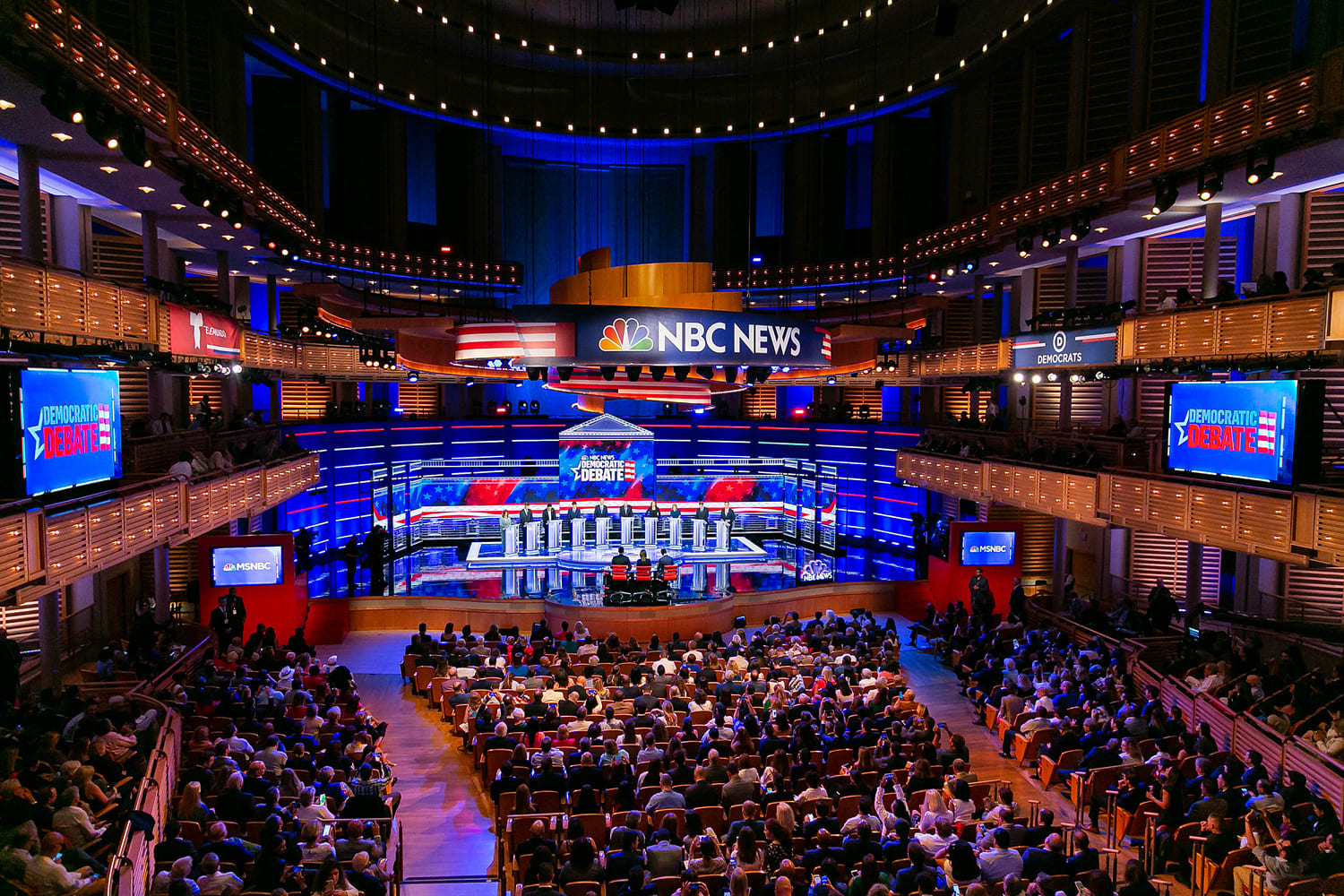
The Democratic National Committee will hold 12 debates next year and in 2028 for candidates seeking the party’s presidential nomination, the party announced, as it sets rules of the road for what’s expected to be a crowded campaign for the White House.
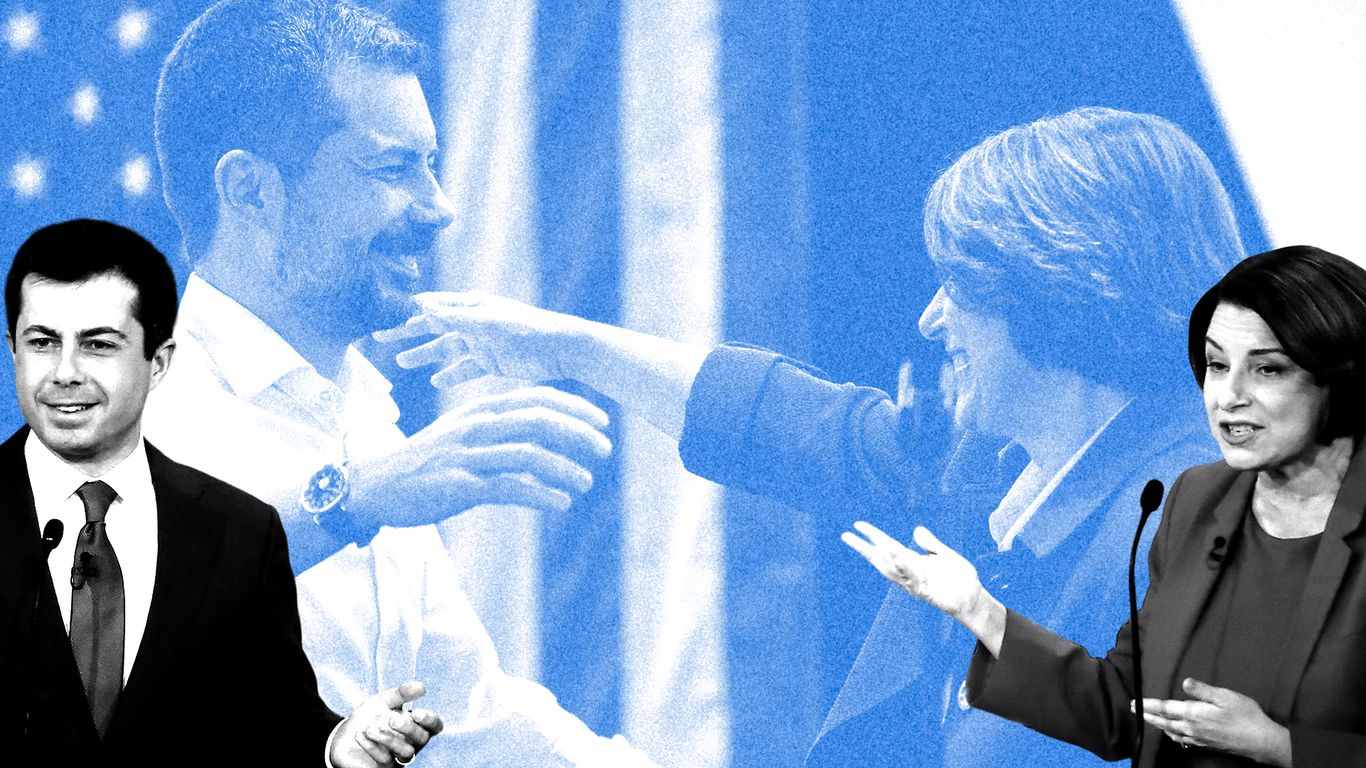
To the surprise of many Democrats and even some of their former aides, Pete Buttigieg and Amy Klobuchar now consider themselves friends after their bitter clashes during their campaigns for president in 2020. Their journey from snarky tension to "real respect and friendship," as Klobuchar describes it, is a story of how two ambitious Democrats came to appreciate each other once the heat of a presidential primary had subsided. Why it matters: It's also a reflection of how Buttigieg — who's weighing another run for president — has become a well-regarded Democratic stalwart after many in the party viewed him as a presumptuous lightweight when he ran six years ago as a little-known 37-year-old former mayor of South Bend, Ind. "I'm sincerely grateful for Amy's friendship," Buttigieg, who was President Biden's transportation secretary, told Axios. "My appreciation has continually grown for her substantive leadership and sense of humor alike." "I know there are people that run against each other for president and literally hate each other," Klobuchar, who's in her fourth term in the Senate but will leave in January to become Minnesota's governor, told Axios. "That was far from the case for us." Flashback: A casual observer might see that as a bit of revisionist history. The Buttigieg-Klobuchar spats during the 2020 Democratic primary were some of the most vicious of that campaign. Aides from both sides can still quote the barbs, word for word. "I wish everyone was as perfect as you, Pete," Klobuchar sniped at one debate in Las Vegas before saying "You've memorized a bunch of talking points and a bunch of things." She added after the debate that Buttigieg was "haughty" and that "given the guy [Trump] we have in the White House, maybe you need someone who's a little more humble." Buttigieg repeatedly mocked Klobuchar for not remembering the name of the president of Mexico in an interview. He said Klobuchar was "not able to speak to literally the first thing about the politic

Florida Gov. Ron DeSantis is quietly working on a book, two sources tell Axios — a project likely to fuel speculation about his making another run for the White House. Why it matters: DeSantis hasn't publicly acknowledged the book project or disclosed what it will be about. But writing a book is often the first step toward a presidential campaign, and it could give the term-limited governor a platform to lay out his vision for the Republican Party's future. DeSantis' state was a rare bright spot for Republicans in this month's midterms, as Democrats made historic gains across the nation. Driving the news: Word of DeSantis' book comes as he's become increasingly outspoken on a range of policy issues, particularly the economic and social impact of artificial intelligence — potentially offering clues about what the book might address. DeSantis has become a vocal critic of the potential dangers of AI, warning that it could eliminate jobs, threaten children's safety and privacy, and drive up electricity bills as data centers expand. DeSantis has pushed for an "AI Bill of Rights" and signed state legislation aimed at preventing tech companies from passing the costs of data centers on to residential consumers. His stance has put him at odds with the Trump administration's efforts to limit states' ability to regulate AI. DeSantis has emphasized affordability, immigration and education — issues likely to remain central to national politics long after he leaves office. Zoom out: DeSantis has made other moves that could keep him in the national spotlight after he leaves office in January. NBC News recently reported that DeSantis is preparing to launch a conservative think tank, which could enable him to retain a political and donor infrastructure. After the midterms, DeSantis embarked on a flurry of media appearances that resembled a victory tour, highlighting how Florida Republicans had largely escaped the Democratic wave. Yes, but: Some DeSantis allies are highly skeptical t
Democrats who might be thinking of launching a presidential run in 2028 are starting to make moves. One such contender is Pete Buttigieg, the former transportation secretary under Joe Biden. Is he the candidate who can unite the broad church in his party? There’s also talk that a vote to elect the new Senate leader could be moved up, helping Chuck Schumer retain power, after Chris Van Hollen challenged him for the position. Jonathan Freedland speaks to Marianna Sotomayor of Puck News about the Democrats looking to shore up power on Capitol Hill and potentially head for the White House Continue reading...

Republican voters in four early 2028 primary states have favorable views of Israel by wide margins and have negative opinions of three leading right-wing critics of the Jewish state, according to a new poll by a national GOP consulting firm. Why it matters: The poll challenges the notion that Republican opinion toward Israel is fracturing significantly, and points to a potential disconnect between GOP voters' attitudes and the sentiments of those who often draw the most attention online. The survey, conducted by OnMessage Inc . for the Combat Antisemitism Movement 's political arm, essentially provides a roadmap for pro-Israel Republicans' messaging ahead of the 2028 presidential campaign. It seeks to cast the right's leading critics of Israel — Tucker Carlson, Candace Owens and Nick Fuentes — as liabilities in the GOP primary. Zoom in: After the midterms, Vice President Vance called on the U.S. and the GOP to "change our relationship to Israel," elevating the nations' longtime partnership as a 2028 campaign issue at a time when Vance is eyeing a presidential bid. Israel is supported by 68% of Republican voters in Iowa, New Hampshire, Nevada and South Carolina, according to the survey, a result similar to findings by Gallup and Pew . 17% disfavored Israel. 78% said the GOP's "relationship with Israel" makes them more likely to vote Republican. Large majorities also agreed with pro-Israel messages. In contrast , 53% of those surveyed said they disapprove of Carlson, and 30% approve. But among voters under 45 years old, Carlson's approval/disproval ratings were tied at 46%. 49% of the Republicans surveyed disapproved of Owens, while 23% approved. Fuentes, the least-known of the three media figures, was viewed unfavorably by 25% and favored by 13%. Among self-described MAGA Republicans, 22% approved and 23% disapproved of him, however. "The fringe messengers are underwater," says a slide deck for the poll, which was conducted ahead of the Combat Antisemitism Movement's

Now the vice-president’s luck is turning, he seems reluctant to commit himself to the next presidential race – and I, for one, hate to see it How do you think history will remember JD Vance? As the first vice-president to spark a vigorous debate about their eyeliner routine ? As one of the last public figures to see Pope Francis alive ? As the only politician in US history to have been the subject of a rumour about sexual relations with a couch (even though it was unfounded)? I have no idea. But it seems increasingly unlikely he will be remembered as the 48th president of the US. After Maga’s midterm thrashing, Vance’s political future doesn’t look as bright as it used to. So much so that there has been a flurry of recent headlines debating whether or not Vance, once considered Donald Trump’s heir apparent, may slink away from a presidential run altogether. Continue reading...

Democrats marching into a debate over expanding Medicare are about to confront difficult questions about how far to go — including for seniors who are already in the program. Why it matters: Holes in traditional Medicare leave seniors exposed to out-of-pocket costs and affordability struggles, but making the program's benefits more generous may be prohibitively expensive. The big picture: Democrats scored overwhelming gains in the midterms after making health care affordability a major priority for the next Congress. Though the election results reinvigorated progressives' push for Medicare for All, there are also less sweeping options for what expanded coverage should look like. How far to go — and what to call the plan — will become critical heading into the 2028 presidential cycle and likely determine whether Democrats can attract any Republican support. Driving the news: Lowering the Medicare eligibility age is emerging as an early front-runner for what Democrats may try to pass and defy President Trump to veto. Sen. Bernie Sanders (I-Vt.) called on Democrats to lower the eligibility age to 55 soon after the election, framing it as an "immediate first step" toward his long-sought goal of Medicare for All. Sanders also wants to add vision, dental and hearing benefits and strengthen children's coverage. House Democratic Leader Hakeem Jeffries of New York on Friday threw his support behind that kind of package, as well as strengthening children's coverage, Stat reported . And groups of Democrats in both chambers have recently introduced legislation lowering the Medicare eligibility age to 50. What they're saying: " Medicare for All is unlikely to be enacted in the near future, but the political push for it could prompt a debate about the services Medicare itself does not cover and the high costs current Medicare beneficiaries can incur," KFF executive vice president Larry Levitt wrote last month in JAMA Forum . State of play: Some Democrats are looking at other chan

USA beat Canada 6-2 to claim 12th world title Knight and Pannek score twice each in victory United States 6-2 Canada – live reaction The United States beat Canada 6-2 on Monday to win the women’s ice hockey world championship in Herning, Denmark, becoming the first US team to capture Olympic and world titles in the same calendar year. Hilary Knight and Kelly Pannek scored twice each as the Americans claimed their 12th world championship, adding to the Olympic gold medal they won in Milan in February. Lacey Eden also scored for the US, while Sarah Fillier had both goals for Canada, who were seeking their 14th world title. Continue reading...
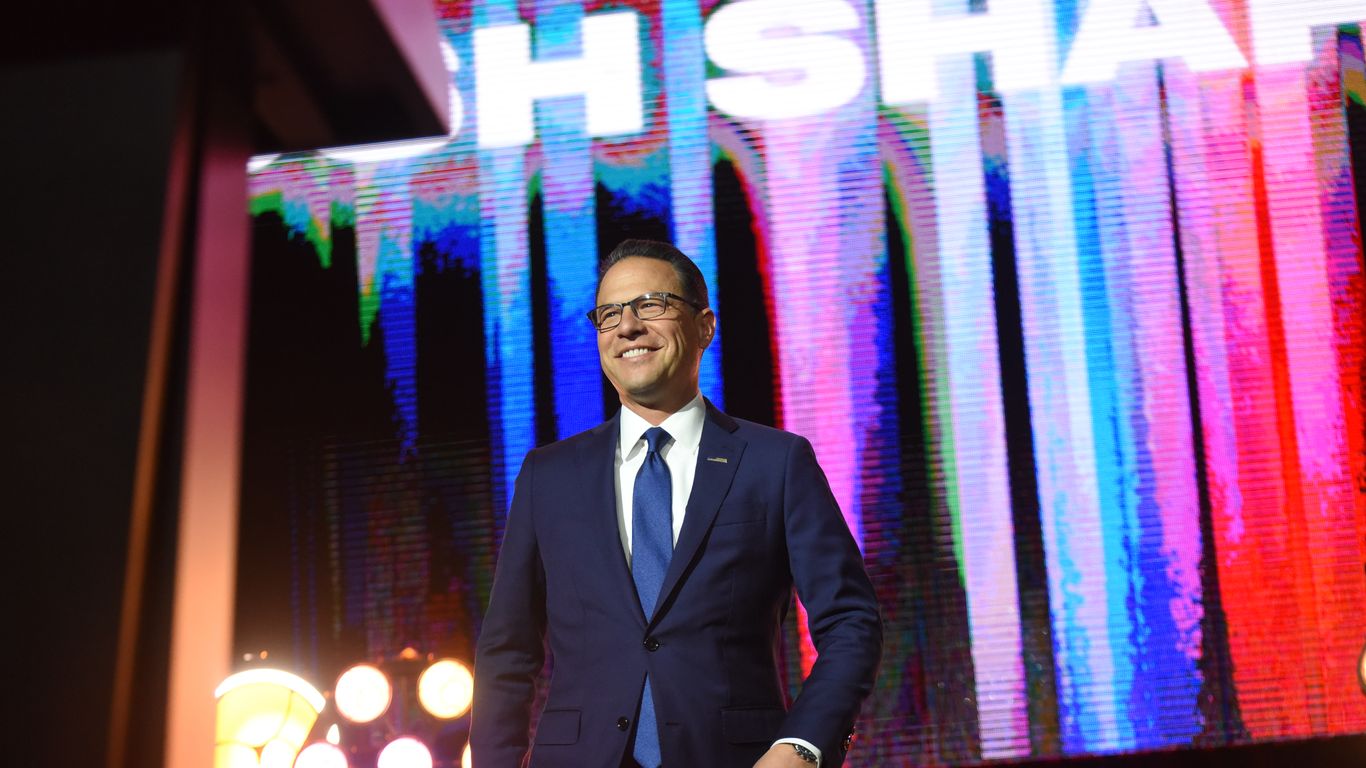
DENVER — Thousands of Democrats gathered here this weekend for a giddy postelection summit, reveling in their party's historic midterm victories and touting the center-left strategy they say powered them. But some progressives saw the event as a lavish, out-of-touch affair bankrolled by billionaires — exactly what Democrats just campaigned against. "I'm all for celebration, but perhaps a fancy retreat does not exactly meet the tenor of the moment," said Josh Orton, president of the liberal group Demand Justice and a veteran of Bernie Sanders' 2020 campaign. Why it matters: The competing views of What's Next, the buzzy confab held by the influential centrist organization Majority Democrats, offer an early glimpse of the ideological battles over health care, money in politics and other issues that will define the party's 2028 presidential primary. Zoom in: Democrats in the Mile High City were practically vibrating with happiness, still not quite able to believe they'd won back both chambers of Congress and flipped deep-red states such as Mississippi and South Carolina. "The vibes are excellent," Delaware Rep. Sarah McBride, a member of the Majority Democrats, said in an interview. "The last high-water mark, we were all in our houses on Zooms," she added, referring to the 2020 presidential election. "This is the first time there's been an undeniable capacity to celebrate widespread wins in the last decade." Free drinks flowed. Political operatives sported bomber jackets embroidered with the phrase "Majority Democrats." Speakers were immortalized in rock concert–style posters on the walls. For a brief moment in Denver's Mission Ballroom, the often-in-disarray Democratic Party looked united. Several presidential hopefuls downplayed the party's divides in speeches. Pennsylvania Gov. Josh Shapiro said onstage that ordinary people don't give "a damn" about "where we fall on some imaginary political spectrum." Michigan Sen. Elissa Slotkin quipped in her address that elected

Vice President Vance won't make a final decision on whether to run for president in 2028 until after the new year — and may wait until late spring to announce his intentions publicly, two sources with knowledge of his plans tell Axios. Why it matters: Vance remains the early favorite to succeed President Trump as the GOP's presidential nominee, but the party's midterm losses have complicated his political future and could reshape the 2028 field. People familiar with Vance's thinking say he's genuinely undecided about running, and that his decision-making timeline was in place before the midterms. Advisers caution that the timing could change, however. Vance is still discussing a potential bid with his family, including his wife, Usha, following the birth of their fourth child, the sources said. The big picture: Vance allies say the midterm losses haven't changed his standing as the early 2028 GOP front-runner, citing his donor network, political infrastructure and name recognition. Vance co-founded the secretive Rockbridge Network , which could anchor his presidential fundraising operation. The group met in Houston after the midterms. As Republican National Committee finance chair, Vance has cultivated relationships with major contributors. He also has ties to technology donors Peter Thiel, David Sacks and Elon Musk — the world's richest person and the GOP's biggest financier. Vance campaigned nationwide for the midterms, building relationships with GOP activists and officials who could prove valuable in 2028. Behind the scenes: Vance's closest political advisers believe he should run in 2028 and that he's likely to do so, according to a person close to the vice president. But the GOP's midterm losses have given Republicans who want to move on from the Trump administration an opening to argue for a different direction in 2028. Vance likely will have to answer for the Trump administration's record in 2028, potentially complicating his presidential ambitions. Vance pr

Renewed commitments to electrification and climate science are vital outcomes from the latest round of UN talks The Cop31 climate talks have acquired something their delegates scarcely expected: a little political breathing space. The comeback by Luiz Inácio Lula da Silva in the second round of Brazil’s presidential race was important for many reasons. Victory for his opponent, Flávio Bolsonaro, would have marked a dangerous retreat from democracy. But Mr Bolsonaro’s commitment to environmental deregulation would also have spelled disaster for the Amazon, making Lula’s re-election a big win for the climate. Similarly, success by Democrats in the US midterms means that Donald Trump’s destructive grip has been loosened. If they win back the White House in 2028, the US should rejoin the UN process in time for Cop34. While the diplomatic picture is less bleak than it might have been, the threat level remains high and rising. António Guterres used his last Cop as UN secretary general to issue a pithy warning that “ it’s make or bake time ”. With the latest analysis pointing to heating of 2.7C by the end of the century – far beyond the 1.5C target in the Paris agreement – governments face another crunch moment: by pivoting away from fossil fuels, they can still avert the most dangerous impacts. Yet the UK’s Andy Burnham was the only G7 leader to make the trip to Turkey; the French and German leaders chose to attend an EU summit in Dublin instead. Continue reading...

At party’s ‘What’s Next’ conference, consensus is they need to act quickly, but over affordability or accountability is the question What’s next for Democrats? It’s the question thousands of Democrats, including lawmakers, strategists, pollsters, creators, organizers, staffers and 2028 presidential hopefuls are trying to answer at a three-day gathering in Denver, after a sweeping victory in the 2026 midterm elections. Continue reading...

After Tuesday’s election, ‘everyone must have a Wednesday agenda’, experts say – and movements must keep putting pressure on Democrats to get their demands met The bright blue map that emerged on election night in the US was unthinkable two years ago. When Donald Trump won the 2024 presidential election, many Democratic voters curled up in bed and doomscrolled, fatigued and fearful about the direction of the country. Any desire to fight back was dampened by the enormity of the loss. But the mood gradually shifted over the following two years, culminating in a generational shift on election day: Democrats flipped five governors’ seats and took control of the House and Senate by wide margins. Voters were angry about the rising cost of living, the war in Iran, masked immigration agents in their neighborhoods and datacenters rising in their backyards. Continue reading...

The midterm election results were a stinging setback for the movement, setting off a scramble among activists to regroup ahead of the 2028 presidential contest.
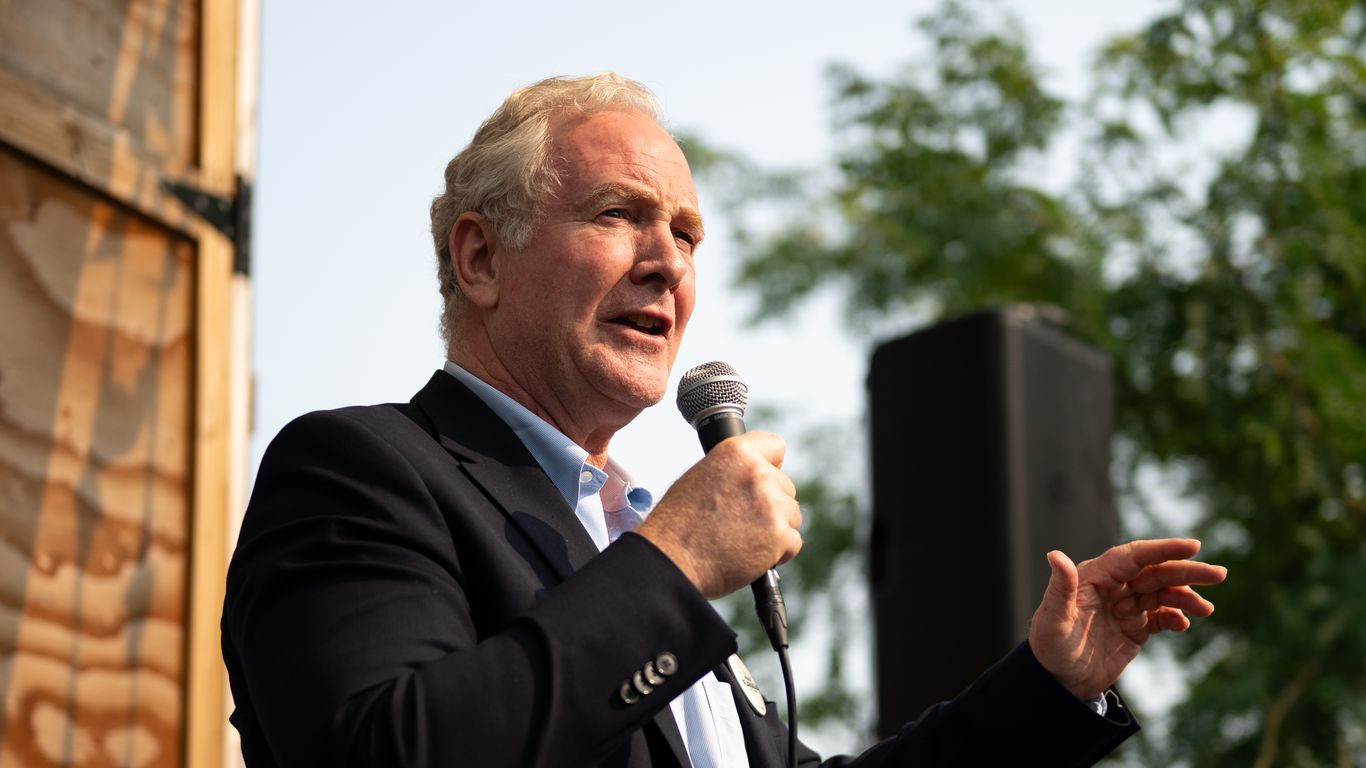
Sen. Chris Van Hollen announced Thursday that he'll challenge Chuck Schumer for majority leader. Why it matters: Van Hollen's bid gives grassroots activists nearly three weeks to pressure Senate Democrats before they cast secret ballots in the Dec. 1 leadership election. The attempt to oust Schumer (D-N.Y.) underscores that deep divisions are plaguing the Democratic Party despite their overwhelming midterm success . Van Hollen (D-Md.) has served in the Senate since 2017 and has been in Congress since 2003. Schumer has been the Senate Democratic leader since 2017 and has served in the Senate since 1999. Driving the news: "In this election, the American people called for change," Van Hollen said in a statement on Thursday. "They called for a change from Donald Trump's disastrous policies – but even bigger than that, a change from the status quo that isn't working for working people." "It's now on us to meet this moment, and to do that we need new leadership. This is not about any one person – it's about answering the call of the American people. That is why I'm running for Senate Majority Leader." Zoom in: Opposition to Schumer has been building: "[T]he time is now for change," Sen. Bernie Sanders (I-Vt.) said Tuesday. He appeared with Sen. Elissa Slotkin (D-Mich.), who demanded a plan for change from her party leadership. Progressives have accused Schumer of not fighting hard enough against President Trump and the MAGA agenda. Sen.-elect Abdul El-Sayed (D-Mich.) is a vocal backer of Van Hollen for majority leader. Van Hollen, who is also considering a 2028 presidential run, said he's been listening to calls for him to challenge Schumer and considering his options.

State Senator Cindy Holscher won the race. Though Kansas is reliably Republican in presidential elections, its voters often break for Democrats in midterms.
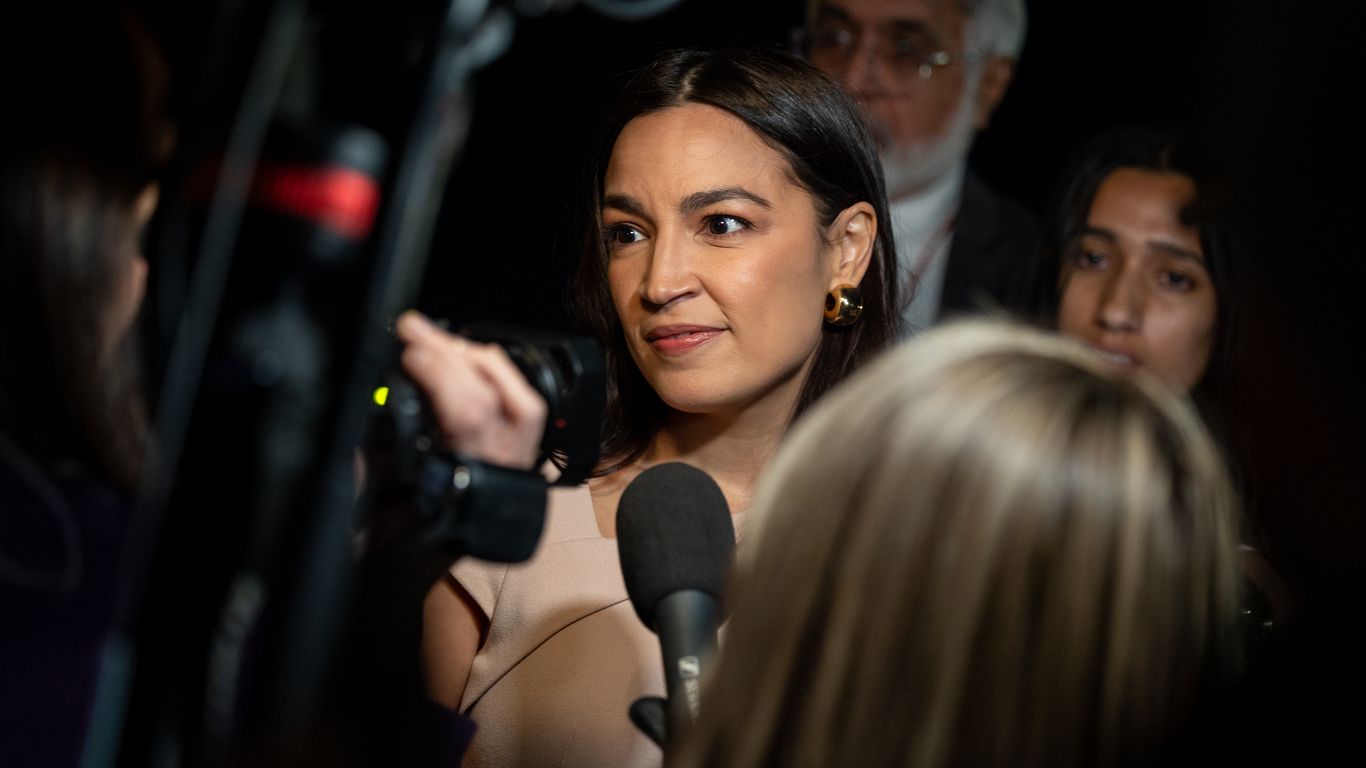
New York Rep. Alexandria Ocasio-Cortez is shaking up her team for the second time in the past few months as she prepares to make the biggest decision of her political life. Why it matters: The overhaul comes as the democratic socialist leader is debating whether to run for president in 2028 — or Senate Minority Leader Chuck Schumer's seat, which is up the same year. Zoom in: Ocasio-Cortez has parted ways with her longtime digital fundraising firm, Middle Seat, according to three people familiar with the decision. At the same time, sources said, she's brought on Aisle 518 Strategies — the company led by Democratic strategist Tim Tagaris, who oversaw Bernie Sanders' record-breaking online fundraising strategy in his two presidential campaigns. Middle Seat has been key to Ocasio-Cortez's operation. Over the past two years, she has paid the firm more than $6 million — about a quarter of her operation's disbursements during that period. AOC is close with Sanders, and if she decides to run for president, progressives say, she would be able to quickly staff up with his former advisers. But Ocasio-Cortez's latest move doesn't necessarily signal that she's leaning toward a presidential run or a Senate bid. Tagaris' firm has helped power the small-dollar fundraising operation for California Gov. Gavin Newsom, who's widely expected to run for the White House. It also has worked with other Democrats who are potential contenders for president — Arizona Sen. Mark Kelly, Georgia Sen. Jon Ossoff and former Vice President Kamala Harris, according to the company's website . Middle Seat, the firm AOC is leaving, has Sanders roots as well: It was founded by alumni of the Vermont senator's 2016 campaign. Flashback: Ocasio-Cortez's reorganizing follows several changes she made to her staff this year, as Axios previously reported . They included parting ways with her longtime campaign manager and creative director, as well as bringing aboard a few former aides. The Washington Sun reported
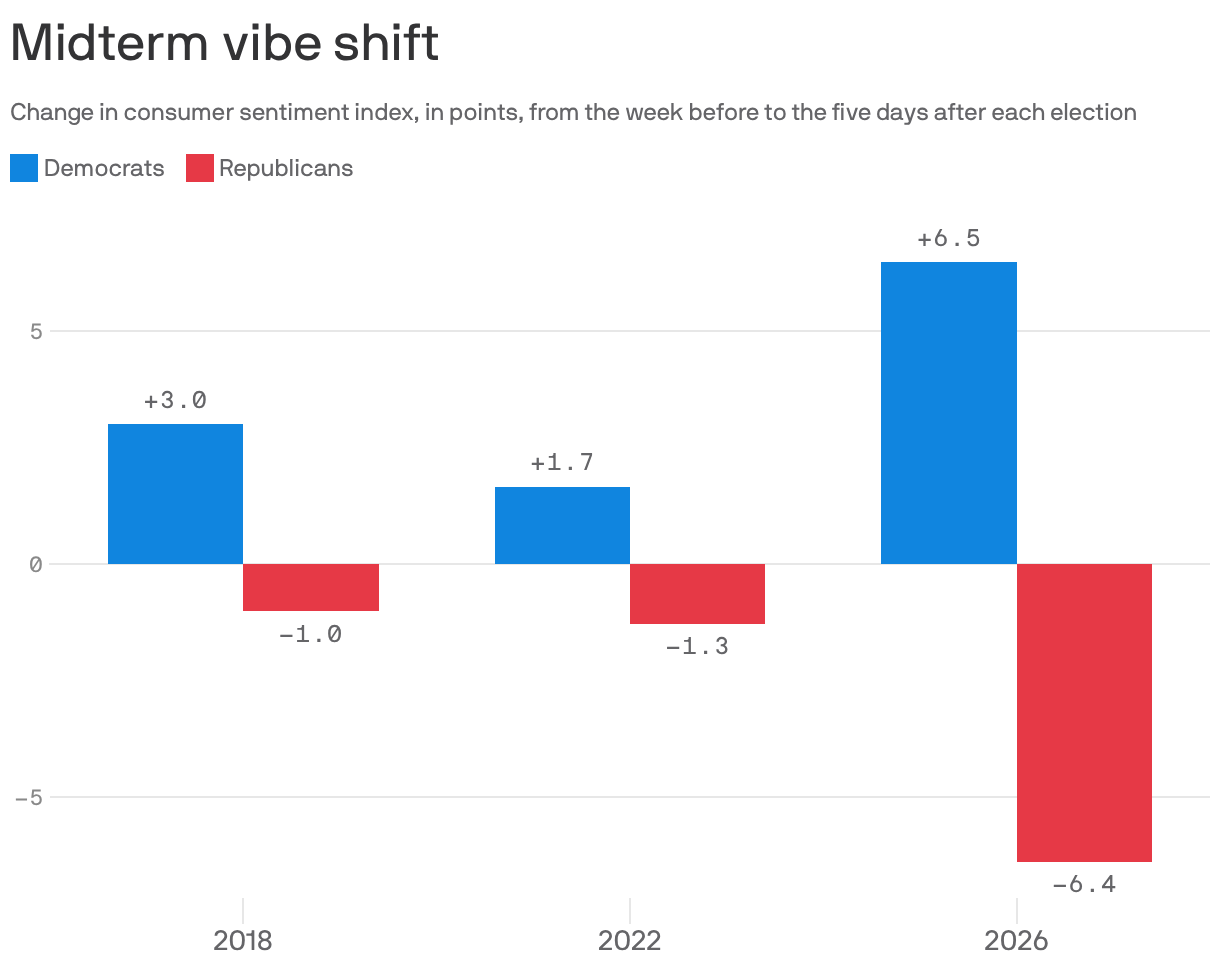
Note: Figures compare average daily sentiment readings over the seven days before each election with the five days after. Election Day is excluded; Data: Morning Consult; Chart: Emily Peck/Axios There was an unusually sharp partisan mood shift in the wake of the midterms, according to sentiment data from Morning Consult that was shared exclusively with Axios. Why it matters: While big partisan swings in consumer sentiment are typical after a presidential election, they have been much smaller in midterm races. The latest numbers show just how tightly Americans' views on the economy are now intertwined with politics. By the numbers: Democratic consumer sentiment rose 6.5 points in the five days after the election compared with the week before, while Republicans' mood fell 6.4 points. How it works: Morning Consult's index considers survey responses from approximately 5,000 U.S. adults. They're asked five questions, including on people's personal finances and financial outlook, as well as their views on overall business conditions. Zoom in: The biggest shifts in sentiment were in respondents' feelings about the future. Republicans' outlook across all five metrics fell after the election. Their confidence in business conditions over the next five years plummeted 12 percentage points. Democrats, meanwhile, had a jump of 9 percentage points in confidence about business conditions (although they remain negative about it) and an even bigger increase — 12 percentage points — in optimism that their own finances would improve over the next year. Of note: Both sides were more negative about their own finances compared with a year ago. Zoom out: Overall sentiment, which includes Independents, barely moved — ticking up less than one point, per Morning Consult. The opposing partisan shifts appear to have canceled each other out. Reality check: It's early days, and sentiment could shift quickly. Between the lines: Consumer sentiment was once a telling measure of how people would ac

The Republican leadership fights are over. For Democrats, the pain has only just begun. Why it matters: All the talk about changing party leadership is empty if no one steps up to run. Senate Republicans demanded more time and deeper conversations about their leadership, but no one stepped forward to challenge John Thune, who won by acclamation. Democrats are demanding their own conversations about the party's future and the leadership of Chuck Schumer and Hakeem Jeffries. Neither has a challenger. ‼️ The intrigue: Where there was a contested leadership fight, the challenger won. Rep. Jim Jordan, the Freedom Caucus founding member who spent years tormenting Republican leaders, will now lead the battered House GOP after defeating 12-year leadership veteran Rep. Steve Scalise by 33 votes. Jordan is the kind of fighter House Republicans want to take on Democrats as they enter the minority, lawmakers told Axios. "We're gearing up for war. And you're talking to a guy who's known as a hammer. You know we need someone who can punch hard, and I think that he'll do that," Rep. Randy Fine (R-Fla.) told Axios. 🤺 Zoom in: No such fighter has emerged to challenge Democratic leaders from within their ranks, and Schumer said he is "confident I will be elected majority leader." The closest thing to a challenge is Sen. Chris Van Hollen (D-Md.), who's listening to calls to run for Democratic leader while also considering a presidential campaign. It's hard to do both. Meanwhile, opposition to Schumer is building: " [T]he time is now for change," Sen. Bernie Sanders (I-Vt.) said Tuesday. He appeared with Sen. Elissa Slotkin (D-Mich.), who said she's not "actively seeking the job" but demanded a plan for change. 🏛️ Over in the House, Jeffries is dismissive of the idea that anyone would challenge him after the midterms gave him a massive majority. "You think I don't have the vote nailed down? I guess we'll find out next Wednesday," he told reporters on Monday. Some of his new members a

The potential presidential contender has misread the electorate – and that’s just the start of his problems The good news is that the dramatic results of last week’s midterm elections mean that Donald Trump and his administration will be much less able to immiserate and impoverish the American people for the next two years, that newly competitive states are likely to see an influx of investment from Democrats, and that states that were once under seemingly unbreakable regimes of Republican control now have Democratic state governments that will hopefully pursue more just, or at least less cruel, policy agendas. The bad news is that the 2028 presidential cycle has already begun. Continue reading...

President Trump, with the clock ticking and congressional investigators closing in, plans to govern even more imperially , hell-bent on stretching executive power, targeting those on his enemies list, pardoning allies, and daring the courts and Congress to slow him down. Why it matters: Trump and his allies are exploring executive action on new tariffs and immigration restrictions, and asserting greater control over spending. On X over the weekend, Trump discussed targeting and perhaps jailing Democrats who investigate administration officials. He claimed politically motivated harassment . Trump is retooling his White House by elevating the one official who's synonymous with his all-gas-no-brakes style: Stephen Miller, who took over for Susie Wiles as White House chief of staff on Monday. Watch Miller and Russ Vought , the White House budget director, to understand how this approach will unfold. Both are architects and advocates of vastly expanding presidential power, believing there are virtually no restraints on what Trump can do as president. The Swamp can expect tougher sledding: Miller, unlike most of his predecessors, is driven more by ideology than by meetings with lobbyists or industry groups. "Stephen gives zero f*cks what K Street thinks," a Trump confidant told us. Between the lines: Midterm losses pushed Presidents Clinton and Obama to the center. Trump's instincts are the opposite: Assert maximal power. The playbook: Restore MAGA. Two years ago, MAGA — mostly its network of podcasts , YouTubers and online activists — was a powerful, united force in media and politics. Today it's a hot, divided mess. Trump's attention to his base drifted. Now Vice President Vance and Miller desperately want to rebuild and rev up MAGA. That's why ending the Iran war , curtailing aid to Israel and pushing harder on RFK Jr.'s MAHA agenda are suddenly top-tier topics. Rule by pen. Miller, Vought and White House lawyers have been drafting executive actions to govern without C

Democrats will charge into January with a sweeping mandate — but as President Trump has repeatedly noted, his veto power can deliver a robust roadblock to his opponents' agenda. Why it matters: Democrats may be forced to compromise to get legislative priorities through. Trump will have to decide how frequently he'll use the power — and whether he'll strike down bills popular among Americans. State of play: Democrats have secured 54 seats in the upcoming Senate, per the AP's projections , and are leading in two tight races in Mississippi and Alaska that have yet to be called. In the House, they've won 254, per AP , with several race calls still to come. Neither majority will be large enough to cross the two-thirds threshold Democrats would need to override a presidential veto on their own. Friction point: Trump knows that — and has teased his plans to impede Democrats' progress by using the power liberally. On Tuesday night, as election results rolled in, Trump posted an image of a red MAGA-esque hat that read "VETO" in all caps. A similar hat was displayed on the Resolute Desk during a Thursday signing ceremony. Asked on Fox News how he'd work with a Democratic Congress, Trump pointed to the veto: "They're in control, but they're really not in control because they can send over, you know, 50 different great bills that they're all excited about and I send them back with a nice stamp, veto." White House spokeswoman Lauren Bis said in a statement provided to Axios that Trump is "willing to work with anyone to continue delivering victories for hardworking Americans." She added, "If Democrats choose to pursue radical left policies, they are choosing to work against the American people." Worth noting: Lawmakers secured enough support to override a Trump veto across party lines during his first term on the National Defense Authorization Act in 2021. Yes, but: While Trump could use veto threats to force lawmakers to negotiate or to halt legislation altogether, vetoing popul

A who's who of Democratic power players descends on Denver this week to plot the party's future, fresh off its sweeping midterm victories . Why it matters: The gathering gives Democrats' rising stars an early stage to test their 2028 message, and explore whether Colorado's red-to- deep-blue shift could offer a national playbook. Driving the news: The three-day " What's Next " conference, starting Thursday, features dozens of Democratic heavyweights and potential presidential contenders, including House Democratic Leader Hakeem Jeffries , Pennsylvania Gov. Josh Shapiro , Texas Sen.-elect James Talarico and former Transportation Secretary Pete Buttigieg . Colorado's own Gov.-elect Phil Weiser , U.S. Sen. Michael Bennet, U.S. Rep. Joe Neguse and Denver Mayor Mike Johnston round out the lineup. Majority Democrats, a group seeking to shape the party's direction, is organizing the event. The big picture: Colorado's two-decade transformation into a Democratic powerhouse made it a natural host, spokesperson Vidhya Jeyadev told Axios. Organizers want to dissect and pinpoint what worked — and what didn't — in the midterms, and how to turn wins into lasting power. The gathering comes as Democrats debate whether they should double down on progressive policies or tack toward the center heading into 2028. Behind the scenes: Johnston, a Majority Democrats member, told Axios in a phone interview he personally lobbied to bring the conference to Denver after organizers began scouting locations about a year ago. He'll give opening and closing remarks and expects private meetings with most of the national leaders attending. He plans to pitch Denver's approaches to homelessness , housing and public safety as national models. He'll also press for more federal money for affordable housing and his universal child care plan . Between the lines: Colorado Democrats have embraced gun safety , immigration and LGBTQ rights — positions some in the party worry could cost votes elsewhere. Johnston

Republicans are returning to work this week, facing the prospect of an especially lame lame-duck session after a bruising midterm election that set off a countdown clock on their control of Congress. Why it matters: Democrats have little incentive to help Republicans advance their agenda before January, while departing GOP lawmakers could complicate matters further by skipping votes or defying party leaders. As a result, most of the items on their to-do list could get kicked to the new Congress. That's aside from a few items House GOP leaders would rather avoid altogether: another Jeffrey Epstein bill and an impeachment vote . Lawmakers also have just over a month before another potential government funding lapse. Driving the news: Rep. Thomas Massie — who GOP voters kicked to the curb in favor of a more Trump-aligned Republican — is pushing another Epstein-related vote, an additional headache for the administration and GOP leaders. He also plans to try to force a vote this week on his impeachment resolution against Defense Secretary Pete Hegseth. Republicans lose their House and Senate majorities Jan. 3, ending their ability to set both chambers' legislative agendas. Reality check: Trump still wields the presidential veto power. Rodell Mollineau, a Democratic strategist and former communications director for the late Senate Majority Leader Harry Reid, said Democrats may postpone some legislative fights until January, when they'll have more negotiating leverage. "I think there's some things that Democrats would be happy to kick down the road," he said. Yes, but: Congress still faces major legislative hurdles. Lawmakers need to pass the annual National Defense Authorization Act, potentially setting up a fight over the Iran war as some Republicans grow more willing to criticize the conflict. A bipartisan permitting bill could overhaul how energy and infrastructure projects are approved. Senate Republicans are also racing to confirm more Trump administration officials

The US president sees Europeans as the mirror image of his ‘woke’ domestic foes. They should brace for further betrayal this winter Europeans have greeted the blue wave that crashed down on Donald Trump and his Republican party with jubilation and relief . Jubilation, because Trump’s second presidential administration has been the most destructive in the history of the transatlantic relationship. His disdain for Europe and his evident delight in attacking its governments – in particular that of Ukraine – have been hard to swallow. Relief, because the midterm election results confirm that Europeans are not unique in being appalled by Trump’s actions: a large majority of Americans are too. I was in Washington immediately after the vote, and the mood was one of excitement and a newfound confidence. And like many Americans, in these results Europeans see hope that US democracy can be saved, American foreign policy moderated and the transatlantic partnership revived. Nathalie Tocci is a professor of practice at the Johns Hopkins School of Advanced International Studies, Europe, and a senior fellow at Bocconi University’s Institute for European Policymaking Continue reading...
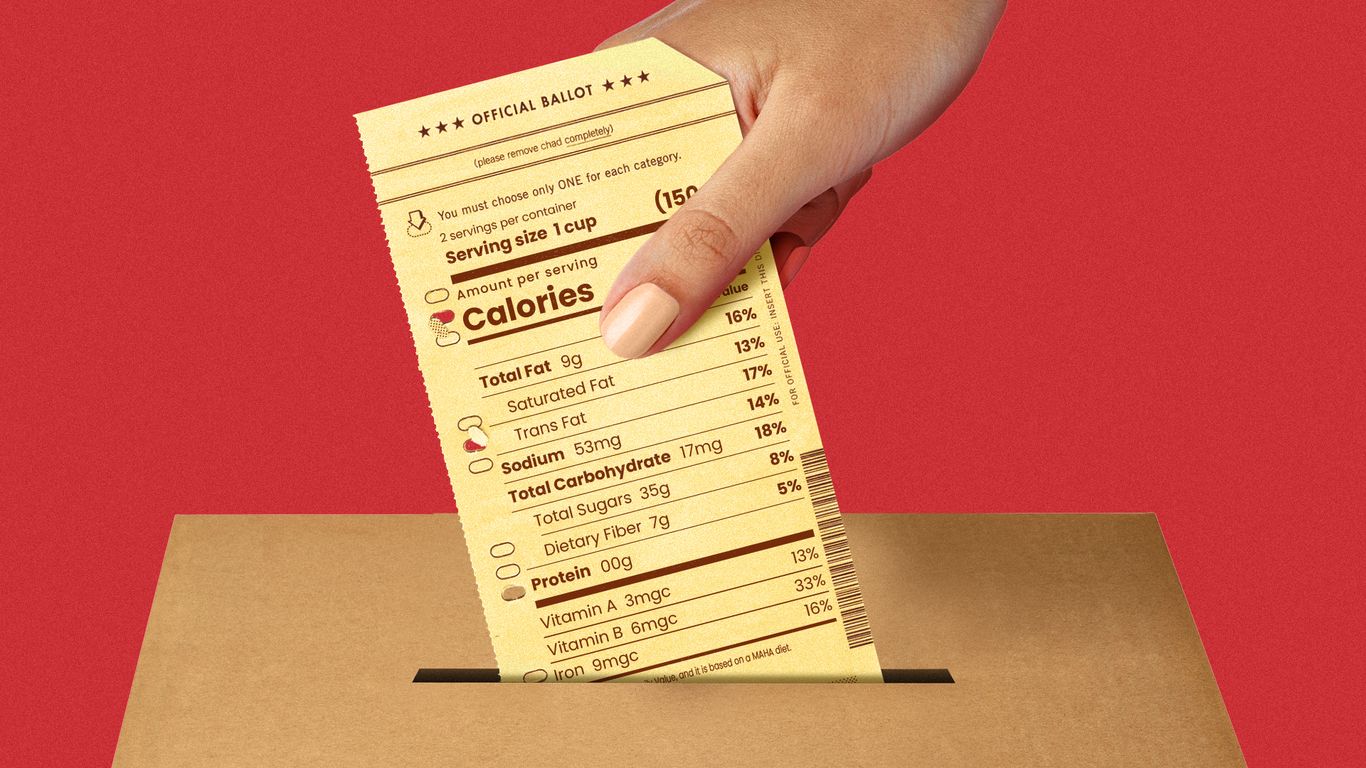
The potential for partnership between newly ascendant Democrats and the "Make America Healthy Again" movement is already threatened by their deep disagreements over Health Secretary Robert F. Kennedy Jr. Why it matters: Democrats want to convince health-conscious voters that they're the party that can deliver on food and pesticide use, but many view an alliance with Kennedy as a nonstarter. They're already threatening to investigate Kennedy, and they're clashing bitterly with him over vaccines and other issues — so any common ground with MAHA over nutrition and pesticides could take a back seat to those fights. State of play: Most MAHA-backed candidates lost at the polls last week. Some of the movement's leaders blame low turnout for the GOP's terrible election night, saying MAHA faithful stayed home because they were disappointed with the Trump administration and a lack of progress on food and environmental issues. Whatever they may think of the White House and federal health officials, the base remains intensely loyal to Kennedy, who created the movement during his 2024 presidential bid. "The voters sent a clear message to this administration and to all political parties, that we are not motivated to vote for people who have a lack of integrity. Promises were made, and promises were broken," said Zen Honeycutt, founder of Moms Across America. While she's open to working with Democrats going forward, "We want them to work with Kennedy, not against him," she added. "That's the red line for almost all of us. You cross that line and you go after Kennedy, you are never getting our vote," she said. "I'm not interested in working with people who are trying to get rid of our champion." The big picture: Some Democrats were making overtures to MAHA voters on key issues ahead of the midterms. Lawmakers like Sen. Cory Booker (D-N.J.) have already said they're willing to work with Kennedy on issues like cleaning up the food supply, school lunches and banning the use of certain

Trump’s most controversial aide begins his first day as White House chief of staff Stephen Miller, the influential architect of Donald Trump’s aggressive immigration crackdown , is due to start as White House chief of staff today. His promotion has horrified many, handing even more power to the president’s most controversial aide. The 41-year-old has been with Trump since the beginning of the US president’s political career – serving as a speechwriter during his 2016 presidential campaign – and has long been seen as a hardliner on the right, serving as the driving force behind first-term Trump policies such as family separation at the US-Mexico border and the travel ban on people from many Muslim-majority countries. Continue reading...
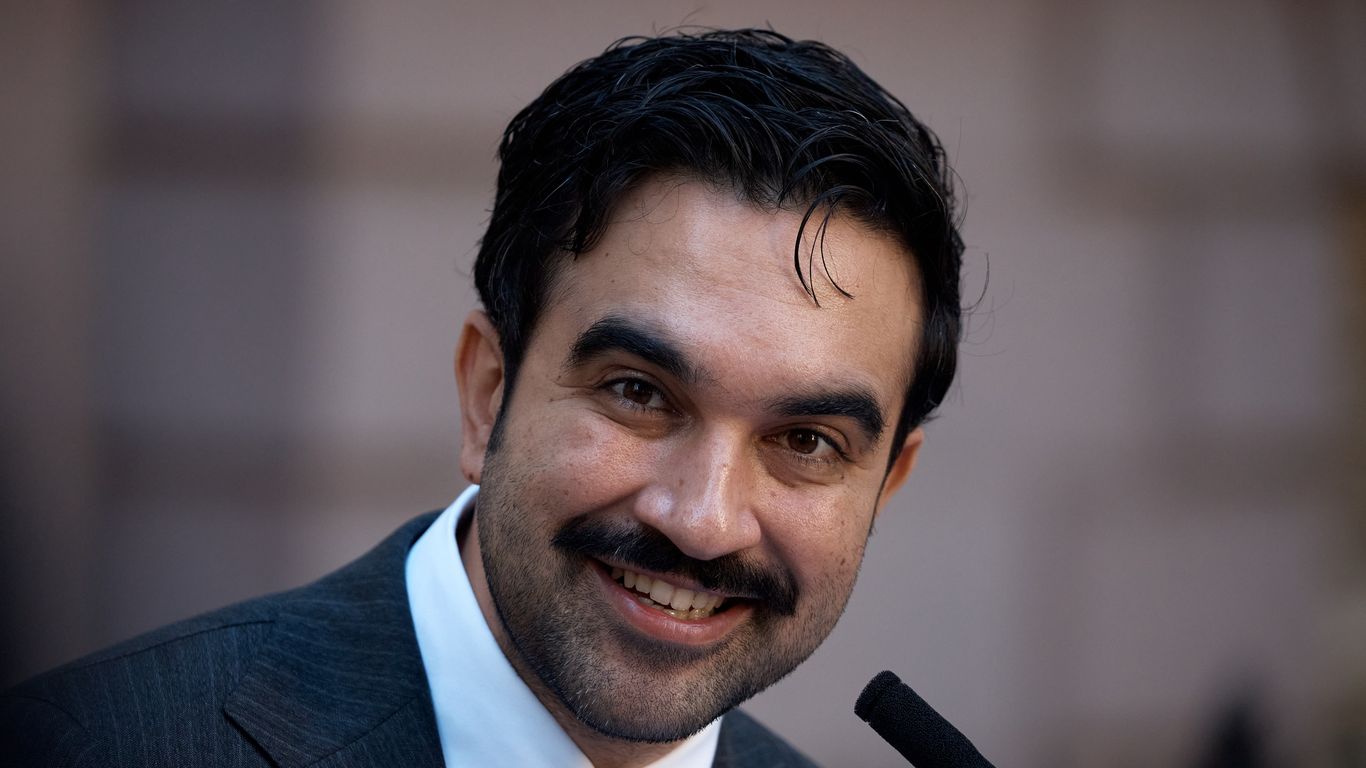
New York City Mayor Zohran Mamdani can't be president, so he's trying to be the next best thing: a progressive kingmaker for 2028. Mamdani has been meeting privately with union leaders, urgently talking up the need for a labor-aligned or leftist candidate to run for the White House, four people familiar with the talks told Axios. He's arguing that progressives can't afford to squander their midterm momentum. Why it matters: Behind closed doors, Mamdani has made a striking admission that helps explain why he's so eager to huddle with allies about 2028: He's uncertain whether New York Rep. Alexandria Ocasio-Cortez, his close political partner, will launch a White House run, the sources said. If Ocasio-Cortez stays out of the 2028 race, it would upend the Democratic primary — and potentially leave the party's insurgent left without a candidate. Zoom in: Mamdani — who's ineligible to be president because he was born in Uganda — wants to coordinate with progressive leaders partly to prepare to unite against any leading centrist presidential contender they aren't happy with, according to one of the sources who has spoken with the mayor. Mamdani "wants the progressive ecosystem to mobilize quickly, strategically and efficiently if a moderate candidate is clearly on the rise," the person said, pointing to how former President Barack Obama appeared to help Joe Biden consolidate support against Bernie Sanders in 2020. Last month, Mamdani summoned the president of the International Union of Painters and Allied Trades, Jimmy Williams Jr., to Gracie Mansion to talk about 2028. Mamdani asked Williams which potential presidential candidates he liked and how his union's endorsement process would unfold. He also asked Williams whether he'd ever considered running for office, the sources said. The source who has spoken with Mamdani noted that the mayor recruited — and helped elect — several left-wing congressional candidates in New York this year. Sara Nelson, president of the Associ

Florida Gov. Ron DeSantis is positioning himself for a presidential run. Secretary of State Marco Rubio is running away from the idea of his own campaign for the White House. Why it matters: The political posturing of the two Florida Republicans — or the efforts to draft either for 2028 — underscores the sudden volatility of the way-too-early GOP preprimary campaign to succeed President Trump . Before Tuesday's midterm Republican wipeout, the party's 2028 primary looked like a relatively easy coronation for Vice President Vance (if he runs, as expected). Now there's a nascent movement to kneecap Vance and promote other possible opponents. Zoom in: As Trump's home base, Florida was bound to take center stage in the conversation. But two things distinguish Florida from other states: DeSantis and Rubio have national profiles rooted in their own prior presidential campaigns, in 2024 and 20216, respectively. Florida was the lone red-wall state that the national blue wave couldn't top, which DeSantis has been happy to emphasize repeatedly since Tuesday. "The alligator people are stirring," said one national Republican consultant with extensive Florida experience, referring to the Sunshine State's official reptile. Zoom out: The differences between DeSantis and Rubio are vast when it comes to their political futures and styles. DeSantis is hungry. Rubio isn't. DeSantis terms-out of the governor's office in January and is looking for work. He hasn't made an official decision on whether to run for president — but he has stoked speculation with a media blitz that began with an Election Day appearance on Stephen A. Smith's podcast. Rubio repeatedly has said he plans to stay put in the Trump administration and serve out the rest of his term, until January 2029. He also said in May that he wouldn't run against Vance, and hasn't changed his position publicly. The intrigue: During the somber election watch party at the White House on Tuesday night, Rubio's phone "blew up" with sup
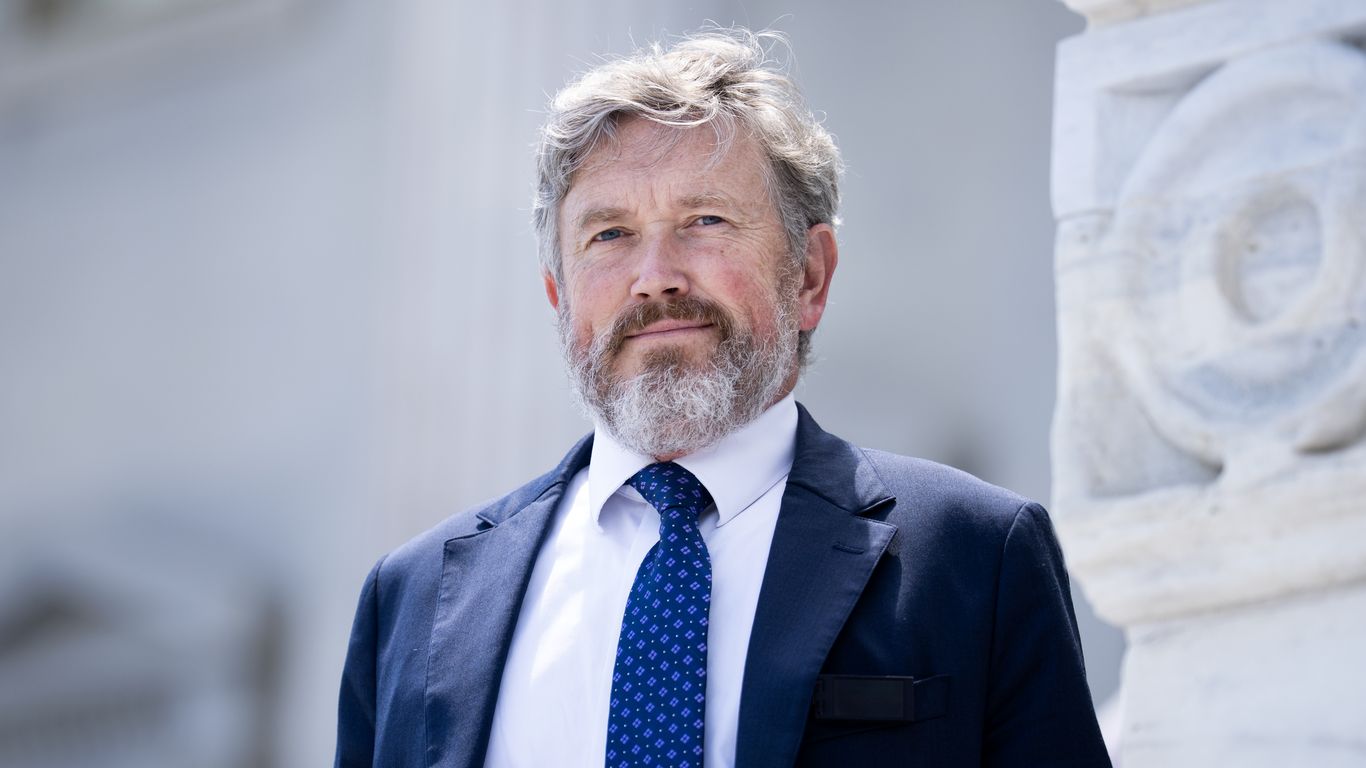
An unusual coalition wants to recruit outgoing Rep. Thomas Massie as the Libertarian Party's 2028 presidential nominee, betting that MAGA fractures can turn a third-party candidacy into a spoiler for the Republican nominee. Why it matters: Organizers see a fighter in Massie, a frequent critic of President Trump who pushed hard on releasing the Epstein files and lost a bitter primary rather than quietly walking away. Massie raised almost $10 million in the process and has a large online donor list and base. For his parting act in Congress, Massie is pushing an impeachment vote against Defense Secretary Pete Hegseth . Driving the news: For months, Libertarian Party operatives and MAGA defectors have been privately and publicly encouraging Massie to run under a rebranded party. "Libertarian Jesus is Ron Paul, and one of our saints is Thomas Massie," Larry Sharpe, a perennial Libertarian candidate and longtime third-party operative, told Axios. Sharpe has spoken with Massie several times about a potential presidential run. Aside from playing GOP spoiler, organizers believe the Libertarian Party's existing ballot access and infrastructure could help them win 5% of the national vote — which would qualify its next presidential nominee for federal funding. Massie didn't respond to several requests for comment. The big picture: The plan is for libertarians to claim dibs on the "America First" agenda, mainly focusing on anti-war sentiment. Organizers believe they can build consensus among supporters of the MAGA wing that's closer to Tucker Carlson, former Trump official Joe Kent and former Rep. Marjorie Taylor Greene (R-Ga.), as well as disillusioned "Make America Healthy Again" activists and populist-inclined voters on the right and left. "A party that would speak clearly about the disaster of the war in Iran, that would speak clearly about the mistake to continue to give military aid, taxpayer-funded military aid, to Israel — that would perk up a lot of ears among young peo

Stephen Miller is no Susie Wiles: He believes in almost limitless presidential power, considers the Democratic Party an extremist organization, and dreams of ruthless crackdowns on immigration and foreign adversaries. Why it matters: Miller, the new White House chief of staff, isn't just unlike anyone who's had the job under Trump — he's unlike any to occupy the powerful position in the modern era. He puts the hard in hard-liner and understands how to pull the levers of power to get his way and make the U.S. government a MAGA machine. Miller's appointment sets the stage for two years of partisan warfare with the new Democratic-led Congress, which is likely to launch investigations of Trump's administration, political committees and allies. "Stephen is Trump's wartime consigliere," Roger Stone, one of the president's oldest friends and advisers, told Axios. The big picture: Despite his post-midterm comments about finding ways to work with Democrats, Trump's choice of Miller signals that he's not looking for truces. He's prepping for war, and sees Miller as a brass-knuckle general and tactical expert impervious to criticism or traditional restraints. Trump's MAGA brain for a decade, the 41-year-old has detailed his Miller Doctrine in speeches, policies and press conferences: Presidential power is "very substantial and will not be questioned." Miller said those words about Trump's Muslim travel ban in 2017 on CBS's "Face the Nation," but to him they broadly apply to other areas of the executive's authority. Court authority is limited. In May 2025, when courts blocked aspects of Trump's deportation policies, Miller said the rulings were the work of "radical rogue judges" who were "at war" with the executive and legislative branches. The political opposition is a threat to America. "The Democrat Party is not a political party. It is a domestic extremist organization," Miller told Sean Hannity in August 2025. He also warned that if Democrats won Congress, "it's game over.
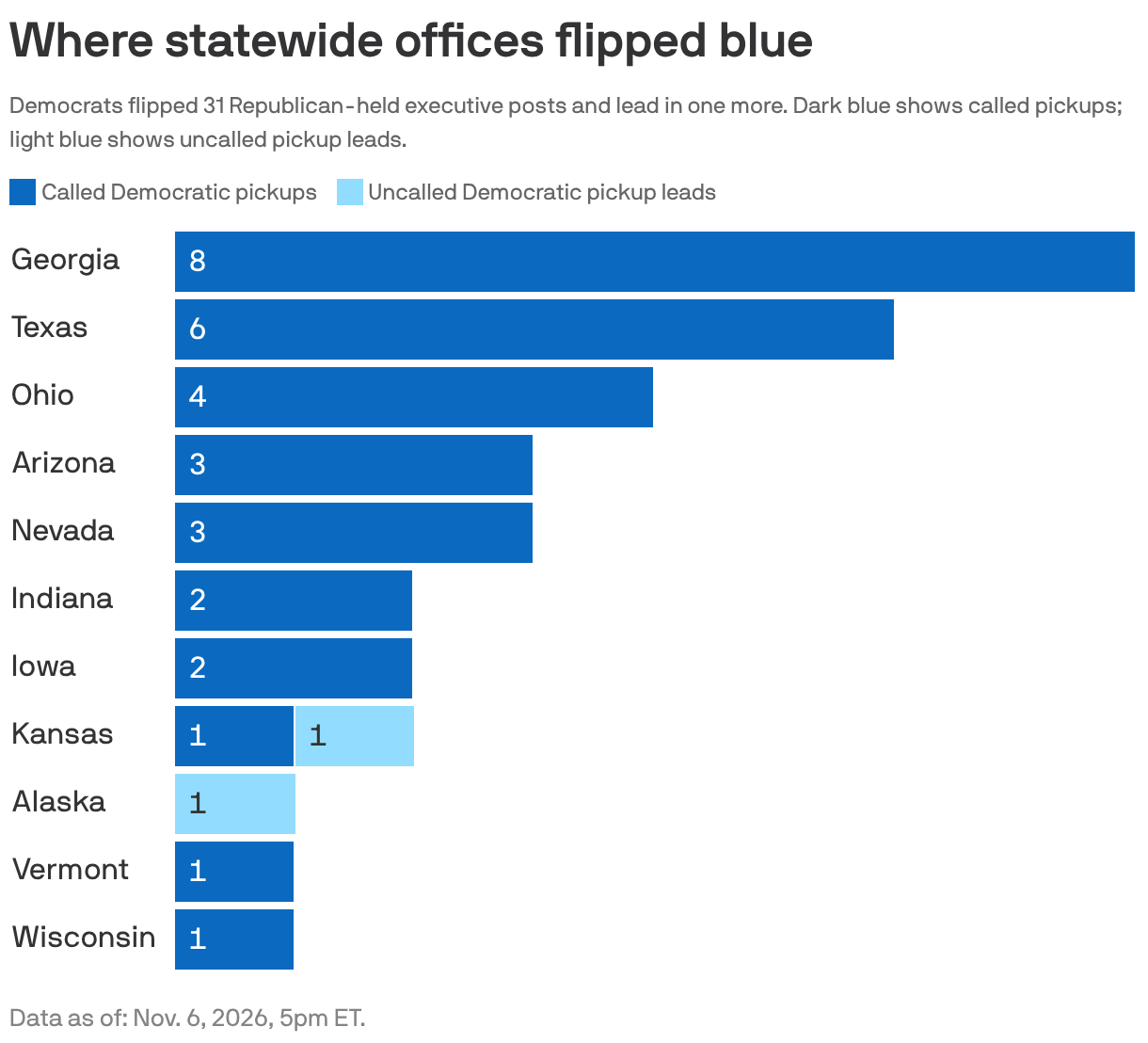
Single-holder executive offices only; excludes courts, commissions and federal offices. Data: Associated Press; Axios analysis; Chart: Andrew Pantazi/Axios Democrats' midterm gains extended deep into the machinery of state government: They swept every statewide executive office on the ballot in Texas, Georgia, Nevada, Wisconsin and Arizona. Why it matters: These low-profile victories will shape what millions of Americans pay for electricity, what their kids read in class and which party runs the 2028 presidential election in key states. The big picture: Democrats captured five Republican governorships, in Texas, Georgia, Ohio, Iowa and Nevada. But the scale of their gains becomes clearer farther down the ballot. Georgia: Democrats wrested all eight statewide executive offices on the ballot, including governor, attorney general, secretary of state and school superintendent. Texas: They flipped all six posts, defeating Gov. Greg Abbott and Lt. Gov. Dan Patrick in a state that hadn't elected a Democrat to statewide office in 32 years. Nevada: Democrats won all six executive offices, flipping governor, lieutenant governor and controller. Wisconsin: Democrats completed their Badger State domination, picking up the office of treasurer, the sole statewide office still held by a Republican. Arizona: Democrats held governor, attorney general and secretary of state. They lead in the three other executive races: treasurer, school superintendent and mine inspector. Data: Associated Press; Axios analysis Between the lines: The Democratic gains reach offices that decide which policies advance, which don't and which get challenged in court. Attorneys general: Nathan Johnson in Texas and Tanya Miller in Georgia will decide when their states sue the Trump administration and what corporations they investigate. Secretaries of state: Democrats flipped these offices in Georgia, Ohio and Indiana, putting new officials in charge of running the 2028 presidential election there. Texas' lieu

Navajo Nation voters made history this week by choosing their first woman president, handing Crystalyne Curley a groundbreaking victory — and a political fight before she even takes office. Why it matters: Curley's victory breaks a barrier in the Navajo Nation, where women hold deep cultural influence, but men have long dominated the presidency. Driving the news: Curley, 40, and running mate Chris Deschene defeated Justin Jones and Emily Ellison in the Nov. 3 election, according to unofficial Navajo Election Administration results . Curley won 50.88% to Jones' 49.12% — a margin of just 1,115 votes across the Nation's 110 chapters. She will succeed President Buu Nygren, whose turbulent bid for a second term ended with a third-place finish in July's primary. Her running mate, former Arizona legislator and energy attorney Chris Deschene, returns to tribal leadership politics 12 years after a Navajo-language qualification dispute derailed his presidential campaign. The Navajo Nation, the country's largest Native American reservation, spans more than 27,000 square miles across Arizona, New Mexico and Utah and has nearly 430,000 enrolled members , according to June 2026 tribal figures. Yes, but: Jones refuses to concede and has threatened a legal challenge, alleging irregularities in the vote count. The Navajo Times reported he initially offered no specific discrepancies. Tribal election law prevents certification until at least 10 days after the election, leaving time for challenges, according to the site . Zoom in: Curley now faces a tougher challenge: tackling poverty, delivering basic services and healing a government fractured by years of infighting. About 35.2% of residents of the Navajo Nation Reservation live below the poverty line, compared with 12.5% nationally, according to 2024 American Community Survey five-year estimates . Between 30% and 40% of Navajo families lack running water at home, according to an April 2026 statement from the outgoing administration.

Historians and political scientists say that framing the wins as ‘Ohio’s working class has come home’ is too simple At its peak, the Mahoning valley was once the beating heart of the US’s steel economy – a hardscrabble, heavily unionized Democratic bastion in north-eastern Ohio. But de-industrialization, sparked by the mass closure of steel mills in the late 1970s, transformed the region. Tens of thousands of manufacturing jobs disappeared. Populations declined. And support for Democrats slowly, but surely, faded. In 2020, Mahoning county voted for its first Republican presidential candidate – Donald Trump – in a generation. Continue reading...

President Trump has told advisers that he plans to keep raising money for his political operation — a move aimed at salvaging his clout after the GOP's midterm debacle. Why it matters: Maintaining a political organization — either his existing MAGA Inc. super PAC or one to be created — would give Trump a vehicle to try to influence elections in 2028 and beyond, including the next presidential contest. It also would give Trump a way to pressure GOP lawmakers who consider breaking with him as the unpopular president enters his lame-duck era and Democrats prepare congressional investigations into his administration. Trump's MAGA Inc. enforced party discipline during the 2026 primary campaigns when it helped defeat Kentucky Rep. Thomas Massie (R), an outspoken Trump critic. Zoom in: MAGA Inc. has been the centerpiece of Trump's political operation during his second term, raising nearly $450 million since the beginning of 2025. The group received massive checks from cryptocurrency and AI industry donors, along with Republican megadonors such as Elon Musk and Miriam Adelson. Trump has hosted high-dollar fundraising dinners at Mar-a-Lago and his golf club in Sterling, Va., drawing business leaders eager to curry favor with the president. Some donors subsequently benefited from administration decisions. The New York Times reported that a medical products company whose executives and affiliates gave $5 million to MAGA Inc. benefited from an administration decision to delay Medicare reimbursement restrictions, for example. By the numbers: MAGA Inc. spent more than $400 million on the midterms, making it one of the election's biggest spending forces, according to a source familiar with the totals. The massive investment failed to prevent Republicans from losing control of Congress amid voter anger over Trump's war on Iran, high prices and corruption concerns. As of Oct. 14, MAGA Inc. had more than $164 million in the bank, though it spent tens of millions more on TV and digita

Democrats have made climate change a centerpiece of their campaigns for years — but this year they barely mentioned it. Why it matters: The midterms showed just how far the topic has fallen down the political priority list, even within the party most committed to addressing it — and suggest affordability will shape how Democrats govern next year. Driving the news: Democrats up and down the ballot campaigned overwhelmingly on affordability, including fuel prices surging amid President Trump's Iran war and rising electricity bills, accentuated by the AI boom. The big picture: The relative absence of climate change is striking considering that Democrats of all political stripes won big. Zoom in: Even some of the party's most prominent climate advocates emphasized affordability over climate change — or reconsidered ambitious climate policies in response to rising costs. New York Gov. Kathy Hochul, who previously championed the state's ambitious climate agenda, pushed to weaken parts of its landmark climate law this year, citing affordability concerns. Sen. Ed Markey (D-Mass.), who co-authored the Green New Deal, played down the proposal during his reelection campaign, emphasizing affordability and other priorities instead. Texas Sen.-elect James Talarico, who has previously warned about fossil fuels' impact on the planet, campaigned on protecting oil and gas jobs alongside expanding renewable energy and lowering electricity bills. Flashback: The political shift has been underway since the 2024 presidential election, when even climate-focused groups began de-emphasizing climate change in their political advertising, a trend that persisted through the midterms. State of play: On a call with reporters the day after the election, leading environmental groups celebrated Democrats' victories as a rejection of Trump's energy policies, arguing that his attacks on clean energy contributed to higher electricity bills. "Trump's energy agenda was an economic disaster for families a

Power is draining away at home, but the US president will see a chance to make his mark through foreign policy Kim Darroch was Britain’s ambassador to the US between January 2016 and December 2019 Election nights are party time in Washington . The bars and restaurants fill up and the city rocks. For diplomats, it’s an opportunity – but it’s also a long night, as you trek across the party scene in search of insight and illumination. Invariably, it has its moments. I recall being at the Washington Post party on the night of the presidential election on 8 November 2016. Washington is an overwhelmingly Democrat city and the atmosphere was raucously optimistic, reflecting Hillary Clinton’s small but consistent lead in the polls. As the first results came in a shocked hush fell across the room. People gathered in small, murmuring groups. Within 30 minutes, half the guests had left. In contrast, I recall speaking to Nancy Pelosi, the queen of the Democrats, at a watch party on 6 November 2018, for the midterms during Trump’s first presidency. I asked her what I should put in my overnight report to London, given that most results wouldn’t be in. She said, with striking confidence, that I should predict that the Democrats would retake the House of Representatives. She was right: the Democrats flipped 41 Republican seats. It gave Pelosi a second term as speaker of the House and gave the world the enjoyable theatre of her sitting directly behind Trump at his State of the Union speeches, rolling her eyes at the bombast. Kim Darroch was British ambassador to the US from 2016 to 2019, and is author of Collateral Damage: Britain, America and Europe in the Age of Trump Do you have an opinion on the issues raised in this article? If you would like to submit a response of up to 300 words by email to be considered for publication in our letters section, please click here . Continue reading...
The Democrats have gained new powers to constrain Donald Trump. But the drubbing that Republicans received could yet prompt him to new excesses Donald Trump is a president without parallel, but history can still be instructive. Lame duck presidents often focus on foreign policy to escape domestic discontent and establish a legacy in an area where a hostile Congress offers less of an obstacle. Mr Trump, who was stunningly rebuffed by voters in Tuesday’s midterms , might seek satisfaction in construction projects, the 2028 presidential race and his family’s future. Or, amid the humiliation and with Republican critics growing louder, he could distract attention with fresh adventurism – perhaps escalating against Cuba – or more likely a vengeful new offensive against Iran. Mr Trump won’t put in the legwork or attention to detail demanded by, say, Bill Clinton’s push for lasting peace in the Middle East. But he loves the glitz of state visits, spectacular military action, hobnobbing with strongmen and (unearned) credit for dubious “peace deals”. With a potential three-way meeting with Vladimir Putin and Xi Jinping mooted for the Apec summit in China this month, Ukraine, Taiwan and others have reason to be nervous. Do you have an opinion on the issues raised in this article? If you would like to submit a response of up to 300 words by email to be considered for publication in our letters section, please click here . Continue reading...
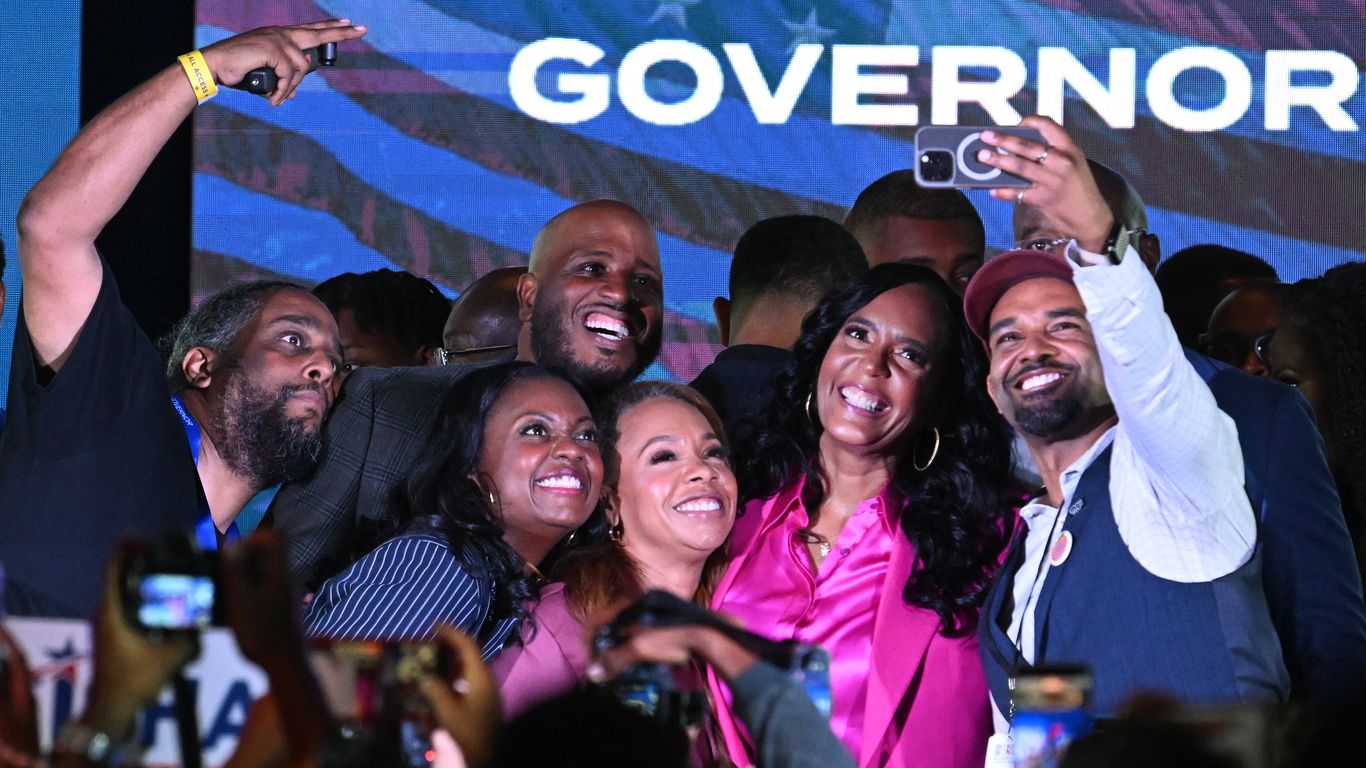
President Trump won historic levels of support from Black men in 2024. Two years later, those gains appeared to evaporate as Republicans suffered their worst midterm defeat in 50 years. Why it matters: Democrats feared the Supreme Court's decision weakening the Voting Rights Act would threaten their political future in the South. Instead, Black voters helped deliver historic Democratic victories in Texas and Georgia, with a potential upset brewing in Mississippi. By the numbers: Roughly nine in 10 Black voters backed Democratic House candidates Tuesday, according to the AP Voter Poll . Only about one in 10 Black men backed Republicans. Roughly one-quarter supported Trump in the 2024 presidential election, according to AP's analysis. For context, a separate 2024 national House exit poll found Black voters favored Democrats 84%–14%. Black men split 75%–24%, while Black women backed Democrats 90%–8%. State of play: Two Democrats who faced questions about their support among Black voters won crucial Senate races. Michigan: Progressive Democrat Abdul El-Sayed defeated Republican Mike Rogers , becoming the nation's first Muslim senator. A late-October poll showed El-Sayed drawing 87% support among likely Black voters. Texas: Democrat James Talarico defeated Republican Ken Paxton after courting Black voters who overwhelmingly backed Rep. Jasmine Crockett in the Democratic primary. An August Texas Southern University poll showed Talarico leading Paxton 79%–12% among likely Black voters. Zoom in: Talarico built commanding margins in Harris County, home to Houston, and Dallas County, both home to large Black electorates, according to AP county-level returns . Zoom out: Black voters helped elect former Atlanta Mayor Keisha Lance Bottoms as the first Black woman governor in U.S. history . About nine in 10 Black men voted for Bottoms, compared with roughly three-quarters who supported Kamala Harris in Georgia in 2024, according to the AP Voter Poll . Black women's support remain

President’s lawyers will try to persuade appeals court to toss criminal trial verdict over $130,000 sent to Stormy Daniels Donald Trump’s legal team on Thursday plan to continue efforts to get his 2024 conviction in the hush money election corruption case thrown out. Attorneys for the US president will try to persuade a New York appeals court to toss the criminal trial verdict from May 2024, when Trump was found guilty on all charges of falsifying business records in the hush-money corruption scheme to influence his eventual victory in the 2016 presidential election . Continue reading...

Vice President Vance stepped out of President Trump's shadow Wednesday, seizing on the GOP's midterm catastrophe to begin the explosive task of claiming MAGA as his own. "The reason we lost is the war," Vance wrote in an extraordinary 600-word postmortem on X , blaming Trump's Iran campaign for Republicans' historic collapse. Why it matters: Vance's presidential ambitions are entangled in the wreckage of a war he privately opposed but publicly defended. His path to 2028 demands a delicate political calculation. Vance must convince MAGA's disillusioned voters that he understands their sense of betrayal, even as he remains a central figure in the administration responsible for the Iran war. His maneuvering will take place under the gaze of a president who doesn't seem particularly eager to leave the stage — and who isn't shy about reining in those on his team who overstep. "Today, JD Vance became president — or acted like he wanted to become one," a source close to the administration told Axios. Zoom in: Vance argued that defections from Trump's 2024 coalition — not lack of turnout — drove the GOP's collapse in Tuesday's midterms. Citing polling of disaffected Trump voters, he identified four demands: "End the war." "Focus on cost of living/inflation." "Put America First." "Change our relationship to Israel." Those happen to be the four hottest topics among top MAGA podcasters and activists. So Vance is aligning with those leaders on topics where MAGA anger with Trump is raging. What they're saying: "If you'd like to argue [the war] was worth it, that losing the Senate for the next 6 years was worth it, then do so," Vance wrote. "Argue it was a worthwhile cost to pay. Agree or disagree, that's at least honest." Trump accepted that challenge Wednesday, acknowledging that the war had hurt Republicans but insisting it was worth the cost. "If I had to do it again, I'd have to do it again," he told reporters. "As far as that war is concerned, I would have done nothing diff

Americans made it very clear on Tuesday that health care is too expensive. The challenge for Democrats is to agree on the quickest way to deliver some relief. Why it matters: Voters can't wait until 2029 for life to get cheaper — but any short-term action to meaningfully lower health costs will require Democrats to make deals with President Trump. The big picture: There's already speculation about what a Democratic unity health care agenda would look like, and what progressives' midterms success means for Medicare for All. But that's largely geared toward the 2028 presidential race or a possible Democratic administration. The short-term reality is that any ambitious policies that significantly expand the government's role in health care are almost certain to collide with Trump's veto pen. Strategists say the Democrats' most realistic option is to find piecemeal affordability fixes next year and play the long game when it comes to reshaping the health system. "If you read history, people make the biggest mistakes when they win. That's when they take their eye off the ball and they don't do the right thing," said Zeke Emanuel, an adviser in the Obama White House and a professor of medical ethics and health policy at the University of Pennsylvania. "This is an affordability election. We need to do affordability, but I do agree with the idea that this is a two-step process," he added. "There's going to have to be longer-term reforms." "For those debating whether the new Congress should consider big and bold reforms or pass practical help for people right away, the answer is yes. Voters can and should expect action on multiple fronts," Families USA executive director Anthony Wright said in a statement. Between the lines: Democrats' top priorities for the next Congress are restoring enhanced Affordable Care Act subsidies and reversing the Medicaid funding cuts in last year's GOP reconciliation law. Their unexpectedly large majorities in each chamber will give them leverag
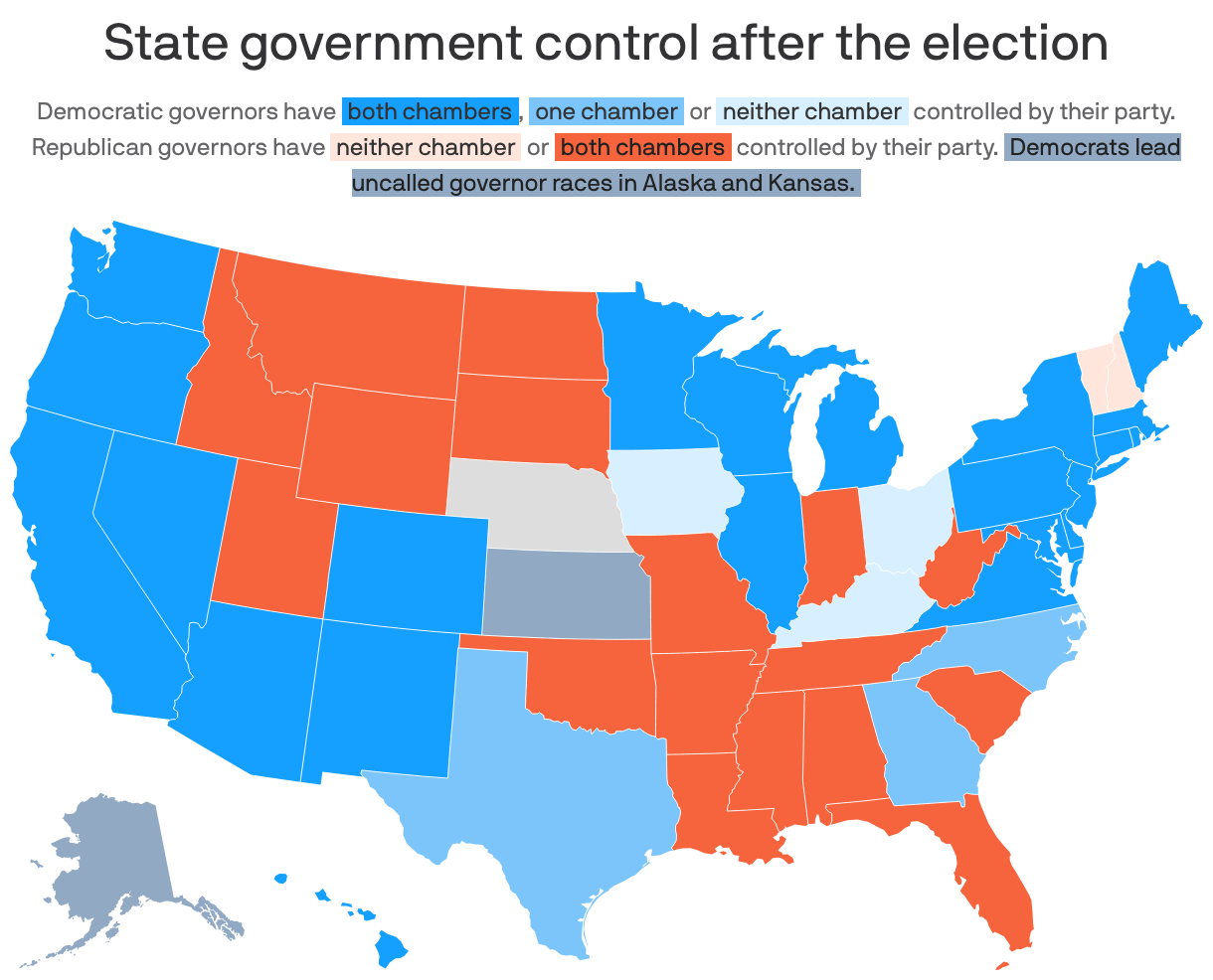
Data: Axios research; Map: Andrew Pantazi/Axios Democrats are on track to take control of a majority of legislative chambers, ending 16 years of Republican dominance over America's statehouses. If current leads hold, 75% of Americans will live in a state with a Democratic governor, and 53% will live in Democratic trifectas. Why it matters: Statehouses are the front line of American federalism, and Tuesday's gains dramatically expand Democrats' power to increase minimum wages, protect abortion access, and set voting rules ahead of 2028 for most Americans. Driving the news: The party is set to flip 12 legislative chambers, dismantle five Republican state trifectas, shatter 11 GOP supermajorities and build 12 of its own, according to AP returns as of 6pm ET on Wednesday. If leads hold, Democrats will control the governor's office and both chambers in five of the seven 2024 presidential battlegrounds: Arizona, Michigan, Nevada, Pennsylvania and Wisconsin. They have also broken Republican one-party rule in the sixth (Georgia) and flipped the House in the seventh (North Carolina). Democrats flipped five GOP-held governorships (Georgia, Iowa, Nevada, Ohio and Texas) and lead in Alaska. Republicans haven't flipped any, despite targeting Arizona, Michigan, Oregon and Wisconsin. Kansas, where Democrat Cindy Holscher was leading by about half a point Wednesday evening, is uncalled. The big picture: Ever since the 2010 Tea Party wave, Republicans have used their grip on statehouses to reshape American life: banning abortion, loosening gun laws, restricting collective bargaining and expanding private-school vouchers. They drew maps that kept them in power even in years Democrats won more votes statewide. Tuesday's Democratic gains broke that firewall. By the numbers: Republicans entered Election Day with 23 trifectas (control of the governor's office and both chambers) to Democrats' 16. If leads hold, Democrats will have 22 and Republicans 18. 24% of Americans will live under a