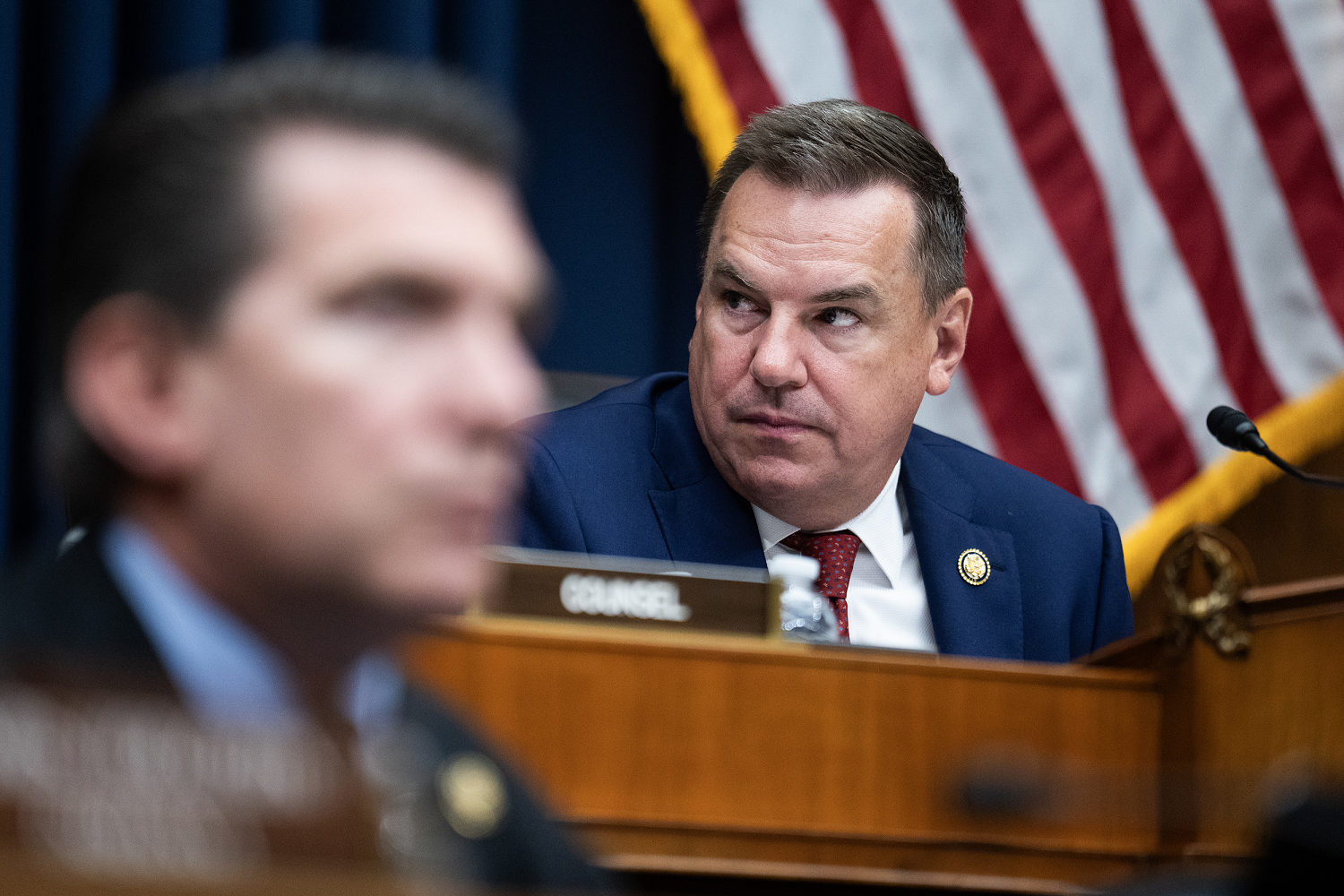
Richard Sterban, the bass vocalist of the Grammy-award winning gospel quartet The Oak Ridge Boys and a country music hall of famer, has died
Results for “richard sterban”
An international health organization has determined that the United States has lost its measles elimination status, according to multiple news reports. Why it matters: It's an official recognition of how much the country's public health has deteriorated due to a rolling series of outbreaks since early last year. Increased public skepticism about the safety and effectiveness of vaccines, a barrage of distrust from federal officials like Health Secretary Robert F. Kennedy Jr. and funding cuts for response efforts have all factored in the surge of cases, according to public health experts. The big picture: The Pan American Health Organization concluded there has been sustained transmission of the highly contagious virus for longer than 12 months, bringing the U.S. case count to its highest level in 35 years. The measles elimination status hinges on whether the same strain of measles stays in circulation for 12 months or longer without a break. The overwhelming majority of cases are in unvaccinated people. While overall measles vaccination rates remain relatively high, public health officials say they have to remain above 95% to maintain herd immunity. Driving the news: An expert panel convened by the Pan American Health Organization made the widely expected decision following a three-day meeting in Washington, D.C. What they're saying: "It is no surprise that the resurgence of measles has coincided with an administration that has inflicted significant damage to our health care system while spreading false claims about vaccines," said Richard Besser, president and CEO of the Robert Wood Johnson Foundation and a former acting director of the Centers for Disease Control. "It is unthinkable that people in the United States should be dying from measles in 2026," the Infectious Diseases Society said in comments prior to the decision. The group cited the potential long-term toll on infants infected this year, some of whom could develop serious neurologic disease years after t
By pleading guilty to accessory to murder after the fact, Richard Glossip will avoid a retrial of the first-degree murder charge.
Sofia Margherita Marrone, known as "Montauk Mary" for decades, was identified via DNA and linked to Jersey Shore "Thrill Killer" Richard Biegenwald.
During his time on death row, courts set nine different execution dates for Richard Glossip, and he came so close to being put to death that he ate three separate last meals.
Former Oklahoma death row prisoner Richard Glossip pleads guilty to a lesser charge after nearly 30 years in prison
A murder charge against Richard Glossip, a former death row prisoner who was nearly executed multiple times, was dismissed on Thursday after being granted a retrial in the 1997 killing of his former boss, according to his attorney.
Former federal appellate judge Richard Posner, a prodigious legal scholar who pioneered the use of economic theory to resolve legal questions, has died
The Kennedy Center's former president Richard Grenell was a paid board member of Ticketmaster's parent company at the same time the two parties were negotiating.
He was the most-cited legal scholar of the latter half of the 20th century and an unapologetic iconoclast, favoring pragmatism over judicial tradition. He was 87.
James Richard Clark Sr. left DNA at both 1970s crime scenes, but advanced cybergenetics testing has only recently linked him to the two killings.
Global tech stocks have plunged after the Democrats’ victory in the US midterm elections, with fears of a slowdown in AI development. Major tech corporations including Apple, Tesla and Nvidia shed about $1tn in a single trading session. Is this stock market jitters, or a sign the AI bubble might be about to burst? Lucy Hough speaks to senior economics correspondent Richard Partington Continue reading...
Yes, the Republicans suffered humiliating defeat. But the fact that a Trump presidency was even possible means something like it could happen again He’s down, but not quite out. Barring divine or other intervention, Donald Trump will remain in the Oval Office for a further two years and 10 weeks. Or, as the White House put it in a plaintive social media post brimming with neediness: “PSA [Public Service Announcement]: Trump is still your president.” But that’s not the only reason why the global celebrations that greeted the Democratic tidal wave that swept Republicans out of even their deepest heartlands should be tempered, if only a tad. Don’t get me wrong, the results of Tuesday’s midterm elections are cause for genuine international jubilation. The defeats of Trump allies in Serbia and Brazil were delicious appetisers, but this was the feast. No mere electoral setback in line with midterm tradition, this was a thorough repudiation of the second Trump presidency and of Trumpism. The 16% swing to Democrats in the popular vote for the House of Representatives was greater even than the 11.2% swing recorded in the Watergate midterms of November 1974, following the resignation in disgrace of Richard Nixon. Trump had worked hard for many months to undermine these elections , either by gerrymandering districts in his favour or preparing the ground for a later claim the vote was rigged, but to no avail: the democratic system proved too resilient, and the American public too determined to have their say. And have it they did, in a voice loud and clear. Jonathan Freedland is a Guardian columnist Continue reading...
Republicans woke up "in shock" Wednesday morning after they got hit with the biggest midterms wave in 50 years. Within hours, that shock was turning into rage. Why it matters: The battle for control of what's left of the Republican conference — headlined by Majority Leader Steve Scalise (R-La.) and Judiciary Chair Jim Jordan (R-Oho) — is the first salvo in a quest to bring GOP lawmakers back from the political wilderness. Johnson set the tone Wednesday morning, when he took himself out of the running for leader, citing the toll the job has taken on his family. A key outstanding question is the extent to which Republican finger-pointing leads to a wholesale shake-up of the party's leadership ranks, versus a slight readjustment. Driving the news: The intra-party blame game quickly hit a fever pitch. "Dear Republican Senate and House "Leadership," No, the polls were not wrong. You were. Even with record amounts of money at your disposal, you managed to get absolutely annihilated," Rep. Greg Steube (R-Fla.) wrote on X Wednesday morning. "Please do us all a favor and step aside so new leadership can take a truly conservative direction," Steube added. "When you have the worst defeat in modern history, you need a new playbook," another GOP lawmaker told Axios. State of play: The fallout is rippling across the entire House GOP leadership team, with every top position facing a contested race. Minority leader: Scalise and Jordan are squaring off in a rematch of their bitter 2023 battle for the speakership. Minority whip: Tom Emmer faces a challenge from Rep. August Pfluger (R-Texas). NRCC Chair: Rudy Yakym and Brian Jack will face off for the post. Current NRCC Chairman Richard Hudson (R-N.C.) is on track to lose his own reelection bid. Zoom in: Behind the leadership infighting, Republicans are reckoning with what went so disastrously wrong on Election Day, with some blaming the Trump administration's policies for their losses. "Iran, Iran, Iran ... we should have never done
Make no mistake: Democrats won by epic, sometimes historic margins across red and blue states, up and down ballots, obliterating almost everything President Trump, and a Republican Party remade wholly in his image, built over the past decade in American politics. Why it matters: Trump and Republicans are left with a mostly white, mostly old House and Senate minority, confronting a younger, more diverse ascendant Democratic Party with power and margins it hasn't held in 18 years, since the dawn of the Obama era. The results speak louder than any words we can write: Democrats won Senate races in Texas, Kansas, South Carolina, Ohio, and perhaps Mississippi en route to what could be a 55-seat majority. Democrats won swing districts all across red America, with national average margins of victory of roughly 13 points, according to a New York Times estimate . Texas is now a Democratic state, top to bottom — unthinkable mere months ago. James Talarico crushed Ken Paxton ( 55% to 43% ) like it was Connecticut. State Representative Gina Hinojosa will become the first Democratic governor of Texas in 32 years . Pastor Adam Hamilton is the first Democrat to win a Senate seat in Kansas in 94 years. North Carolina looks like a true-blue state after Democrats flipped the Senate seat and likely ousted Rep. Richard Hudson (R-N.C.), chair of the National Republican Congressional Committee (NRCC) — meaning he led the GOP drive to keep the House. North Carolina's congressional delegation could swing from 10R-4D to 5R-9D. Georgia was even worse for Republicans, where they lost all power at the state and U.S. Senate levels. Florida Gov. Ron DeSantis (R) predicted on X that the losses were so widespread, so deep, so severe that Republicans might not "have a shot at Senate control until 2032." How to think about last night more broadly: This is a 50-50 nation with fast, whiplash shifts in power at the federal level due to persistent discontent with the party in power. So, on one hand, this
House Minority Leader Hakeem Jeffries (D-N.Y.) is set to preside over a commanding Democratic majority after his party swept districts President Trump carried by double digits. Why it matters: Democrats' landslide win will make it much, much easier for the likely next speaker to secure the gavel without a sweat and ignore the demands of his progressive wing. Rep. Greg Stanton (D-Ariz.), a leader of the center-left New Democrat Coalition, told Axios in an interview Tuesday night that Jeffries "now has the space to utilize his full talents as speaker." The size of Democrats' victory, Stanton said, "allows him to govern without worrying about being leveraged by anyone." Driving the news: Jeffries is on track to enjoy a majority of dozens of votes, with the New York Times projecting Democrats to win as many as 256 seats to Republicans' 178. Democrats flipped districts where the national parties didn't even spend money, likely unseating Republicans such as Reps. Lauren Boebert and Richard Hudson who were considered safe just months ago. It's a major partisan win for Democrats as a whole, but the party's centrist wing is also hailing the result as a much-needed strategic victory over the left. Zoom in: Progressives — particularly "The Bloc," a group made up of hard-charging leftists like Darializa Avila Chevalier and Adam Hamawy — had hoped to use a small majority to extract concessions from Jeffries. Many of them have declined to commit to supporting Jeffries as speaker and signaled they would use their votes as leverage force votes on progressive legislation such as Medicare-for-All, defunding ICE and cutting aid to Israel. But the left's strategy is "going to look different from what it would have been with a smaller margin," one incoming House progressive told Axios, noting that "leaders have more flexibility when they have big majorities." Progressives "can't really extract much now [with this] colossal majority," a progressive strategist acknowledged, adding that "w
In red states and blue, Republicans suffered losses on a scale even Democrats would never have dared to dream about 24 hours ago. Why it matters: Democrats worried that polls showing a blue wave were overestimating the party's strength. It turned out polls underestimated the size of the Democratic romp — by a lot. The margins Democrats racked up in red states were stunning: Georgia: Sen. Jon Ossoff won reelection by nearly 18 percentage points. North Carolina: Former Gov. Roy Cooper won his Senate race by roughly 19 points. Texas: State Rep. James Talarico cruised to victory by approximately 12 points. These weren't nail-biters in competitive states. They were landslides in states President Trump carried just two years ago. The Texas trifecta Democrats won the Texas House, Senate and governor's mansion, giving the party unified control of state government for the first time since 1995. The sweep came alongside Talarico's double-digit victory in the U.S. Senate race. Texas, long the GOP's biggest electoral stronghold, delivered Democrats victories up and down the ballot. North Carolina was a bloodbath The man in charge of steering House Republicans to victory — Rep. Richard Hudson, chair of the National Republican Congressional Committee — lost his own seat. He'll join the ranks of other defeated party leaders — Speaker Tom Foley in 1994 and DCCC Chair Sean Patrick Maloney in 2022 — who spent so much time trying to build a majority that they failed to protect themselves. The carnage extended across the state. North Carolina's congressional delegation could shift from 10 Republicans and four Democrats to five Republicans and nine Democrats. The ridiculously cheap wins Democrats are leading in districts that received little or no outside spending from the Democratic Congressional Campaign Committee (DCCC) or House Majority PAC, the party's main House super PAC, according to AdImpact. In North Carolina's 6th, 9th and 13th districts, Missouri's 2nd and Tennessee's 4th, D
Rep. Richard Hudson, R-N.C., lost on Tuesday to Democrat Richard Ojeda in North Carolina’s 9th District, NBC News projected.
The world's biggest crypto heist is the latest feat by North Korean hackers who have spent years perfecting an arsenal of financial theft, social engineering and sophisticated cyberattacks. Why it matters : The suspected North Korean hackers behind the $6.3 billion Binance theft appear to have combined familiar hacking tactics with extraordinary speed and automation — raising fresh questions about how AI could supercharge their already sophisticated operations. Driving the news : Binance said late Thursday that its blockchain partners have frozen at least $3 billion of those $6.3 billion assets on-chain so far, and it believes the hackers gained initial access by compromising one engineer's laptop alongside other "points of breach." Several blockchain investigation firms have tied the hack to TraderTraitor, a group linked to the North Korean government's Lazarus Group collective. Binance co-CEO Richard Teng said in a video on social media Friday that the attackers also used a "self-destruct mechanism that destroyed tooling and traces" as they went, making it more difficult to investigate what happened. "This was a complex attack," he said. The big picture: North Korean government hackers have spent more than a decade carrying out financial heists and disruptive cyberattacks, and they have turned cryptocurrency theft into an industrial-scale operation. In 2016, hackers attempted to steal nearly $1 billion from Bangladesh's central bank, successfully making off with $81 million. In 2017, North Korea was blamed for the WannaCry ransomware outbreak , which disrupted hundreds of thousands of computers across more than 150 countries. In recent years, the country has intensified its focus on pillaging crypto exchanges in part because the digital assets can more easily be transferred and laundered across borders — although those attacks tend to leave more of a paper trail. The same North Korean hacking group, TraderTraitor, also set the last record for the world's largest c
Australian actor and martial artist Richard Norton, who faced off in movies against Chuck Norris and Jackie Chan, died of a heart attack tiggered by peptides, according to a coroner’s report.
A student-led protest movement has ended the 14-year rule of Serbia's right-wing party, former President Aleksandar Vučić conceded Sunday. Why it matters: The historic upset sidelines a Balkan strongman who courted President Trump's family and allies, raising questions about future U.S. relations with a country that has balanced ties with Russia and the West. Vučić 's outreach has included the president's son Donald Trump Jr. and longtime ally Richard Grenell, while a proposed development involving Trump's son-in-law Jared Kushner became embroiled in controversy. The big picture: The movement's electoral breakthrough reflects a broader wave of youth activism in Europe, where young people have mobilized over corruption, education and economic pressures. The victory could usher in democratic reforms in Serbia, where Vučić consolidated power. Driving the news: Vučić said Sunday evening it was "clear" that his Serbian Progressive Party had lost to the student-backed electoral movement, although official results had yet to be announced, according to translations of his announcement . He projected the Student List would win between 135 and 140 seats in the 250-seat parliament, compared with 105 for his coalition. Cardiologist Ilija Srdanović heads the Student List, though the grassroots movement emphasized its decentralized leadership. The result echoes the student-led movement that helped topple Slobodan Milošević in 2000 , with Serbians reviving that era's "He's finished!" rallying cry as they celebrated Sunday. Context: The movement emerged from mass protests after the November 2024 collapse of a railway station canopy in Novi Sad that killed 16 people, fueling public anger over alleged government corruption. It subsequently evolved into an electoral movement campaigning for accountability and institutional reform. What's next: The Student List must choose a prime minister and form a government while Serbia faces a separate presidential election in December to replace