NWSL Championship to bring fans "the best soccer in the world"
The next frontier in growing women's soccer in the U.S. is where the players train and play their games.
CBS News · 4h ago

The next frontier in growing women's soccer in the U.S. is where the players train and play their games.
The FBI estimated cargo theft losses in the U.S. and Canada reached nearly $725 million in 2025.
An alleged train heist ring targeted dozens of freight trains, California prosecutors say. Ash-har Quraishi reports.
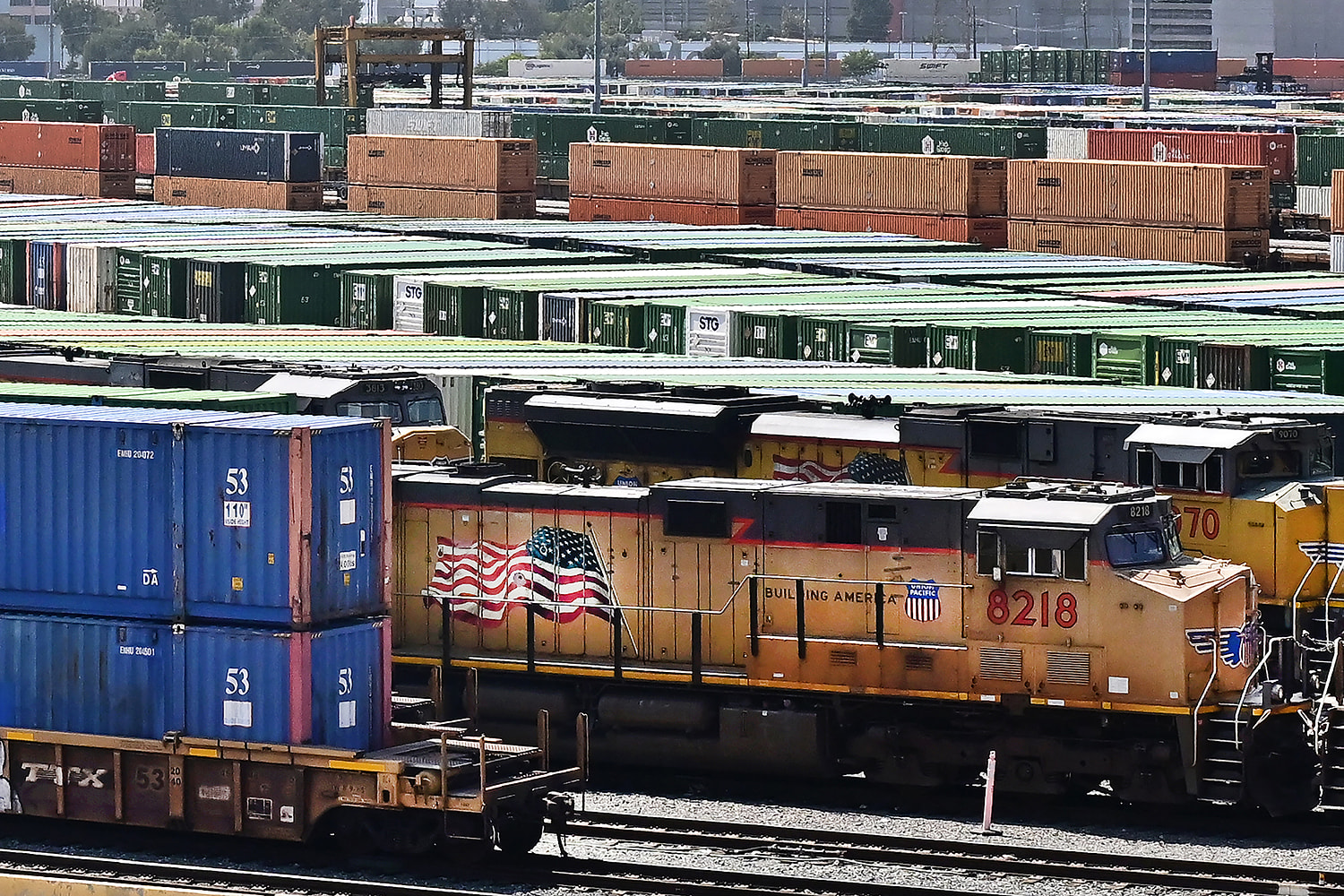
More than a dozen people were charged with allegedly orchestrating a massive train heist operation to steal over $22 million in cargo — from popular shoes to power tools — from major retailers.
A crew of 14 men boarded moving trains in Southern California, forced them to stop and made away with sneakers, electronics and power tools, according to an indictment unsealed on Thursday.
Fourteen suspects face federal charges in an alleged $22.5 million cargo theft scheme targeting 36 freight trains in Southern California.
Florida is set to carry out a record-breaking 20th execution of the year on a man convicted of killing a pregnant woman and her husband, while Texas plans to execute a man convicted of killing a Houston jeweler during a $3.6-million diamond heist
A man who is accused of attempting to strangle a Northwestern University student in her dorm room got into the building after following two other students to the campus from the train, prosecutors said. NBC Chicago's Vi Nguyen reports on the three students being hailed as heroes.
A man who is accused of attempting to strangle a Northwestern University student in her dorm room got into the building after following two other students to the campus from the train, prosecutors said.
Diaunte Adams allegedly followed a Northwestern University student from a train into her dorm, bypassing two layers of security before students stepped in.
Since the spacecraft’s 1977 launch, our wonderful and terrible species has done great damage to our planet. Voyager has offered us a clear view of ourselves Imagine traveling nonstop for 49 years, alone in the dark with no destination in sight, powered by curiosity and engineering. Further imagine making that journey not at bullet train or jet plane speed, but much faster: at 37,800 miles per hour, free from friction in a vast sea of cold, soundless space, bombarded by radiation and cosmic rays yet still able to communicate with folks back home. Continue reading...
Months after Twitch stirred backlash for allowing Amazon to train AI models on streamers’ content unless they opt out, some TwitchCon attendees remain critics of the technology.
Refrigerator hacks. $6.3 billion crypto heists . 14-country espionage campaigns carried out in just 11 days. All in the span of a week. Why it matters: State-backed hackers are finding new ways to launch cyberattacks at remarkable speed and scale, with AI and automation threatening to widen the gap between attackers and defenders. Driving the news: Hackers tampered with refrigeration system s at dozens of European grocery stores in one night earlier this week — raising temperatures and spoiling food in a sweeping attack some linked to Russia. "It's hard to imagine this is not the work of a nation state pretending to be a criminal actor," Cynthia Kaiser, former deputy director of the FBI's cyber division, told Axios. "Given the concentration around Europe, Russia is a reasonable first suspect." French blood banks were also affected in the attacks on European refrigeration systems, authorities said Wednesday. SentinelOne researchers reported Tuesday that Russian-aligned hackers have previously claimed attacks on European refrigeration systems. Meanwhile, the Pentagon has also been investigating a series of suspected hacks of refrigeration systems on its military bases over the summer. Nextgov reported that investigators suspect Iran was behind those attacks. Others have suggested potential Iran ties in Europe as well. The big picture: No clear evidence has yet linked the attack on food supply through smart refrigeration to AI or automation, but nation-state hackers have used those tools in other breaches to speed up their operations. Google researchers said Friday that multiple hacking groups have used automated security testing tools in recent attacks. One China-linked group gained deep access to a victim's network in as little as 15 minutes. North Korean hackers behind last week's record-setting Binance heist also likely used automation to move stolen cryptocurrency and cover their tracks, according to Chainalysis. Case in point: China-linked hackers used an AI-powe
Binance said the net outflow from the cryptocurrency exchange represents just 2.1% of its total holdings.
An amateur historian says he’s found evidence that the namesake of New York's popular Jones Beach played a key role in an infamous pirate heist in the Red Sea centuries ago
Voters are turning against the Republicans. But the clearest possible message is needed to safeguard democracy The psychologist Jennifer Freyd identified a pattern often used by perpetrators: deny, accuse, and reverse victim and offender. More than one observer has noted that Donald Trump employs that pattern politically. With polls suggesting Republicans are likely to lose the House and perhaps the Senate too in the midterms, the man who refused to accept Americans’ democratic verdict in 2020 is hawking a narrative of cheating Democrats who will steal seats via illegitimate votes. The January 6 insurrection showed how acute the peril to American democracy had become. It is more so now. This time, Republican efforts to undermine the results began well in advance. In 2020, Mr Trump’s vice-president, Mike Pence, the attorney general, William Barr, and others refused his most outrageous demands; now the justice department is supine. And the supreme court’s gutting of the Voting Rights Act , which safeguarded against the worst kinds of racial discrimination, means that states no longer require pre-approval for decisions that could well tilt a race. Districts have already been redrawn. Continue reading...
The world's biggest crypto heist is the latest feat by North Korean hackers who have spent years perfecting an arsenal of financial theft, social engineering and sophisticated cyberattacks. Why it matters : The suspected North Korean hackers behind the $6.3 billion Binance theft appear to have combined familiar hacking tactics with extraordinary speed and automation — raising fresh questions about how AI could supercharge their already sophisticated operations. Driving the news : Binance said late Thursday that its blockchain partners have frozen at least $3 billion of those $6.3 billion assets on-chain so far, and it believes the hackers gained initial access by compromising one engineer's laptop alongside other "points of breach." Several blockchain investigation firms have tied the hack to TraderTraitor, a group linked to the North Korean government's Lazarus Group collective. Binance co-CEO Richard Teng said in a video on social media Friday that the attackers also used a "self-destruct mechanism that destroyed tooling and traces" as they went, making it more difficult to investigate what happened. "This was a complex attack," he said. The big picture: North Korean government hackers have spent more than a decade carrying out financial heists and disruptive cyberattacks, and they have turned cryptocurrency theft into an industrial-scale operation. In 2016, hackers attempted to steal nearly $1 billion from Bangladesh's central bank, successfully making off with $81 million. In 2017, North Korea was blamed for the WannaCry ransomware outbreak , which disrupted hundreds of thousands of computers across more than 150 countries. In recent years, the country has intensified its focus on pillaging crypto exchanges in part because the digital assets can more easily be transferred and laundered across borders — although those attacks tend to leave more of a paper trail. The same North Korean hacking group, TraderTraitor, also set the last record for the world's largest c
Binance exchange says it will cover customer losses as it scrambles to freeze affected assets, with about $3bn located so far Q&A: How big a deal is the $6.3bn crypto heist? Tell us: have you been affected by the Binance hack? Business live – latest updates The world’s largest cryptocurrency exchange has been hit by a record $6.3bn (£4.7bn) hack described as the biggest heist in history, with experts identifying North Korea as the likely culprit. Binance said it would cover all customer losses as it froze $3bn of the affected assets. Continue reading...
Anthropic filed yesterday for what could be the biggest IPO ever, capping a massive day of AI dealmaking that nearly equals 1% of U.S. GDP. Why it matters: Few industries have ever become so central to the American economy so quickly — and we're watching Wall Street finance the buildout in real time. Driving the news: Anthropic's long-awaited IPO may seek to raise a record $100 billion. Also yesterday, SpaceX secured $40 billion in debt financing to lease GPUs — the chips that power modern AI — and Meta said it would seek up to $95 billion in financing for its AI buildout. Together, that's roughly $235 billion in a single day — more than the entire U.S. airline industry adds to the economy in a year. The big picture: AI's appetite for capital has outgrown what any one single part of the financial system can supply. Anthropic alone has committed roughly $750 billion to computing power in the coming years — about seven times what its record-setting IPO may raise. Even private investors are struggling to keep up: OpenAI's record $120 billion funding round took months to close. Zoom in: Most Americans will be financially exposed to these deals, even if they never buy a share. SpaceX and Meta are already major holdings in the top stock indices that fill pensions, 401(k)s and other retirement plans. Anthropic will soon join them. Between the lines: Anthropic's filing spells out how big the stakes are, devoting more than a quarter of the document to risks. The company warns that AI could pose "catastrophic or existential risks to humanity" and that models may try to manipulate the people using them. Zoom out: Each of these three deals is a bet that AI use keeps compounding fast enough to justify the industry's trillions in spending. The flip side, however, is that declining use could crack the foundation of America's entire economy. The bottom line: Everyone is on the AI train, whether we want to be or not.