Doctors in Ukraine Try Treating Infections Like Biological Warfare Attacks
As many as 40 percent of injured soldiers face severe infections that can lead to amputations and death. One initiative is trying to fix that.
The New York Times · 3h ago

Research, space and the environment
Doctors in Ukraine Try Treating Infections Like Biological Warfare AttacksAs many as 40 percent of injured soldiers face severe infections that can lead to amputations and death. One initiative is trying to fix that.
 Are sharks really older than trees?
Cumbria Wildlife Trust starts work repairing damage to Skiddaw Forest's peatland.
SpaceX sent another batch of its Starlink broadband satellites to orbit from California just after midnight on Halloween (Oct. 31).
A new study has mapped human urogenital development in its native spatial context, revealing how neighboring organs coordinate their development through cellular communication and molecular signaling during embryogenesis.
A new gene-editing system could make it easier for researchers to introduce precise genetic changes into crops such as tomatoes, soybeans and rapeseed. Developed by researchers in China, SmartPE improves prime editing efficiency in several dicot plants, addressing a major limitation of the technique.
Countries have been trying to get a global agreement to halt nature decline back on track.
Neutrinos are funny little particles that weigh almost nothing, making them one of the universe's most elusive building blocks. They can come from objects as mundane as bananas and as exotic as supernovas—the exploding death throes of massive stars. Most neutrinos stream through space and pass through the Earth without interacting with anything.
With high pressure developing across the UK, the start of November is looking very settled with no significant rain in the forecast.
"He wore his heart on his sleeve, which made him a man to rely on, to admire and, in my case, love."
In the Texas Panhandle, two livestock guardian dogs patrol a herd of cattle grazing the Rita Blanca National Grasslands. Although their singular focus is protecting the herd from would-be predators, their presence may make them wildlife conservation allies.
From haunted zoo cages to ghostly bar owners, here are five stories from our archives that will make you shiver, or maybe chuckle.
Emily Kwong and Ari Daniel of NPR's Short Wave talk about mysterious X-ray objects, the link between movement and learning and how a small part of the brain triggers memory formation.
Deep in a forest in Indonesian Borneo, conservationists open a cage. A female orangutan and her baby waste little time, clambering up the towering trees and disappearing into the canopy, safe at last.
Striped bass fishing has been Bill Jakob's passion for more than 60 years, and he remembers an era when he'd spend all night casting his line into the crashing waves off Montauk and get eight or nine fish ranging up to 40 pounds (18 kilograms), a big catch by anyone's standards.
Minerals in the space rock provide hints about the early history of the red planet, when water was flowing on the surface.
How handy would it be if you could make your tattoos invisible for a job interview in the morning, and reveal them again for a party in the evening? This sounds like science fiction, but it may soon be reality.
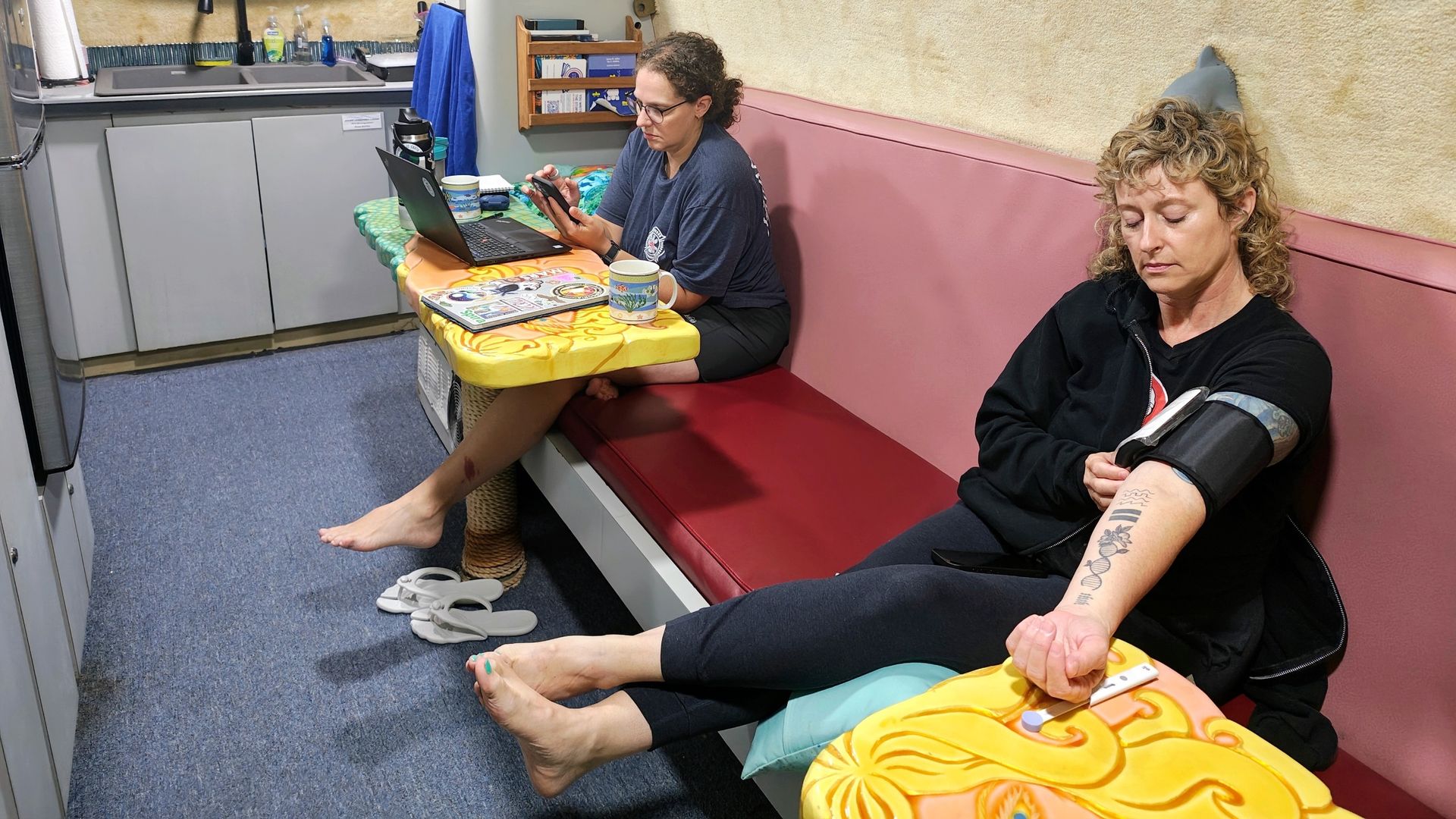
After five days of living underwater, Analog Astronaut Commander Dr. Musilova and her crew return to terra firma, affected by higher pressures and the team's disconnection from home.