
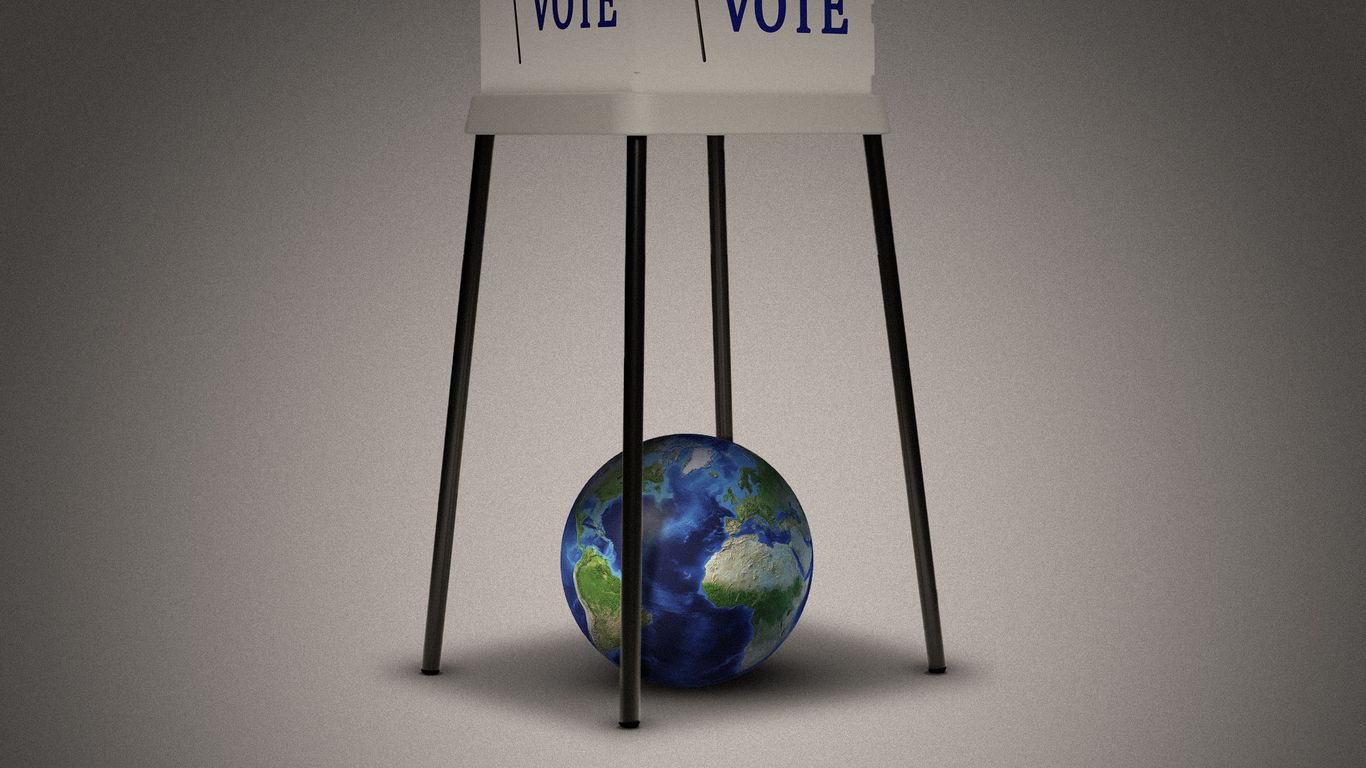
Democrats have made climate change a centerpiece of their campaigns for years — but this year they barely mentioned it. Why it matters: The midterms showed just how far the topic has fallen down the political priority list, even within the party most committed to addressing it — and suggest affordability will shape how Democrats govern next year. Driving the news: Democrats up and down the ballot campaigned overwhelmingly on affordability, including fuel prices surging amid President Trump's Iran war and rising electricity bills, accentuated by the AI boom. The big picture: The relative absence of climate change is striking considering that Democrats of all political stripes won big. Zoom in: Even some of the party's most prominent climate advocates emphasized affordability over climate change — or reconsidered ambitious climate policies in response to rising costs. New York Gov. Kathy Hochul, who previously championed the state's ambitious climate agenda, pushed to weaken parts of its landmark climate law this year, citing affordability concerns. Sen. Ed Markey (D-Mass.), who co-authored the Green New Deal, played down the proposal during his reelection campaign, emphasizing affordability and other priorities instead. Texas Sen.-elect James Talarico, who has previously warned about fossil fuels' impact on the planet, campaigned on protecting oil and gas jobs alongside expanding renewable energy and lowering electricity bills. Flashback: The political shift has been underway since the 2024 presidential election, when even climate-focused groups began de-emphasizing climate change in their political advertising, a trend that persisted through the midterms. State of play: On a call with reporters the day after the election, leading environmental groups celebrated Democrats' victories as a rejection of Trump's energy policies, arguing that his attacks on clean energy contributed to higher electricity bills. "Trump's energy agenda was an economic disaster for families a
Results for “bills”

Democrats' big night gives them a chance to turn voter anger over high energy prices into legislative action and congressional oversight, but divisions within the party could complicate their plans. Why it matters: This was an energy election . High gasoline prices, record diesel costs, and rising power bills fueled discontent with President Trump and his party. Voters' rebukes of data centers could slow the buildout of power-hungry AI infrastructure. The latest: Stunning Senate wins in red states and House wins nationwide propelled Democrats to control of both chambers, and flipped several governor's mansions. Energy costs were prominent in key races, such as Democrats hitting GOP rivals over farmers' bills in Iowa, Kansas and Ohio. Texas Governor-elect Gina Hinojosa (D) bashed Greg Abbott (R) over his prior embrace of data centers in the state where developers are planning big projects. The data center backlash also featured in Ohio and Pennsylvania, where Sherrod Brown defeated Sen. Jon Husted (R) and Paige Cognetti unseated Rep. Rob Bresnahan (R). Both Republicans faced criticism over their support for data centers. State of play: A detailed Democratic energy agenda hasn't emerged, but there are early clues. Democratic Leader Chuck Schumer tied Republicans to electricity costs in his first comments after returns came in. Likely Speaker-in-waiting Hakeem Jeffries has vowed to quickly push an affordability agenda, with energy as a key pillar. He tasked Reps. Nikki Budzinski (D-Ill.) and Mike Levin (D-Calif.) with leading a "Gas and Utilities Affordability Working Group" that crafted ideas, though they remain under wraps. Another potential source of ideas: Hundreds of proposals backed this year by the 100-plus member House Sustainable Energy and Environment Coalition. Some could gain bipartisan backing, like support for advanced nuclear power. But other areas would be largely symbolic, like restoring some IRA tax credits. Catch up quick: In the Senate, Schumer has

Top party strategists may hate seeing one of their candidates gutted by a brutal ad. But they can still admire the hit. Why it matters: A record $11.6 billion has plastered political ads across screens of every size in the country during the 2026 midterms . Only a handful of those earned the grudging respect of operatives on both sides. 📺 Zoom in: Multiple Republican strategists singled out the "brutal" series of ads attacking Sen. Roger Marshall (R-Kans.) over lawsuits against patients with overdue medical bills — some of whom were later arrested . Against the advice of his own team, Marshall released a self-directed ad answering the attacks. In Nebraska , an ad highlighting a past vote by former Gov. Pete Ricketts to pardon a man convicted of rape was singled out by both parties as one of the cycle's most damaging. Ricketts is expected to win re-election to the Senate. In Maine, an upbeat jingle hit Democratic nominee Troy Jackson for having children with his second cousin. "If he'll f**k his own family, he'll f**k yours too," the radio ad said (among other things). Sen. Susan Collins (R-Maine) called for the ad to be taken down. And in Florida , Rep. María Salazar (R-Fla.) turned on her own party leader, criticizing President Trump over ICE's aggressive enforcement tactics, saying some immigration policies had "gone too far." The intrigue : Even hardened operatives are dealing with a new frontier: AI-generated attack ads that can make up scenarios and put words in an opponent's mouth. In Michigan , a Republican-aligned super PAC used AI-generated imagery to depict Democratic candidate Abdul El-Sayed in a fabricated family photo and playing a game with cards referencing "Death to America" and 9/11. In Texas, GOP Senate nominee Ken Paxton's team used AI to depict Democratic candidate James Talarico defacing a Bible with a crayon and saying: "In the beginning God was non-binary, and he wasn't a Christian. And God said, 'let there be six genders,' and there were." ?

These resource-guzzling centres drive up utility bills and are hated across the political spectrum. Cue a clunky, but potentially influential, new name for them Jesus may have turned water into wine, but Donald Trump has done one better: he turned Lake Ontario into Lake America and the Gulf of Mexico into the Gulf of America. And then, for his next trick, he insisted we all stop talking about artificial intelligence (AI) and call it superintelligence (SI) instead. Those, of course, are only a few of the name changes the president has ushered in. When he’s not golfing or commenting on senators’ buttocks , president Trump loves a rebranding project. Which makes sense: coming up with a new name is far easier than making meaningful improvements to people’s lives. Continue reading...

Around the world, virtues such as compassion and kindness are gathering dust, like old hymn books in a long-deserted church Towards the end of the summer, the Tory-Reform defector Robert Jenrick authored an op-ed piece for the Daily Telegraph about the seemingly impossible economics of rising benefits bills because of mental ill-health. In his capacity as Reform’s Treasury spokesman, his task was to big up its plans to cut 25% of so-called welfare spending by 2030, and thereby tackle what he called the state’s “suicidal empathy”. Straight away, I wondered where this most opportunistic politician had borrowed that phrase from, and instantly found out: a book with the same title , published this year by the Canadian academic Gad Saad, whom the dust jacket describes as having particular expertise in “the use of evolutionary psychology in marketing and consumer behaviour”. It comes with an endorsement from Elon Musk. “Western civilisation is doomed unless the core weakness of suicidal empathy is recognised and actions are taken that are hard but necessary for survival,” says the world’s richest man. “All of Gad’s books, including this one, are great.” Continue reading...

Concerns about datacenters and high energy bills could help Democrats clinch races in Ohio, Arizona and Michigan In Arizona, where summer temperatures regularly hit triple digits, air conditioning can be a matter of life and death. This year, as the state recorded its hottest summer on record , Diali Avila’s monthly power bill went up to $400, the highest it has ever been. Avila, the state director for Climate Power, an advocacy group, said the upcoming elections offered voters an opportunity to elect candidates who can ease their utility bills. “People are making the connection: they’re looking at their electricity bills that they get at the end of the month, and then they’re looking at their ballot, and they’re [realizing], this is my moment to take action,” she said. Continue reading...

In a downpour against the Atlanta Falcons, Tampa Bay decided throwing was for losers. They were proved right I don’t think I’m being cheeky when I say that passing is the most exciting part of football. A solid hit is nice, and a big run can thrill you, but this is a quarterback-centric game. When a QB is bad, teams usually lose and fans get bored. So, Sunday’s performance by Baker Mayfield and the Tampa Bay Buccaneers has me positively gobsmacked. I wouldn’t say their 16-0 win over the Atlanta Falcons was thrill-a-minute, but it certainly was historic. By completing a grand total of zero passes out of a paltry three attempts, Baker Mayfield led the Bucs to the first game with no passing offense since the Buffalo Bills beat the New York Jets 16-12 on 29 September 1974. If you are miraculously old enough to remember the NFL before the advent of the forward pass in 1906, first off, congratulations on being over 120 years of age. Please email me your full diet and exercise regimen. You’re probably on your feet (if standing is still something physically possible), cheering a bit of hard-nosed, classic football. The rest of us young whippersnappers still grinding through our first century are holding our noses. Of course, Mayfield – a former No 1 overall pick – can throw. As recently as 2024 he threw for 41 touchdowns and 4,500 passing yards in a season. But Sunday’s game was played in pouring rain that led to farcical moments like this , and Tampa clearly decided that the ground game was the only way to go. That Tampa Bay could score at all, let alone 16 points, is a credit to Bucky Irving and Kenneth Gainwell running as if their lives depended on it. Irving finished the day with 170 rushing yards and one touchdown, while Gainwell had 140. Combined, they rushed 52 times for 324 yards – the most ever in a single game for the Bucs. They more than made up for Mayfield’s borderline irrelevance in the pocket. Mayfield made himself useful blocking for his runners, but otherwi

Unbeaten Minnesota v Detroit; Jackson v Allen in Buffalo Email Graham here A pair of quarterback heavyweights?! Yes, just a bit. Lamar Jackson returns from a three-game absence for the Baltimore Ravens to face Josh Allen and the Buffalo Bills. Jackson’s two MVP awards play Allen’s one but Allen is very much the favourite to add to a second to his trophy cabinet after a scintillating start to the season. After their own hot start with Jackson at the controls the Ravens have slumped to 4-3. Two defeats in succession leave Baltimore bottom of the AFC North. So they will be hoping Jackson can jump back in and stop the slide. Unfortunately the omens aren’t great. The Bills have beaten the Ravens on three straight occasions at home, the latest being last season’s thriller from the opening week as Buffalo scored 16 unanswered points in the final four minutes to overturn a 15-point deficit in their 41-40 victory. (4-3) Baltimore Ravens v Buffalo Bills (5-1) (1-6) Tennessee Titans v Cincinnati Bengals (4-2) (2-5) Arizona Cardinals v Dallas Cowboys (3-4) (6-0) Minnesota Vikings v Detroit Lions (4-2) (2-5) Indianapolis Colts v Jacksonville Jaguars (4-2) (3-4) Las Vegas Raiders v New York Jets (2-5) (5-2) Cleveland Browns v Pittsburgh Steelers (5-2) (3-4) Atlanta Falcons v Tampa Bay Buccaneers (2-5) Continue reading...

Congress must act to ensure that families are able to heat their homes before the start of the season Heating oil may be the clearest warning yet of how the war in Iran is deepening the US’s energy affordability crisis. Families who heat their homes with oil are facing bills that could be 50% higher this winter, adding nearly $900 to the cost of keeping their homes warm. These families were already struggling before the war began. As the Guardian recently reported , research by my organization found that electricity shutoffs in 10 states had increased 28% over the past two years. Millions of Americans were already falling behind on their utility bills, forced to choose between paying for energy, food, medicine and rent. Now they face another round of increases in gasoline, electricity and home heating costs. Continue reading...

At 77, Houston grandmother Sistafabu Modupe still needs a day job. Her monthly Social Security check alone doesn't cover her bills, leaving her unable to retire. Like millions of older Americans facing financial hardship, she has come to terms with the possibility that she may have to work for the rest of her life.

Data: Resources for the Future; Note: Central RFF scenario ; Chart: Ben Geman/Axios The Senate permitting plan would cut emissions from power plants in the near term and help keep electricity prices down, a new analysis finds. Why it matters: The study from scholars at Resources for the Future, a nonpartisan think tank, offers some of the most detailed independent modeling yet of the bill 's effects. It will help inform lobbying and advocacy around the bill ahead of a test vote looming on Nov. 9. Driving the news: The analysis models how the bill would affect the power sector compared with current law and policies. Among the findings from its central scenario: It would drive "robust" transmission expansion ( see above ), enabling "use of additional clean energy and existing resources of all types." Overall electricity system costs are an estimated 3.5% to 7% lower each year through 2041 compared to a no-bill baseline, saving over $350 billion total through 2050 in present-value terms. That should translate into lower electricity bills for people, co-author Kevin Rennert tells Axios, though the study does not directly model retail prices. The bill would boost the build-out of renewables, partly enabled by expansion of transmission, with added clean energy displacing fossil fuels even though additions of gas-fired capacity still occur. CO2 from the power sector would initially drop as more coal is edged aside, and then climb over time — but remain below levels projected without the bill. By the numbers: In 2028, there's roughly 60 gigawatts more clean energy capacity on the grid in the study's central outlook compared to a baseline of current law and policy. Data: Resources for the Future; Chart: Ben Geman/Axios The intrigue: The RFF analysis shows how it sees the bill initially pushing power plant emissions downward. Even that eventual upward trend is hardly guaranteed. This kind of study is by definition packed with assumptions and variables that the authors acknowl

House progressives are planning to use their growing power to force votes next year on their most sweeping and divisive policies, including Medicare for All, abolishing ICE and cutting aid to Israel. Why it matters: The ultimate goal is to get these policies on the front burner for a Democratic president in 2029, even if that means forcing House Democrats into tough decisions. Rep. Pramila Jayapal (D-Wash.) told Axios the left wants mark-ups and votes on bills such as Medicare for All "so that we can prepare for when we have the trifecta and so that we can really build the support we need." "Forcing the vote is important so we can see where everyone is at, I think that's really key for 2028 and 2029," said Mai Vang, a progressive House candidate in California. The big picture: Here is what progressives most want to see go to a House vote in 2027, according to lawmakers, candidates and operatives who spoke to Axios: 1) Medicare for All The Medicare for All Act introduced by Rep. Pramila Jayapal (D-Wash.) has 118 co-sponsors — more than half the House Democratic caucus. The left wants to force the issue onto the floor and make their Democratic colleagues reckon with the policy's popularity in public opinion polls . Ultimately, they aim to ensure support for Medicare for All is a must-have for any 2028 presidential candidate to win the primary. "Years ago I negotiated with [former House Speaker Nancy] Pelosi to get the hearings , but we have not had a markup," Jayapal, a former Progressive Caucus chair, said in an interview with Axios. Jayapal pointed to the bill she and Rep. Pat Ryan (D-N.Y.) unveiled last week, which would lower the Medicare age from 65 to 50, as a potential compromise measure that could get caucus-wide support next year. Yes, but: A Democratic wave could bring in a bloc of members from red-leaning districts who could be sensitive to being tagged as wanting to end private insurance. Jayapal told Axios there's an "opening we've never seen before" with

The post “Peak Greenwashing”: Two Bills in Congress Endorse Misleading Recycling Claims appeared first on ProPublica .