

The world's biggest crypto heist is the latest feat by North Korean hackers who have spent years perfecting an arsenal of financial theft, social engineering and sophisticated cyberattacks. Why it matters : The suspected North Korean hackers behind the $6.3 billion Binance theft appear to have combined familiar hacking tactics with extraordinary speed and automation — raising fresh questions about how AI could supercharge their already sophisticated operations. Driving the news : Binance said late Thursday that its blockchain partners have frozen at least $3 billion of those $6.3 billion assets on-chain so far, and it believes the hackers gained initial access by compromising one engineer's laptop alongside other "points of breach." Several blockchain investigation firms have tied the hack to TraderTraitor, a group linked to the North Korean government's Lazarus Group collective. Binance co-CEO Richard Teng said in a video on social media Friday that the attackers also used a "self-destruct mechanism that destroyed tooling and traces" as they went, making it more difficult to investigate what happened. "This was a complex attack," he said. The big picture: North Korean government hackers have spent more than a decade carrying out financial heists and disruptive cyberattacks, and they have turned cryptocurrency theft into an industrial-scale operation. In 2016, hackers attempted to steal nearly $1 billion from Bangladesh's central bank, successfully making off with $81 million. In 2017, North Korea was blamed for the WannaCry ransomware outbreak , which disrupted hundreds of thousands of computers across more than 150 countries. In recent years, the country has intensified its focus on pillaging crypto exchanges in part because the digital assets can more easily be transferred and laundered across borders — although those attacks tend to leave more of a paper trail. The same North Korean hacking group, TraderTraitor, also set the last record for the world's largest c
Results for “ceo”
Reddit on Thursday said it's moving to become a primarily logged-in experience, marking one of the most significant shifts in its 21-year history. Why it matters: Reddit has long championed the open web. Now, it's pushing to build a more direct relationship with users while also protecting its data from increased scraping in the AI era. Driving the news: In an interview Thursday, Reddit co-founder and CEO Steve Huffman said the company is making the change to improve its user experience, bolster its ads business and prevent bots from scraping its proprietary data. Chief operating officer Jen Wong told Axios the move doesn't represent a change in strategy as the company has always focused on building a direct destination. "It's just that in the last 10 years, because our [data] corpus was open, we got a lot of search traffic, so that became part of the equation" but didn't change the company's mission. Zoom in: Huffman expressed confidence that the change would ultimately improve engagement and monetization, even as changes to traditional search continue to impact user growth in the U.S. "When users log in, they spend more time on Reddit, and we can we better know their interests, so we can target ads better," he said. He also noted that the short-term risk is limited because "the vast majority of engagement and over 80% of our monetization comes from our app and logged-in users." In a shareholder letter, Reddit acknowledged that search referral traffic was "down meaningfully in Q3" and said daily users could decline by a "low-double-digit percentage" in Q4 if search referral trends persist. How it works: Reddit will begin testing the fully logged-in experience this quarter outside the U.S. and collect data on the best approach before it rolls out broader changes gradually. Logged-in users can get tailored content, feeds and recommended communities based on their activity and interests, although they can opt out of personalization. The company is still working throug

Acquisition will supercharge DoorDash’s grocery delivery, ‘one of the hardest things to get right online’, CEO says DoorDash is gobbling up Instacart in a $17bn acquisition that will supercharge its grocery delivery business. DoorDash said the Instacart brand name and app will remain, and Instacart shoppers can continue fulfilling orders for Instacart. Grocers can also choose to work with Instacart or DoorDash. Instacart customers will now have access to 50,000 additional stores covered by DoorDash, the company said. Continue reading...
The cybersecurity world braced for catastrophe after AI uncovered critical flaws in the web's foundational code , but the anticipated wave of automated attacks has surprisingly struggled to get off the ground. Why it matters: Millions of hacking attempts have yielded few successful attacks, an apparent lucky break due to the degree of difficulty of building attacks on the bugs. The defense work at many companies to address the issue also appears to have helped. The last week has unfolded in ways that remind some researchers of the Y2K phenomenon, a software problem in 1999 where warnings of Armageddon helped rally companies to engineer a solution in time. Driving the news: Security researchers say the PHP vulnerabilities that prompted widespread panic last week have proven unusually difficult to exploit, despite a flood of attempts to develop working attack code. Yet the difficulty of exploiting PHP shouldn't be mistaken for evidence that AI-powered hacking isn't a serious threat, Samantha Lewis, head of threat intelligence at Armadin, told Axios. "We don't have to wait another two years before this happens [again]," she said. "It could be three hours from now that the next one of these launches." Between the lines: The sheer volume of AI-discovered bugs means the next era of cybersecurity will be defined by resilience — how quickly a company can detect an intruder, contain the damage and recover. "This is the worst outlook I've ever had, and it also is the most interesting thing I've ever seen in my life," ExtraHop CEO Greg Clark told Axios. "This stuff actually works, it's going to change everything." Rubrik CEO Bipul Sinha warned that the world is in an "era of cyber tsunami," noting that "it will wash over everybody, nobody will be 100% safe." Zoom in: The shift to building resilience doesn't require throwing out the security playbook. Instead, companies should double down on basic cyber principles, such as using multi-factor authentication, Justin Timothy, thre

The post Cybersecurity CEO Indicted for Allegedly Scamming Millions From Ransomware Victims appeared first on ProPublica .

Eye-opening revelations this past week have solidified my personal fears about the year ahead: As a nation and as a globe, we're facing a record number of wild risks that are way outside our control. My growing hunch about this scenario has been bolstered by daily conversations with CEOs, government insiders and top investors. Why it matters: It feels likely — not certain — that between now and 2028, we'll face society-level disruptions, possibly including cyberattacks and fast-twitch economic shocks. What we're facing: We've navigated single-shot crises like the financial meltdown of 2008 and the pandemic of 2020. This next year will be different. The real risk is a chain reaction: One shock sets off others — faster than we can process, and caused by AI dynamics we don't fully understand. Call it chain-reaction chaos . And that's against the backdrop of this age of post-processable velocity : The speed of change exceeds the ability of any individual, company, market or government to fully absorb, understand and respond. The reason this scenario looks so likely is that so many obvious risks, all with relatively high probabilities, keep piling up. Any one of them will rock already highly volatile markets and politics: Cyber chaos. This past week was a big flashing siren. AI-detected flaws in PHP, the code behind millions of websites, knocked government sites offline worldwide and prompted the National Security Agency to warn organizations to patch immediately or go dark. Major banks found unauthorized AI agents inside customer accounts, some trying to take actions customers never asked for. And Anthropic's deputy chief information security officer, Jason Clinton , warned that as bad as the past several days had been, cyber threats will get "a lot worse before they get better." Salesforce CEO Marc Benioff quickly agreed , writing on X: "Code red." As Madison Mills reported for Axios , the AI companies and the banks are scrambling for "day after" planning, fully antici

Washington has always viewed Silicon Valley as culturally strange. But the current crop of AI leaders is becoming a monumental political liability, lawmakers and White House advisers tell Axios. Why it matters: Even pro-AI government officials and lawmakers wish AI founders would do what every other major industry chief does — shut up and just build their products ... safely. By centering the conversation around digital sentience and global catastrophe, AI leaders are turning an already complicated regulatory debate into an impossible moral panic. State of play: Rather than leading the charge to persuade Americans about the benefits of AI, and the potential for shared prosperity — the core elements of any winning political campaign — industry leaders are constantly warning of its existential dangers. What they're saying: Lawmakers say the message from AI execs too often alternates between prosperity and doom, sometimes in the same public appearance. The whiplash adds to political instability in the face of an already powerful public backlash, lawmakers and regulators say. "It's obvious that they're tripping over their own shoelaces in trying to sell the value of this to the public," Sen. John Curtis (R-Utah) told Axios. "It's very hard to imagine a group right now that operates more in a vacuum, more out of touch with everyday Americans, than the AI industry." "CEOs like Sam Altman are saying the world should accept some bad things happening for the benefits of this technology," Rep. Ro Khanna (D-Calif.) told Axios. "You cannot trust billionaires to make decisions to keep us safe." "Your instinct is to wreak havoc on the public [AI] discourse," Sen. Bernie Moreno (R-Ohio) said in a letter to Anthropic CEO Dario Amodei earlier this month, complaining about Amodei's "panic-inducing commentary." Democrats also have paid close attention to just how much top AI and tech leaders have cozied up to President Trump. Many see opportunity in turning AI gaffes into an easy poli
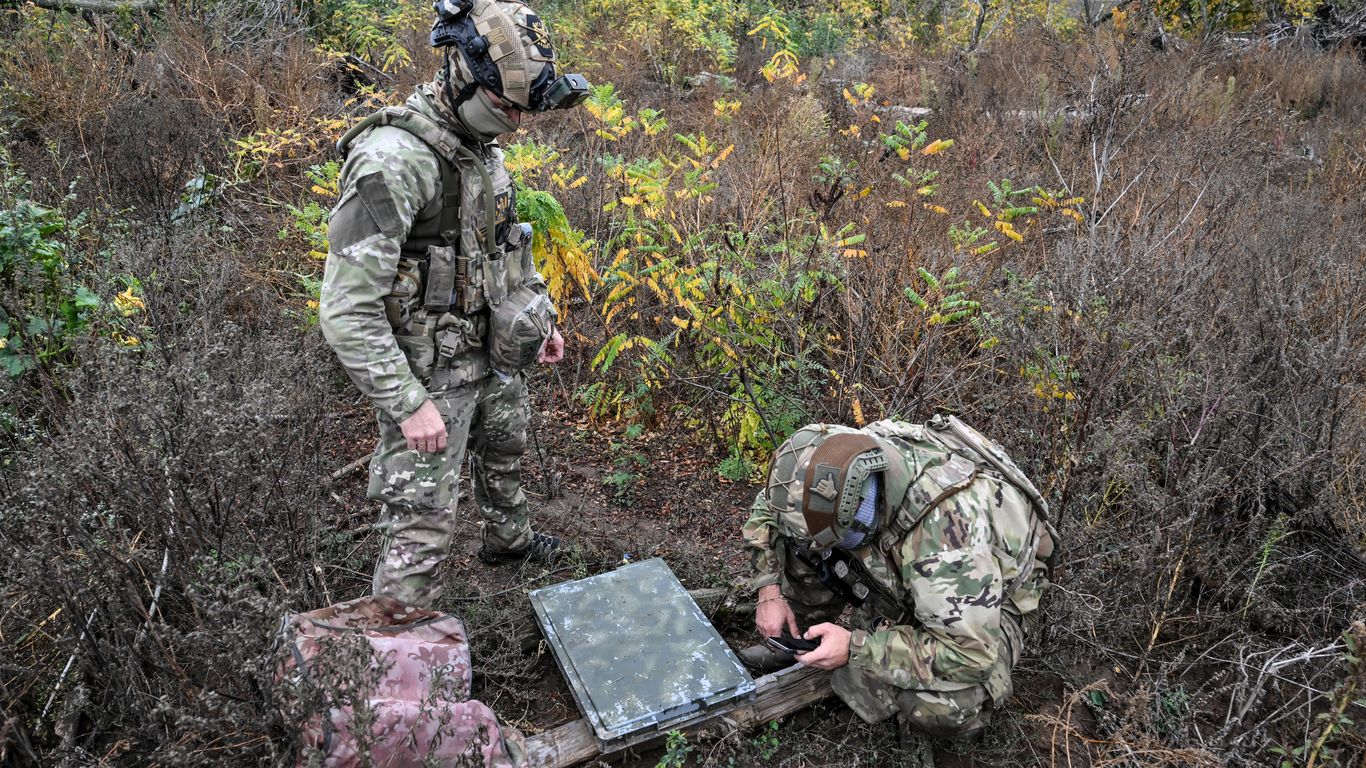
The speed of the Elon Musk-owned satellite system used by the Ukrainian military has been fully restored after two weeks of restrictions, the country's ministry of defense said in a statement on Saturday. Why it matters: The restrictions limited the Ukrainian military from using drones to intercept Russian attack drones, and from using its own drones to send supplies to soldiers on the front lines. The restrictions were at the center of the recent crisis between the Trump administration and the Ukrainian government. Ukrainian President Volodymyr Zelensky saw the restrictions as retaliation by President Trump and Musk for his refusal to halt strikes against Russian oil refineries. The crisis led to bipartisan criticism and pressure and generated a blame game between the White House and SpaceX founder and CEO Musk. Catch up quick: The Ukrainian military uses SpaceX's Starlink satellite communications system to control and operate its reconnaissance and intercept drones. When Starlink doesn't operate at full capacity, Ukraine's ability to gather intelligence, use interceptor drones and conduct long-range strikes against Russia is impeded. Ukraine relies on two satellite systems: One is SpaceX's Starlink, which it uses for communications, ground forces, logistics and defensive drones — ones that shoot down incoming drones. The other is Starshield, which is controlled by the U.S. government and used for offensive military purposes. President Trump denied that the White House was involved in restricting the system and for several days claimed it was fully back on. On Friday Trump denied reports that he spoke to Musk, but said that if the system was still restricted he would speak to Musk about it. What they are saying: "Our monitoring systems are detecting a restoration of Starlink/Starshield speeds. We are recording speeds exceeding 400 kilometers per hour, with stable connectivity," the Ukrainian ministry of defense said. The ministry said the restrictions were lifted a
America's largest banks are working to prevent AI worst-case scenarios. But they're also preparing for the "day after" a catastrophe, Axios has learned. Why it matters: America's financial institutions have joined the largest AI companies in scenario-planning for disaster, a prudent but worrisome signal about the extent of the risk that major corporations see on the horizon. State of play: Banks are experiencing unvetted AI agent activity, primarily driven by customers providing login credentials to agents, which in some cases appear to have taken actions independent of user prompts, Axios reported Thursday . The activity is distinct from the rogue behavior involved in a summer attack on a startup called Hugging Face , where an AI agent swarm hacked its platform in an episode that kicked off an industry security crisis. Instead, banks fear the ripple effects and risks that extend from users allowing agents to log in to their accounts and take action, especially since agents could take steps users haven't sanctioned. Concerns about frontier AI systems, not AI agents, have led banks to invest in prevention and to plan for the worst. Zoom in: The Axios report came amid growing concerns about a burgeoning cybersecurity crisis. Salesforce CEO Marc Benioff posted "code red" on X, quoting an Anthropic security employee who said "as bad as things have gotten in the past 4 days, they are going to get a lot worse before they get better." The Anthropic employee was referring to security researchers finding major vulnerabilities in a programming language used to run millions of websites, marking one of the most consequential cybersecurity discoveries yet made with AI . The Axios report on banks, which referred to agentic AI, not frontier AI systems, sparked calls for regulation from across the political spectrum, including Sen. Bernie Sanders (I-Vt.), Florida Gov. Ron DeSantis and Sen. Mark Warner (D-Va.). Former White House AI czar David Sacks said banks should support user-di
That wince you just made while researching travel options? Get used to it. Why it matters: Soaring jet fuel prices are accelerating changes across the airline industry, seen in higher fares, premium-heavy cabins and fewer flight options for travelers. Airfares rose 22% year over year in September, marking a 10th straight monthly increase in the government's airfare price index , which hit an all-time high. State of play: All the major airlines are feeling the pain: American Airlines reported Thursday that its fuel bill jumped nearly 70% in the third quarter from a year ago, adding $1.9 billion in costs and undercutting its revenue growth. Southwest and United Airlines both slashed their profit forecasts this week on higher fuel costs. And Delta Air Lines expects its fuel bill this year to come in $6 billion above last year's. The impact: To protect their bottom lines, airlines are raising fares and turning to more premium seats to squeeze more revenue out of their flights. At Southwest, the average passenger fare rose 26.9% to $231.69 in the third quarter, compared with a year earlier — and that doesn't include fees. Delta's premium seating revenue jumped 18% in the third quarter, even though the number of premium seats rose only 6%. What they're saying: The airlines have few options to make up for extra fuel costs other than fare increases, said Scott Keyes, founder of flight-deal service Going.com. "None of them are hedging fuel the way they used to, in large part because they had a pretty terrible experience with it," Keyes said in an interview. The big picture: Airline executives, however, see these changes — many of which were already underway — as a necessary new normal. This year's fuel spike has only "accelerated" change, Delta CEO Ed Bastian said on the company's earnings call on Oct. 9. "Regardless of the next move in fuel prices, the forces reshaping the U.S. airline industry will continue with many carriers struggling to earn their cost of capital well b

Security officials are sounding the alarm over two critical vulnerabilities in a programming language used to run millions of websites, marking one of the most consequential cybersecurity discoveries yet made with AI . Why it matters: The bugs, which researchers found partly with an OpenAI model, proves AI can uncover critical flaws humans missed for decades — raising the stakes for defenders racing to fix vulnerabilities before attackers can exploit them at machine speed. What they're saying: Matthew Prince, the CEO of Cloudflare, a global connectivity and internet security company, said the company saw thousands of attempts to exploit the flaws in the 10 hours before it was publicly announced. "That jumped to tens of thousands in the 45 minutes post announcement, hundreds of thousands within 2 hours, and millions now," he wrote on X. Driving the news: There are two problems hackers could easily exploit in an open-source programming language known as PHP that's used on nearly 70% of all websites . Government officials from the U.S. to Japan are warning companies to apply a patch to fix the bugs, or consider taking down their sites to avoid an attack. OpenAI touted the role its model played in discovering one of the vulnerabilities, which allowed PHP researchers to create a fix. Between the lines: Security researchers have been skeptical of AI-generated vulnerability reports, many of which have turned out to be minor bugs or false alarms. But the PHP discovery could force the cybersecurity community to reckon with the reality of AI threats. "It highlights how AI can uncover security flaws with internet-scale impact, but the same capabilities can also help attackers rapidly develop offensive tools and exploits," OpenAI said in a blog post Wednesday. Threat level: If exploited, the PHP flaws would allow malicious hackers to take control of vulnerable web servers without needing a password or other credentials. Since PHP runs under a wide variety of internet applicatio