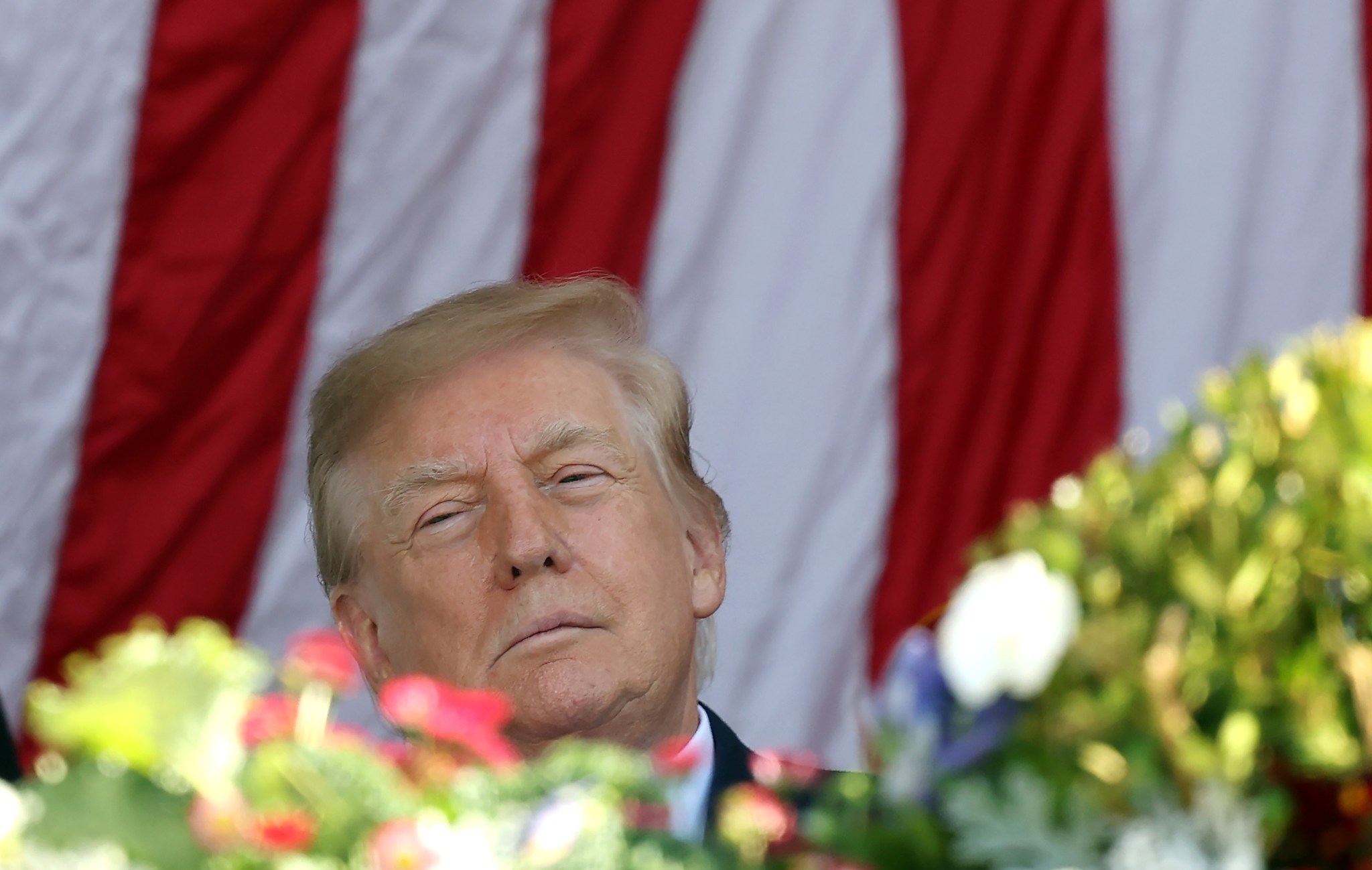
President Donald Trump is calling for an investigation into economic data released by the Commerce Department before the November midterm elections that the agency revised this week. On Wednesday, the Commerce Department’s Bureau of Economic Analysis revised its third quarter report to reflect that the U.S. economy grew 4.3% from July to September, rather than […]
In a Thanksgiving post, the US president seeks investigation after blue wave of Democrats unseat Republicans Donald Trump has alleged without evidence that economic figures published by the US federal government before this month’s midterm elections were “fake” and demanded an investigation after voters roundly rejected his Republican party. In a holiday message on social media tinged with bitterness, the US president wished a happy thanksgiving “to even those who issued fake Economic Numbers, just prior to the Election, and corrected them yesterday, three weeks late, showing that the GDP was actually 4.3%, versus 3.4%”. Continue reading...
President Donald Trump called for an investigation into the Bureau of Economic Analysis after third-quarter US GDP growth was revised up 0.9 percentage points to 4.3%.
President Trump raged against the timing of a stunning revision showing that the economy grew about 0.9 percentage points more than previously thought during the third quarter, grumbling that the good news came after the midterms.
President Donald Trump is suggesting without evidence a conspiracy within the government to report upwardly revised economic growth figures after the midterm elections that were disastrous for Republicans
President Donald Trump on Thursday accused his Commerce Department of purposely issuing incorrect economic growth figures before the midterm elections, and said he wants to launch an investigation.
President Trump called for an investigation into the government's economic statistics on Thursday, alleging without evidence that growth figures released before the midterm elections were deliberately understated. Why it matters: Revisions to GDP are routine and reflect more complete information that becomes available after the initial estimates are published. The allegations could renew concerns about political interference in the production of critical economic data that underpin trillions of dollars in investment decisions and Federal Reserve policy. What they're saying: The Bureau of Economic Analysis on Wednesday substantially revised the third-quarter GDP data, reflecting a 4.3% annualized pace of growth, up from the 3.4% reported less than a week before the midterm elections. Trump claimed in a Thanksgiving morning Truth Social post that the initial figures were "FAKE." "Why wasn't the correct number issued before the Election? I am asking for an immediate investigation of this situation," Trump wrote in the post, calling it a "massive, and purposeful, error." The intrigue: Government statistical agencies operate under longstanding standards that are aimed at insulating career economists and statisticians from political influence in the collection and dissemination of economic data. But it's not the first time an agency has come under Trump's fire anyway, following his dismissal of the Bureau of Labor Statistics commissioner last year over revisions to jobs data. This time, however, the agency that released GDP and other key economic data is housed within the Commerce Department — led by one of Trump's closest political allies, Howard Lutnick. Friction point: There is a legitimate debate about how to improve the timeliness and accuracy of government economic data. But that is fundamentally different from Trump's allegation that federal statisticians deliberately misrepresented the strength of the economy. How it works: The initial GDP figure is not supposed t
President Trump on Thursday called for an investigation into economic data released ahead of the midterm elections after the federal government revised its estimate of third-quarter growth upward. The president, in a Thanksgiving Day post on Truth Social, alleged without providing evidence that the initial gross domestic product (GDP) figures were deliberately understated. “Why wasn’t…
President Donald Trump accused his own administration of a “purposeful” move to under-report US economic growth, seizing on a routine data revision to underpin an allegation of election interference with no evidence.
Three things can be true at once. First, America’s artificial intelligence buildout is of existential importance to our economy. Without it, we’d likely be in a technical recession, when GDP falls for two consecutive quarters (six months). We’d be unable to achieve the productivity gains necessary to compensate for our aging population and rising interest […]
Wall Street has been reeling amid fears about the future of the AI boom. But in the here and now, the U.S. economy is experiencing an outright boom. The big picture: Growth was even stronger this summer than it appeared, and the robust expansion is continuing this fall, according to a range of data released Wednesday morning. That is pushing Americans' incomes up and the pace of layoffs down. The strong data helps explain why the Federal Reserve is prepared to raise interest rates two weeks from now even in the face of financial market turbulence. Driving the news: The U.S. economy grew at a 4.3% annual rate in the July-through-September quarter, according to the second revision to GDP data — well above the 3.4% originally reported. The strong results have continued into Q4. The Commerce Department separately said that personal income rose 0.7% in October, well ahead of analysts' expectations. Overall orders for durable goods came in below forecasts for October, but core capital goods orders — a forward-looking measure of investment spending — climbed 1.2%, also well ahead of projections. The Labor Department said that only 189,000 people filed new claims for jobless benefits last week, matching the lowest of 2026 and among the lowest readings on record (claims go back to 1967). Zoom out: The Q3 GDP reading was powered by business investment, especially for software, showing that the AI buildout remains a powerful driver of overall economic growth. It wasn't driven by volatile components of GDP like inventory and trade swings; real final sales to private domestic purchasers surged at a whopping 5.8% pace, and gross domestic income — conceptually similar to GDP — rose at a 4.4% rate. Translation: This isn't some fluky reading, but rather a sign of underlying robustness. Rapid growth looks set to continue in Q4; the Atlanta Fed's GDPNow tool estimates current-quarter growth at 2.9%. Zoom in: Nonresidential fixed investment — the GDP subcategory that covers capital spe
Data: Bureau of Economic Analysis ; Chart: Courtenay Brown/Axios The U.S. economy grew substantially faster this summer than initially thought, the government said Wednesday — a blockbuster upgrade to its estimate of third-quarter GDP. By the numbers: The economy expanded at a 4.3% annualized rate, up from the 3.4% initially reported and nearly twice the rate of 2.2% in the second quarter. Why it matters: The economy has even more momentum than previously understood, a sign of remarkable resilience in the face of higher borrowing costs and stubborn inflation that could give the Fed more latitude to raise rates. Zoom in: The upward revision reflected stronger business investment fueled by the AI buildout and software investment, as well as consumer spending. A measure of underlying private-sector demand — which strips out trade, inventories and government spending — rose at a whopping 5.8% annual rate, up from the 4.9% initially reported. The backdrop: Separate data out Wednesday showed personal income jumped 0.7% in October while inflation-adjusted consumer spending stalled, pushing the saving rate up to 4.1% from 3.6% the prior month. The personal consumption expenditures price index — the Fed's preferred inflation gauge — climbed 3.8% from a year earlier, from 3.6% in September. Core inflation, which excludes food and energy, accelerated to 3.3% from 3.1%. On a monthly basis, both headline and core prices rose 0.3%. The bottom line: The U.S. economy was on remarkably strong footing heading into the end of the year, though inflation remains stubbornly high. Editor's note: This story has been updated with additional details.
The Commerce Department released its second estimate of third quarter GDP which showed the economy grew at a solid annualized rate of 4.3% in the quarter.
It is possible for democracy to reverse the dynamic of oligarchy. But we must act now The explosion of extreme wealth in the world is the defining social fact of our times. When Forbes magazine began ranking the world’s largest fortunes in 1987, the wealth of the richest 0.0001% of our planet’s population equaled 3% of global GDP. Since that time, the wealth held by this tiny group of people – just 3,000 households – has ballooned and now reaches 17% of global GDP. Continue reading...
Singapore further raised this year’s growth forecast as the artificial intelligence boom delivers a larger-than-expected lift to the economy, defying the drag from higher oil prices and the recent tech selloff in the stock market.
The midterm elections delivered a message to Washington it had long ignored: People vote on economic realities, not economic datasheets. Affordability was the defining issue that fueled the Democrats’ takeover of Congress. In a Business Insider poll, only 2% of voters described the economy as “excellent.” 59% were “very concerned” about gas prices, 88% were […]
Prime Minister Andy Burnham speaks at a news conference in Brussels after the UK and European Union reached a set of deals to deepen their post-Brexit relationship. "The UK Treasury has said that the deal struck here will add up to 0.5% to UK GDP. That is a £17 billion boost to the British economy," Burnham says. (Source: Bloomberg)
In spite of stock market volatility, the shenanigans at Nvidia, and the unsettling pattern of technology disruptions, the U.S. economy continues to power ahead. In the third quarter of this year, GDP growth registered at 3.4%. Forecasts for the current quarter suggest more of the same: GDP growth modestly above 3%. Recent economic data are […]
Nigerian authorities are attempting to clean up the mining sector in a country whose subsoil is rich in deposits of uranium, gold and lithium. The vast majority of these resources are mined illegally, meaning billions of euros are not included in the national GDP. Two years ago, the Nigerian government launched a paramilitary force, The Mining Marshals, to fight this illegal activity. Our Nigerian team visited an informal mine and then accompanied a patrol of Mining Marshals, here is their Report.
Prime minister is to meet European leaders at summit this week and secure agreements that ‘could raise GDP by 0.4%’ Andy Burnham will say on Monday that Brexit “has not worked” and that he will sign a new deal with the EU. It is the latest in a string of comments by the prime minister criticising Brexit, after he told the Welsh Labour conference on Saturday that the UK has “lost more than we gained” through leaving the EU. Is consistent with the Labour manifesto and the government’s red lines. It improves the Brexit deal and brings it closer to what people thought they were voting for in 2016. And it passes the so-called “Makerfield test” by delivering real, tangible improvements in people’s everyday lives. Continue reading...
China’s Singles’ Day online shopping event, which rivals Black Friday in the United States, posted sluggish sales this year as consumer optimism lagged far behind reported GDP growth. Chinese consumers are reportedly still worried about the depressed real estate market and would rather save than spend on the biggest retail day of the year. The post China’s Big ‘Singles Day’ Shopping Event Struggles as ‘Optimism Over Recovery’ Fades appeared first on Breitbart .
Many are shocked at the $9 million deal that quarterback Kamario Taylor is set to rake in at Mississippi State. The post Kamario Taylor Reportedly Raking in $9M in Shocking NIL Deal: ‘More Than the GDP of Mississippi’ appeared first on Breitbart .
"The investment we have is so huge as a percentage of the [U.S.] GDP, they're already too big to fail. They became too big to fail almost instantly in 2023."
Kamario Taylor has had an outstanding season with Mississippi State so far, and the quarterback is reportedly being rewarded with a mega contract that would put him in the elite league of QBs in college football. According to reports, Taylor is set to receive a bumper offer to stay at Mississippi State, an amount that would be in the region of $7.
ONS also says GDP rose 0.2% month on month in September, in a boost to the chancellor, John Healey The UK economy grew by 0.7% in the third quarter, as expected by City analysts, confirming that consumers and businesses remained resilient despite high oil and gas prices. The Office for National Statistics said a jump in the cost of petrol, diesel and natural gas prices following the re-escalation of the conflict in the Middle East played an important role in restricting economic growth in the three months to the end of September. Continue reading...
Friday’s jobs report was a rout. Employers added 165,000 jobs in October, 100,000 more than economists expected, and the unemployment rate fell to 4.1%. Third-quarter GDP grew at a 3.4% annual rate in the first estimate. By any scoreboard, the economy is producing. Yet here in California, gas topped $6 a gallon in late September, […]
"To me, the biggest warning sign from France is really not just the K-shaped economy effect, but the generational effect that's going on and to see young people really driving this latest protest."
Demographics are destiny. The foundations of the European Monetary Union, which provides the financial underpinning for the European Union, and its central bank, the European Central Bank, are increasingly fragile. Without significant structural reforms in its member countries, the EMU will unravel. Across the currency union, public spending on pensions hovers around 12% of GDP. […]
The U.S. economy expanded at its fastest clip in over five years during the third quarter, according to the Commerce Department’s initial reading on GDP. Yet despite a barrage of robust data, Treasury bonds staged a surprise rally in October.
Derek Halpenny, MUFG global markets research head, tells Bloomberg Television artificial intelligence is "everywhere" in GDP data in the United States. "The US is very exposed, very dependent to a continuation of the very positive story that we have on AI," he says, adding that the dollar is also vulnerable. (Source: Bloomberg)
"We’re not in hawkish or dovish land. What’s happening is yield curve management, which itself is a function of how precarious the U.S. debt picture is."
There was a mixed Halloween bag of economic news this week. GDP growth is up, but so are prices. For now at least, interest rates are staying the same. What does that mean for the midterm elections?
Defence secretary says value for money and modernisation key for defence spending to ‘fight the wars ahead’ Wes Streeting started stockpiling food and water in case of a national emergency weeks ago, the defence secretary has said, as he talked up the threats to the UK and said his department has already begun ramping up its spending in response. Streeting spoke after the chancellor, John Healey, said he wanted defence spending to reach 3% of GDP by 2030 and 3.5% by 2035; having already asked Whitehall departments to find 1% cuts in their budgets for long-term investment to fund defence spending. Continue reading...
The national debt topped the entire gross domestic product (GDP) for fiscal 2026, according to new data from the Bureau of Economic Analysis (BEA). From the fourth quarter of 2025 through the third quarter of this year, the country’s economic output was more than $32.2 trillion, according to the BEA’s non-seasonally adjusted statistics. As of…
The economy grew 3.4 percent in the third quarter, the fastest pace in a year. Strong spending and growth contrast with the poor marks many voters are giving the economy.