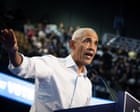
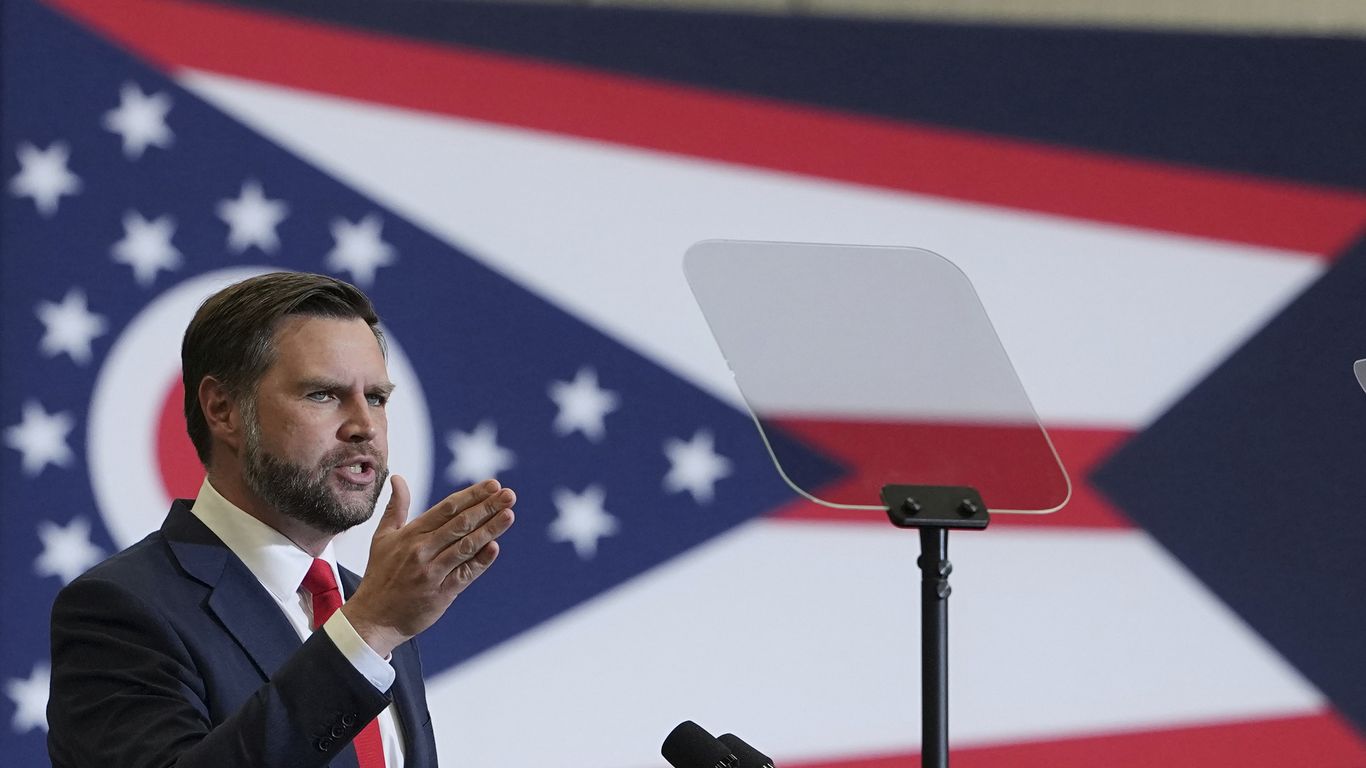
Former president has given series of blistering speeches to help candidates in key races – and deployment has proved a hit with party’s progressive wing That could have been awkward. Barack Obama , campaigning for Senate candidate Abdul El-Sayed in Michigan, acknowledged that his fellow Democrat has criticised some aspects of the Obama presidency. “Yeah, Abdul didn’t agree with some things we wanted to do – that our administration was doing – when I was president,” he told a rally in Detroit . “You know who else doesn’t agree with everything I do? Michelle Obama.” The crowd erupted in laughter. “I’d say about five times a day, she says, ‘You knucklehead. Why you do that?’” Continue reading...
Results for “democrats”
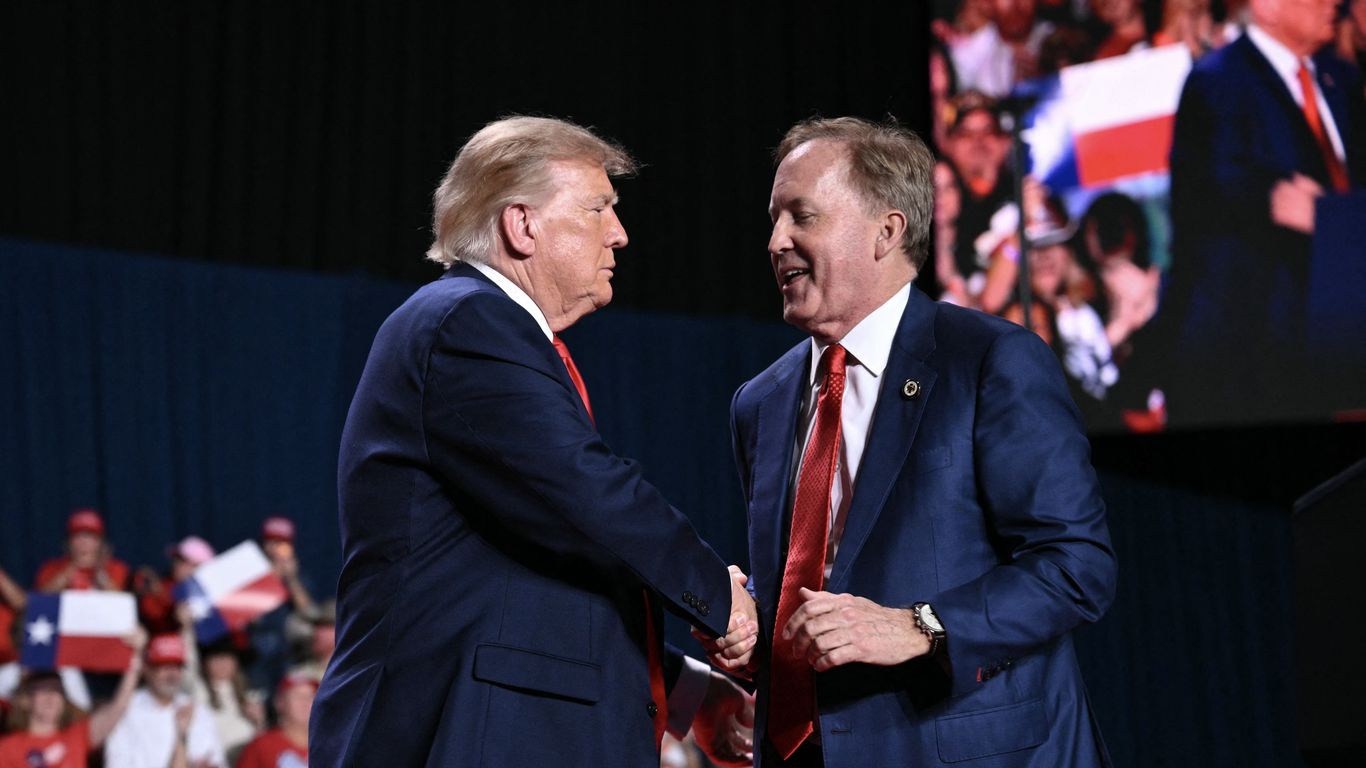
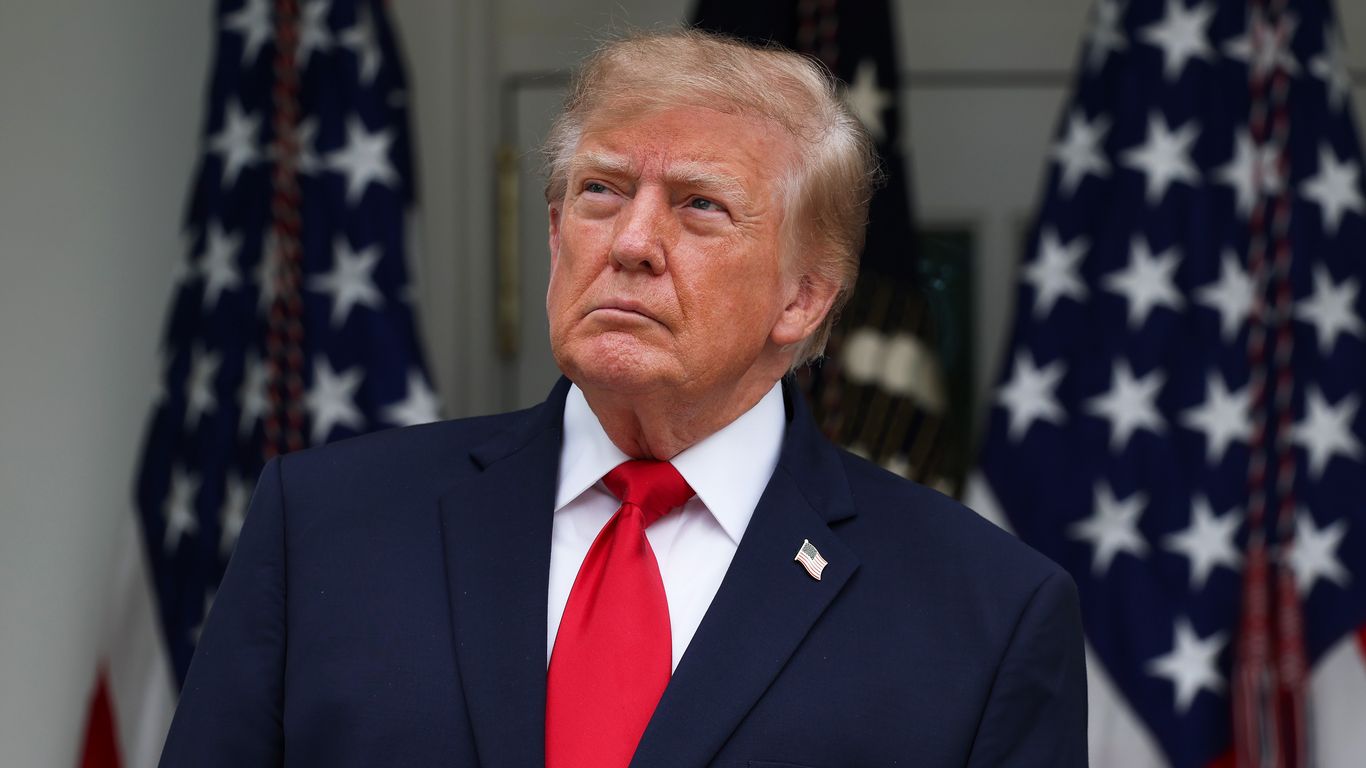
Donald Trump uttered five words this summer that could seal the Republican party’s fate: ‘Pretend I’m on the ticket’ He spoke admiringly of a senator’s posterior. He baselessly accused a Muslim candidate of being a terrorist . He boasted about his renovations of the White House. He quipped that his own supporters couldn’t afford a hamburger at his Mar-a-Lago club. Every now and then, he spoke about the cost of living, and other everyday concerns of voters. Donald Trump has held dozens of campaign rallies before next week’s US midterm elections. The 80-year-old remains convinced that he can prove the doubters wrong again and help Republicans retain control of the US Congress. But it was five words he uttered at this summer’s Republican convention in Dallas that could seal his party’s fate: “Pretend I’m on the ticket.” Continue reading...
Voting sites in 18 far-flung communities failed to open, the suit claims.
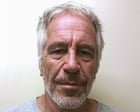
But select Democrats, too, are being accused of having ties to the late sex offender as country prepares to vote In races across the country, Democratic candidates or groups that support them have released ads accusing Republicans of protecting pedophiles by voting against legislation to release files related to Jeffrey Epstein . The ads appear intended to evoke an emotional response by accusing candidates of “protecting” Epstein, a notorious pedophile accused of running a sex-trafficking ring involving minors. Continue reading...
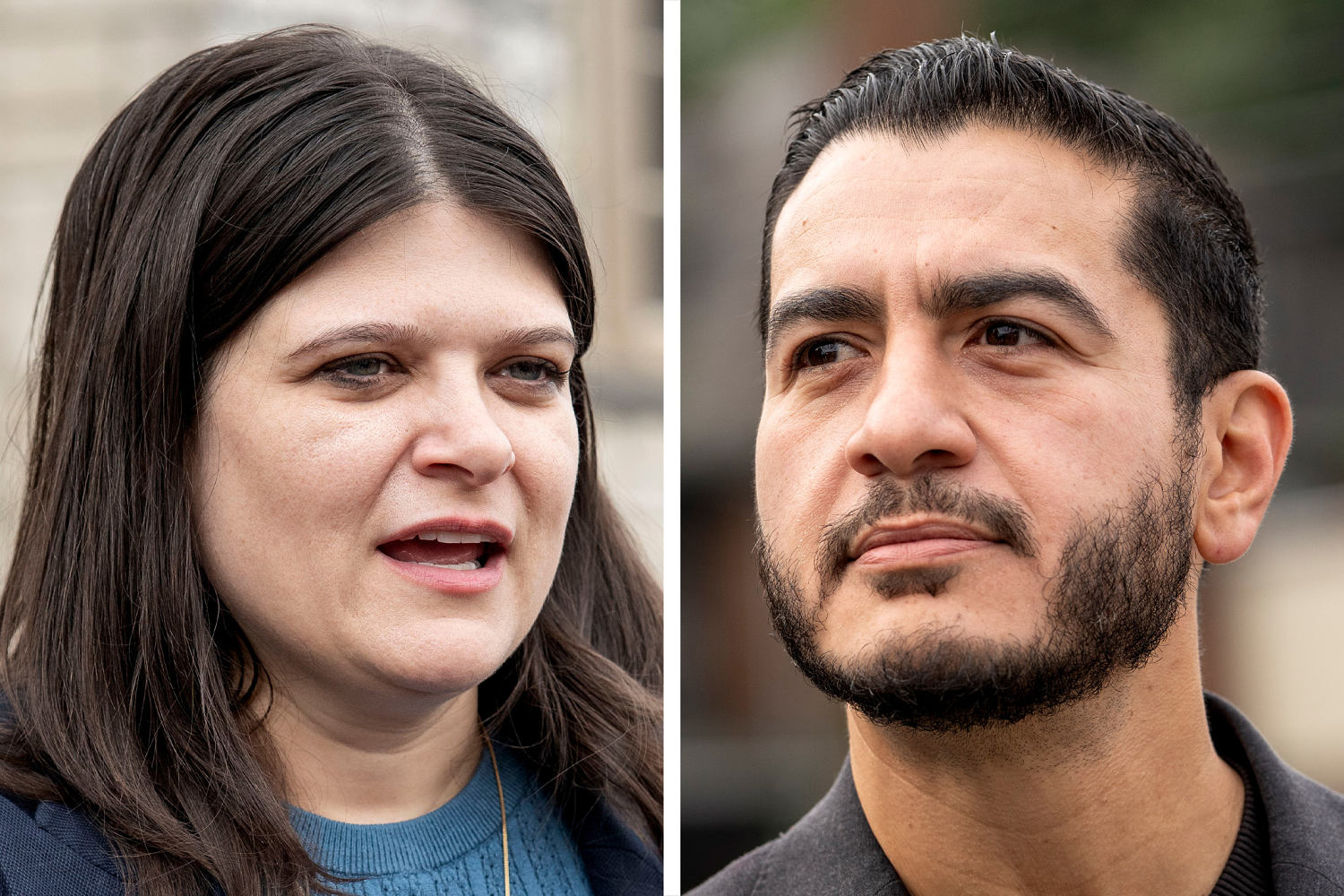
With control of Congress on the line, next week’s midterms amount to a referendum on Trump, who has urged voters to pretend he is on the ballot Sign up for the Breaking News US email Hello and welcome to the US politics live blog. Donald Trump is tele-rallying from Mar-a-Lago with just three days to go before the midterm elections. On Sunday, he will make appearances at rallies in Iowa in Kansas in a reversal after he initially backed out . The top federal prosecutor in Alaska confirmed on Friday the existence of a criminal and a civil investigation into an alleged scheme by Mary Peltola’s campaign and national Democrats to confuse voters in the closely watched Senate race by recruiting a spoiler candidate who shares a name with the Republican incumbent, Dan Sullivan . Michigan Democratic Senate candidate Abdul El-Sayed resisted a demand from his defeated primary rival, congresswoman Haley Stevens , that he apologize for criticism of US military aid to Israel on Friday – two days before they were scheduled to campaign together in Detroit. Early voting this cycle has set a record. More than 49 million Americans have already cast ballots, either in person or by mail, the Associated Press reported. Continue reading...
You won't need to stay up all night Tuesday to spot a big Democratic wave in the 2026 midterm elections . But it could take days — or even weeks — to know whether Republicans have survived a smaller one and held on to the House or Senate. Why it matters: A handful of early results in key states and congressional districts will tell us whether Democrats are headed for a landslide or disappointment. What we're watching: Florida, Florida, Florida. Most polls close at 7pm ET, and the state counts quickly — ready for release when the Panhandle finally calls it a night an hour later. At 8:01pm , refresh your browser and watch FL-14. The great mid-cycle redistricting wars transformed this Tampa-based district from Harris +8 to Trump +11. If Democratic Rep. Kathy Castor survives, Republicans can all but kiss their majority goodbye, according to party strategists. Next up is FL-25. The country's most expensive general election race is playing out in a district that went from Harris +4 to Trump +9. If Democratic Rep. Jared Moskowitz's race is close — or too close to call early in the night — House Republicans can keep hope alive. While you're at it, this is a good time to check on South Carolina's Senate race, where polls close at 7pm and the state counts relatively fast. If Sen. Darline Graham loses to Annie Andrews in the Trump +18 state, Senate Republicans can say goodbye to their majority. (And they'll be sweating if it's close.) "Underperformance is rarely isolated," said Jason Thielman, executive director of the National Republican Senatorial Committee in 2024. "If you see the GOP underperforming early in the East, it is likely going to continue as you move further West." At 9pm, check in on Virginia: The commonwealth's polls close at 7pm, but historically tight races often aren't called until the 9pm hour. If Democrats flip VA-01, a Trump +5 seat, they're in for a very good night. If they flip VA-05, a Trump +12 seat, they're in for a great night. Between the lines: VA
The unprecedented measure has enormous potential nationwide. The clash exposes the party’s corporate-progressive divide Midway through this summer, a high-quality poll found that Democrats in California were overwhelmingly in favor of the upcoming ballot measure for a one-time 5% tax on billionaire wealth. The ratio was more than 4 to 1. But the state’s most powerful Democrats – including the governor Gavin Newsom, his near-certain successor Xavier Becerra and the Los Angeles mayor Karen Bass – have lined up with Silicon Valley billionaires who’ve raised upward of $340m to defeat the initiative. Continue reading...
Dr. Letitia Plummer has been polling ahead in the race to lead Harris County, where turnout could decide statewide races.
The tensions between the former Democratic primary candidates have drawn in other Michigan Democrats as the party hopes to secure a critical Senate seat.
US attorney Michael Heyman cited reports that Mary Peltola’s Senate campaign and Democrats allegedly ‘orchestrated a sprawling conspiracy’ to recruit a sham candidate Sign up for the Breaking News US email James Talarico, the Democratic nominee in Texas, attacked his Republican opponent Ken Paxton for cancelling some of his final rallies before the midterm election. “No one’s going to Ken Paxton’s rallies, so he’s canceling them and hoping Elon Musk will buy his seat for him,” Talarico wrote, referencing the donations Paxton has received from the world’s richest man. Continue reading...
In a podcast interview, she asserted that criticism of Israel from some prominent Democrats did not reflect the views of the party itself.
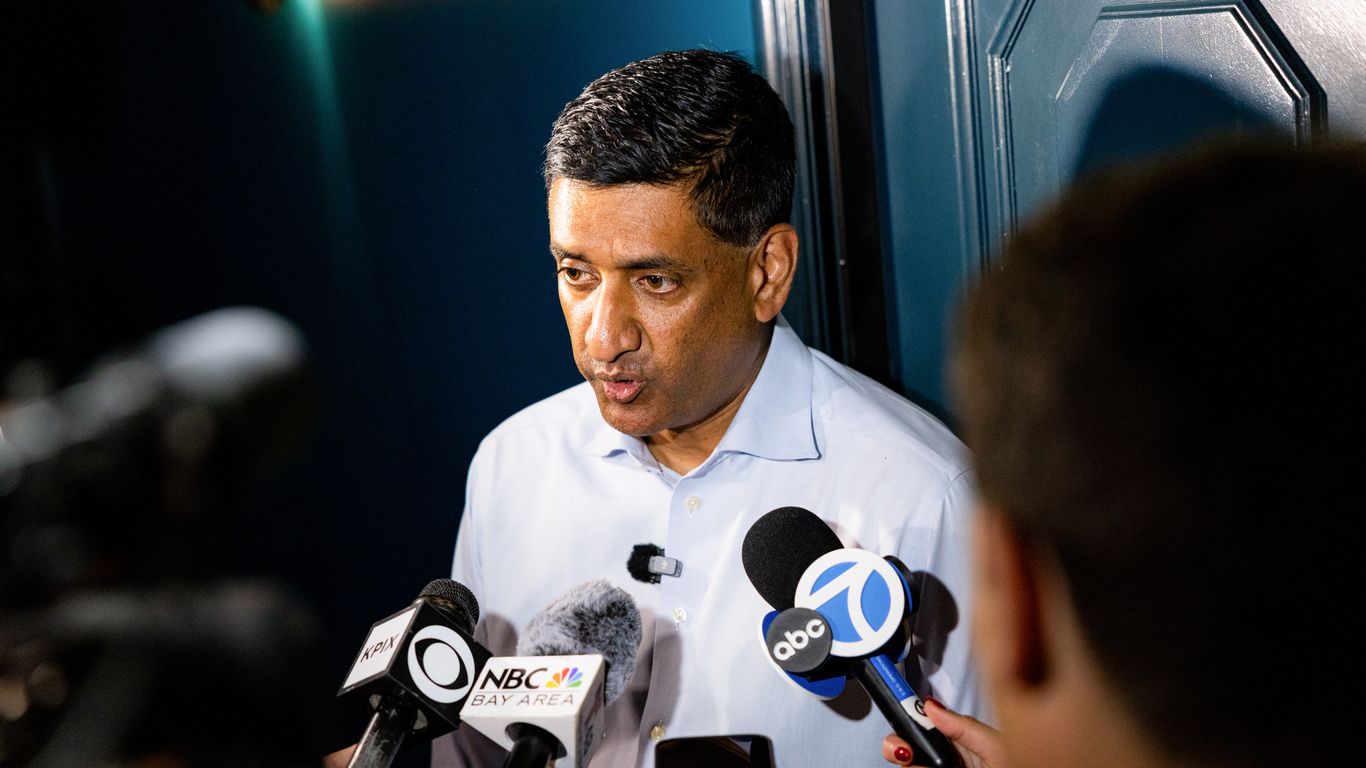
Rep. Ro Khanna (D-Calif.) is endorsing a trio of insurgent Democratic candidates who are challenging his fellow California House Democrats, Axios has learned. Why it matters: This is an aggressive move by a potential 2028 presidential contender who styles himself as one of the few Democrats willing to get into direct confrontations with the party establishment. He has backed members of the progressive "Bloc" who have refused to commit to voting for Minority Leader Hakeem Jeffries (D-N.Y.) as speaker. This is territory where even other high-profile House progressives — including Rep. Alexandria Ocasio-Cortez (D-N.Y.), another potential 2028er — have largely refused to tread. Driving the news: "Today I'm endorsing three new generation leaders Angela Gonzales-Torres, Eric Jones, and Mai Vang," Khanna said in a statement first shared with Axios. Gonzales-Torres, a former local elected official challenging Rep. Jimmy Gomez, "will join us in our fight against corruption, to stand up for survivors, and to lead with a moral vision," Khanna said. Khanna said he has known Jones — a venture capitalist running against Rep. Mike Thompson — "for many years," calling him "a change agent who understands the working class and building a better life for those left out." Vang, a Sacramento City Council member running against Rep. Doris Matsui, "will call out the genocide in Gaza, be for taxing billionaires, and stand for Medicare for All and the working class," Khanna said. Between the lines: Khanna said he has a "tremendous respect and admiration," for Thompson, 75, who has been in office since 1999. "But voters are crying out for change." Khanna said of Matsui, 82, who has held her seat since 2005: "I respect Doris Matsui's incredible service to our state and nation. This is the time to pass the baton." Jones is 35. Vang is 41. Khanna did not reference Gomez, who is under investigation by the House Ethics Committee over allegations of sexual misconduct. Gomez has admitted to "person
Mr. Musk’s rhetoric, heated as it is, partly explains why he has spent nearly $475 million to back Republicans in the midterms.
Immigrants at Texas detention facility, protesting against harsh conditions, say they face threats of force-feeding Members of Congress sent a scathing letter to federal immigration officials this week demanding answers about conditions inside a Texas immigration jail, as detained immigrants on a prolonged hunger strike claim officials are retaliating against them and threatening them with force-feeding. A group of seven congressional Democrats sent the letter earlier this week to Markwayne Mullin, the Department of Homeland Security (DHS) secretary, and David Venturella, the Immigration and Customs Enforcement (ICE) acting director, protesting about the treatment of hunger strikers. Continue reading...
Democrats weighing 2028 presidential bids are piling onto the AI hate wave in their messaging, per an analysis shared exclusively with Axios. Why it matters: Democrats are turning AI anxiety into a political rallying cry ahead of 2028, while Republicans remain divided over how to respond. Driving the news: 2028 contenders including Gavin Newsom, Alexandria Ocasio-Cortez, Kamala Harris, Pete Buttigieg, Jon Ossoff and more have all increased their AI commentary in recent months, per new research from Upswing, conducted on behalf of Reset Tech, a nonprofit advocating for tech regulation. Among 21 Democrats named as potential 2028 contenders, tech mentions on X nearly quadrupled, and press release mentions nearly tripled since the start of the year. Tech is now the second-most common topic in releases, trailing only jobs and the economy, with the highest concentration of mentions around data centers and phone bans in schools. To gather the data, Upswing analyzed nearly 30,000 X posts from 38 accounts associated with 21 potential presidential contenders and 3,868 press releases from 16 officeholders between Jan. 1 and Oct. 15. Between the lines: Democrats are galvanizing around AI as a winning issue. Democrats are "taking a meaningful advantage" on AI after the topic was initially seen as a "jump ball" for both major political parties, Rishi Bharwani, U.S. director of Reset Tech, told Axios. AI regulation has gone from the back burner to a top issue over the last six months, he added. While the economy is still what matters most to voters, AI is increasingly part of the financial conversation as it dominates markets and the macroeconomic backdrop. Zoom in: It's not just messaging. While data center bans have been proposed in Democratic- and Republican-majority states, New York is so far the only one to pass a moratorium. House Democrats drafted a resolution opposing government bailouts for AI companies if the so-called "bubble" bursts. There are also a variety of legisla

President Trump's energy policies and investment deals could become major targets of Democratic investigations if the party wins control of either chamber of Congress. Why it matters: Congressional probes could expose new details about the administration's dealings with major companies and foreign governments. What they're saying: House Democrats are likely to take a "shotgun" approach of "throwing everything out there and then seeing what sticks in the realm of popular opinion," TD Cowen analyst John Miller said via email. Democrats will be looking for agencies that exceeded their authority, deals involving administration officials' families, or both, Miller said. The big picture: Scratch the surface of Democrats' biggest potential oversight targets, and energy is everywhere. Russia. Trump's dealings with Moscow will again be front and center — and so will the energy dimension. Democrats in both chambers are likely to investigate Trump's diesel deal with Moscow, which they claim violates a 2022 law barring imports of Russian fuels. The inquiries could also extend to U.S. banks and ports, which lawmakers have already warned could face congressional investigation. Venezuela. "We expect Venezuela to be the subject of a number of inquiries," RBC Capital Markets analysts said in a note. Democrats have already raised questions about whether any oil companies knew about plans to depose Nicolás Maduro. Investigations could also examine the legality of the Pentagon's 35% stake in the corporate parent North American Blue Energy Partners and the terms of the deal, the note states. The Iran war. High gasoline and diesel prices give Democrats another reason to scrutinize the decision to attack Iran, especially if pain at the pump persists. Sens. Sheldon Whitehouse (D-R.I.) and Elizabeth Warren (D-Mass.) have already pressed major oil and gas companies about their profits during the conflict. AI and data centers. Wider and intense oversight of AI will touch on data centers' ener
America's corporate titans greeted President Trump's 2024 victory with open checkbooks , 12-figure investment pledges and fawning tributes to his coming "Golden Age." Two years later, on the eve of a potential blue wave, Democrats are preparing to greet those same executives with a stack of subpoenas . Why it matters: The CEOs who staked their reputations and fortunes on MAGA's staying power could spend the final two years of Trump's presidency defending their dealings under oath. The big picture: A Democratic House would carry its campaign against billionaire power and corruption deep into corporate America, scrutinizing the relationships between Trump's White House and the executives who courted him . Corporate leaders now face a delicate balancing act: rebuilding ties with Democrats while avoiding retaliation from a president who still controls federal contracts, tariffs and regulators. Already, companies that scrambled to dismantle DEI programs or fund Trump's ballroom are hiring Democratic lobbyists , pushing back against the administration and rediscovering the virtues of bipartisanship. Zoom in: Elon Musk is taking a more confrontational approach. The billionaire, who has poured $445 million into Republican super PACs this election cycle alone, has threatened retaliation against Democrats preparing to investigate his sprawling business empire and tenure in the White House. DOGE: As head of Trump's short-lived cost-cutting initiative, Musk gutted USAID, drove mass federal layoffs and gave his team access to sensitive government systems. Investigators want to know whether his companies benefited from contracts or regulatory decisions while he wielded power inside the White House. Ukraine: A fierce critic of President Volodymyr Zelensky, Musk ordered Starlink restrictions that disrupted Ukraine's military satellite communications. Democrats are now demanding records of his communications with Trump and Vladimir Putin . Musk responds to reports that Democrats pla
A bipartisan deal to speed energy development is facing concerns it could favor natural gas over renewables because of President Trump's opposition to wind and solar. Why it matters: The worries from Rep. Sean Casten (D-Ill.) could complicate efforts to pass the bill before year's end, highlighting divisions even among Democrats who have long supported permitting reform. Driving the news: Casten, a former energy executive and leading Democratic voice on permitting reform, said he isn't yet backing the bill and is negotiating changes with Senate Democrats to prevent it from disproportionately benefiting natural gas. "My test for the bill is: I talk to energy developers, and ask, 'What would you build in response to this bill?' And the answer I get overwhelmingly is a lot of gas," Casten told Axios on stage at a University of Chicago event Wednesday. "I think you have to look at the bill in the context of everything else that the Trump administration has done." The big picture: The AI boom is fueling demand for electricity, prompting a rush to build natural gas power plants alongside renewable energy projects. The permitting deal could help determine which technologies benefit most from that expansion. Catch up quick: The bill, sponsored by two Republicans and two Democrats who lead the Senate's energy and environment committees, would speed construction of power lines and other energy infrastructure. An initial procedural vote is scheduled for Nov. 9, shortly after the midterm elections, setting up a potential push to pass the legislation before the new Congress takes office. Threat level: The bill aims to prevent political favoritism in energy permitting, but Casten worries one provision could have the opposite effect. It would allow developers to challenge discriminatory permitting decisions in part by comparing them with decisions made over the previous five years. Casten argues that as Trump's second term becomes part of that historical benchmark, the administrat
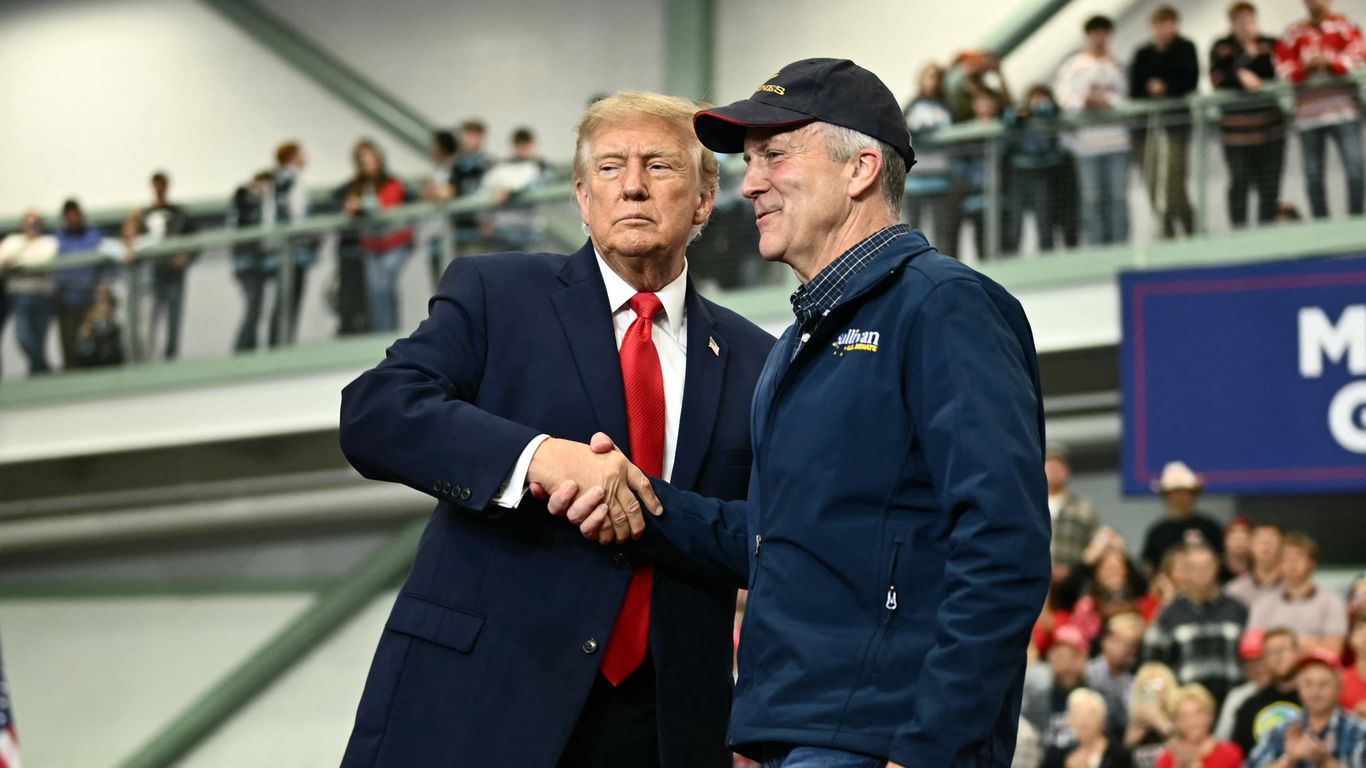
Alaska Gov. Mike Dunleavy (R) suggested Thursday the state could withhold certification of the U.S. Senate election results if Democrat Mary Peltola wins. Why it matters: Withholding certification could complicate Peltola's path to the Senate, as Republicans investigate allegations that Democrats recruited a candidate with the same name as GOP incumbent Dan Sullivan . Driving the news: Asked during an interview with NewsNation whether he would certify the election if Peltola wins while the matter remains under investigation, Dunleavy stopped short of committing to do so. "We're going to investigate it. We're going to follow the law," Dunleavy said, adding that any findings of illegal conduct "may in fact impact whether somebody is seated in the U.S. Senate." He said the matter would involve discussions with Senate leadership and that officials would need more information before determining "whether we send something down or not." Pressed on why he had not given an unequivocal yes, Dunleavy said: "We're going to ensure that we aren't going to send a scam to Washington." For the record: Peltola has denied any involvement in the alleged scheme. What they're saying: "Dunleavy's threat to overrule the will of Alaskan voters exemplifies what Alaskans hate about partisan politics and shows why he's the least popular governor in the country," a spokesperson for the "Alaskans for Mary" campaign said in an emailed statement Thursday night. "Mary won't be intimidated by Dunleavy, Sullivan, or any of their DC allies who are trying to steal this election from Alaskans before votes are counted — and she's going to win this race by focusing on solutions to Sullivan's price hiking policies and putting Alaska first." The big picture: House Oversight Committee Chair James Comer (R-Ky.) is investigating allegations that Democratic operatives recruited another candidate named Dan Sullivan to draw votes away from the Republican incumbent. President Trump accused Democrats and Peltola's
Democrats' main Senate super PAC is privately telling top donors that Texas offers their best shot at flipping a deep-red Senate seat, followed by Ohio, where the race remains close. Senate Majority PAC also sees victories in Iowa and Alaska as within reach, though the outcomes could take longer to become clear. Why it matters: Democrats are increasingly confident about Election Day on Tuesday — and sharing their qualified optimism with their biggest donors. To retake the Senate, Democrats need to win two of those four states — all of which Trump won by double digits in 2024 — flip North Carolina and Maine, and avoid an upset in Michigan. JB Poersch, president of Senate Majority PAC, projected confidence that Democrats will wrest control of the Senate from Republicans during a private donor briefing this week as he walked through the races state by state. He also reminded donors that Kansas, where even Republicans are deeply worried, is a state Trump won by roughly 16 points in 2024. But it's in play . What they're saying: "This matches what we've been saying publicly and privately for weeks. There are signs of optimism in Texas, but it remains a toss-up, as do Iowa, Ohio and Alaska," said Lauren French, a spokesperson for SMP. "There is positive movement for Democrats, but it is critical to remember that every seat on the battleground map voted for Donald Trump by double digits," she said. "These are deep red states and we're focused on bringing them over the finish line so the Senate can work to provide real relief to families who are being crushed by the cost-of-living crisis." The big picture: Texas hasn't elected a Democratic senator since Lloyd Bentsen in 1988. Democrats thought they'd end the drought in 2018 and let themselves fall for then-Rep. Beto O'Rourke, who lost to Sen. Ted Cruz by 2.6 percentage points. Four years later, O'Rourke tried again to prove a Democrat could win statewide in Texas. He lost the governor's race by nearly 11 percentage points. T
Alaska's tight Senate race is facing a new controversy over two candidates named Dan Sullivan appearing on the ballot — a twist that's drawn attention from President Trump . The big picture: The controversy is adding uncertainty to one of the nation's most competitive Senate contests, with control of Congress on the line in next week's midterm elections. Catch up quick: The New York Times reported this week that Democratic operatives with ties to Mary Peltola's Senate campaign helped recruit a candidate named Dan J. Sullivan to challenge Republican incumbent Dan S. Sullivan. Trump accused Peltola and Democrats of election fraud and called for criminal prosecution, though the Times did not establish that any laws were broken. Alaska Gov. Mike Dunleavy ordered an investigation into Peltola's campaign over the NYT report. House Republicans are also launching an Alaska Senate race probe. Though the presence of two Sullivans in the Senate race has been known for months, the Times' report adds a new wrinkle to a dispute that's already reached the courts. Here's what to know about the controversy. The same-name Senate race controversy The controversy centers on two candidates with nearly identical names appearing on Alaska's Senate ballot: Republican incumbent Dan S. Sullivan and unaffiliated challenger Daniel J. Sullivan Jr. The ballot will show registered Republican "Sullivan, Dan S." and unaffiliated candidate "Sullivan, Daniel J. Jr." Peltola and Republican Gerald Heikes will also be on the ballot. The challenger initially filed as a Republican but later changed his registration to undeclared. He will appear on the ballot without a party label. Flashback: Concerns about the duplicate names have existed for months. In June, a top Alaskan election official ruled that candidate Daniel J. Sullivan was ineligible to run on the state's primary ballot. The official said she found the candidacy was "filed with a purpose to confuse or mislead and to thereby compromise the ballo
The Michigan Senate candidate is calling for public ownership and other reforms, offering a potential antidote to ideological gridlock The Michigan senatorial candidate Abdul El-Sayed, a Democrat, occupies a strange but increasingly common place in modern American politics. He’s praised by progressives, begrudgingly tolerated by moderate Democrats and largely demonized by Republicans. He’s also uniquely positioned to forge an all-too-elusive thread of political kinship between these perpetually-at-odds groups with his bold but contentious plan for reining in AI, called AI Under Democracy . Continue reading...
President Trump accused Democrats and Mary Peltola's campaign of fraud and perjury Wednesday after the New York Times reported that Peltola aides helped recruit another candidate named Dan Sullivan. Why it matters: The revelations add a new twist to Alaska's tight Senate race, where a second Dan Sullivan on the ballot could complicate the Republican incumbent's reelection bid. Zoom out: "Mary got in this race because Alaskans deserve a champion who is fighting to lower their costs and put Alaska first, and no tweet or threat from any DC politician will keep her away from that fight," an "Alaskans for Mary" spokesperson said in a Wednesday night email. "The Alaskans for Mary campaign has no involvement with either Sullivan campaign." The campaign confirmed no assertions have been made in federal court about how Dan J. Sullivan's candidacy came to be or who was involved in his decision to run. Driving the news: The New York Times reported Wednesday that Peltola campaign aides worked with a veteran Democratic operative named Jerid Kurtz, whom the Times described as experienced in ballot-related political tactics. A Peltola staffer was reportedly told to search for every Dan Sullivan in the state. The effort ultimately located Dan J. Sullivan, a retired teacher who registered as a Republican shortly before filing to run for office, per the Times. Dan J. Sullivan previously said he voted for Democrats in the last three presidential elections. He later changed his party registration to undeclared and will appear on November's ballot without a political party label. The latest: Alaska Gov. Mike Dunleavy ordered an investigation into Peltola's campaign Wednesday as a result of the Times report, posting on X that: "Alaskans have a fundamental right to vote for the candidate they actually intend to support." "Deliberately tricking voters into casting their ballots for someone else strikes at the integrity of our elections," he said. Peltola called the Times report a distracti
House progressives are planning to use their growing power to force votes next year on their most sweeping and divisive policies, including Medicare for All, abolishing ICE and cutting aid to Israel. Why it matters: The ultimate goal is to get these policies on the front burner for a Democratic president in 2029, even if that means forcing House Democrats into tough decisions. Rep. Pramila Jayapal (D-Wash.) told Axios the left wants mark-ups and votes on bills such as Medicare for All "so that we can prepare for when we have the trifecta and so that we can really build the support we need." "Forcing the vote is important so we can see where everyone is at, I think that's really key for 2028 and 2029," said Mai Vang, a progressive House candidate in California. The big picture: Here is what progressives most want to see go to a House vote in 2027, according to lawmakers, candidates and operatives who spoke to Axios: 1) Medicare for All The Medicare for All Act introduced by Rep. Pramila Jayapal (D-Wash.) has 118 co-sponsors — more than half the House Democratic caucus. The left wants to force the issue onto the floor and make their Democratic colleagues reckon with the policy's popularity in public opinion polls . Ultimately, they aim to ensure support for Medicare for All is a must-have for any 2028 presidential candidate to win the primary. "Years ago I negotiated with [former House Speaker Nancy] Pelosi to get the hearings , but we have not had a markup," Jayapal, a former Progressive Caucus chair, said in an interview with Axios. Jayapal pointed to the bill she and Rep. Pat Ryan (D-N.Y.) unveiled last week, which would lower the Medicare age from 65 to 50, as a potential compromise measure that could get caucus-wide support next year. Yes, but: A Democratic wave could bring in a bloc of members from red-leaning districts who could be sensitive to being tagged as wanting to end private insurance. Jayapal told Axios there's an "opening we've never seen before" with
Democrats will happily tell you how good they feel about retaking the House on Tuesday — just as soon as they stop hyperventilating into a paper bag. Why it matters: They've been burned too many times on Election Day to feel anything more than "nauseously optimistic," as one House Democrat put it to Axios. The polls point to a decisive Democratic victory on Nov. 3, yet fears of a massive polling error or some other eleventh-hour disaster are giving party members sleepless nights. "One woman at a rally in New Jersey told me last week that she was 'nauseously optimistic,'" Rep. Jamie Raskin (D-Md.) told Axios. "That may capture a lot of people's last-minute jitters." A House Democrat who has spoken to leadership told Axios: "They feel optimistic. You know, guarded. Guarded optimism. Where we're going to end up, you never know." State of play: Democrats are targeting dozens of Republican-held seats they think could flip, some of which President Trump carried by 10, 15, even 20 percentage points in 2024. Democrats' House Majority PAC, for instance, went on the air Wednesday in retiring Rep. Elise Stefanik's (R-N.Y.) district, which Trump won by 21 points. They also began spending against Rep. Mike Flood (R-Neb.), who won his last reelection with 60% of the vote. HMP is so bullish it has moved money out of the races to replace retiring Reps. Don Bacon (R-Neb.), Chuck Edwards (R-N.C.) and Darrell Issa (R-Calif.), which they believe Democrats are on track to win handily. "I am cautiously optimistic we win between 20-25 seats," Rep. Ro Khanna (D-Calif.) told Axios. Democrats' landslide scenario puts them closer to 40 or 50 pickups, which would be a historic night for the party. Yes, but: Mid-decade redistricting in Republican-controlled Southern states is all but certain to cut into those gains. The GOP is expected to easily flip redrawn seats in Tennessee and Louisiana where the incumbent Democrats chose to retire rather than face uphill reelection battles. Democratic lead
With less than a week until a potentially historic midterm election , the political discourse is being dominated not by war or seismic shifts in technology, but by the Cheesecake Factory . The big picture: Culture wars regularly swarm American political discussions, especially when the jibes are personal. Former President Obama's passing joke over the weekend about Cheesecake Factory decor did just that — by criticizing President Trump 's personal taste and style. "He's got the White House looking like Saddam Hussein opened a Cheesecake Factory," Obama said, poking fun at the president's controversial White House renovations . Zoom in: John Murphy, professor emeritus at the University of Illinois Urbana-Champaign who studies political rhetoric, tells Axios that the first time he heard Obama's comment, he "really did think, 'this is going to go somewhere.'" That's both because of the messenger and the butt of the joke: Obama "can get under Trump's skin like no one else in the world can," he says. Obama knows all too well how seemingly trivial moments can blow up; in 2014, he wore a tan suit instead of a black one to discuss foreign policy, and years later his sartorial choices remain a political talking point. The tan suit has its own Wikipedia page , and still nets pop culture references . State of play: Days after Obama's quip, the news cycle and social media are still serving up the joke, and the White House posted "Lo-fi" beats accompanied by a cartoon image of Trump in front of a Cheesecake Factory. Conservative critics used the jab to paint Obama as elitist. Treasury Secretary Scott Bessent , a multimillionaire, criticized Obama outside a Cheesecake Factory, saying he "had a great meal, and I would tell the Martha's Vineyard set to give it a try." Murphy notes that framing comes from a classic red v. blue playbook to paint Democrats as "elitist." "It's a conscious strategy, I think, on the part of conservative media to gin up culture-war arguments," he says. Th
If Democrats gain full control of Congress next week, as many polls and prediction markets suggest they will, private equity could once again find itself in the political crosshairs. The big picture: Private equity has become a rhetorical punching bag for a number of Democratic House and Senate candidates, including in debates and on the stump, as an affordability bête noire. Most of this has related to housing, both single-family and mobile homes, but also has extended to health care. What they're saying: "It's no doubt that housing is way out of control and a big part of that is because private equity has come into Maine," said Troy Jackson in an Oct. 6 debate with Sen. Susan Collins. "I do think we have to go after private equity, make it so that they can't buy these things and charge outrageous prices." Chris Pappas, running for an open Senate seat in New Hampshire, said during a campaign stop at a mobile home community: "We need to... address the housing crisis that we're seeing, including addressing the corporate private equity influence that we're seeing in housing that's making it less affordable and is causing a lot of consternation here at this park." Rep. Marcy Kaptur (D-Ohio) decried PE ownership of residential care facilities during a public event, saying: "Those people know nothing about health care." State of play: Congress passed a bipartisan bill this past summer to restrict PE ownership of single-family homes, with the Treasury Department last week issuing related regulations . The legislation became law despite not being signed by President Trump, who supported it but was in a snit over the Senate not passing his voter identification bill. Zoom in: A Democratic sweep would likely result in Sen. Elizabeth Warren (D-Mass.) taking the Banking, Housing and Urban Affairs Committee gavel, which means she'd go from writing strongly worded letters to holding hearings and guiding legislation. "Americans are sick and tired of private equity's playbook of ro
Some Democrats are making a play for segments of the "Make America Healthy Again" base, hoping pitches about food safety and environmental health will attract voters disillusioned with the Trump administration's lack of progress on those fronts. Why it matters: Policies around cleaning up the food supply and agricultural practices helped forge a coalition that's credited with helping President Trump win a second term. But disagreements over issues like pesticide use are fueling speculation that MAHA voters may not show up in force to help Republicans in the midterm elections — and may be persuaded to put their faith in Democrats instead. Driving the news: Some Democrats say they're the party better positioned to take on established interests through regulation and are honing messaging with an eye toward the 2028 presidential race. The Center for American Progress, an influential progressive think tank, recently released a proposal focused on healthier foods and reducing harmful chemicals alongside polling showing Democrats are poised to claim the agenda as their own. "I do think the MAHA grassroots movement has raised the salience of some issues where Democrats have an opportunity to align, particularly on chemicals and pesticides," said Topher Spiro, an author of the CAP report. "I think that these are issues that have been percolating for a long time, and that, frankly, Democrats haven't done a great job of prioritizing." "If you're looking at who are the swing voters in this electoral environment, they overlap very highly with voters who care about these issues," added Becca Siegel, chief insights officer at CAP. Though affordability concerns have dominated the midterm elections, some Democratic lawmakers and candidates have already backed legislation or policy agendas that overlap with MAHA themes. Michigan Senate candidate Abdul El-Sayed last month released a proposal titled "Building a Healthier America" that included calls for banning certain pesticides — a k
Senate Republicans see Iowa moving their way and Ohio slipping, with pessimism growing over Alaska and Kansas. Why it matters: Even when they squint, top Republicans struggle to see a majority beyond 51 seats, according to half a dozen senior operatives. ✈️ A combination of paid media and Air Force One visits has bolstered GOP confidence that they'll hold South Carolina and Mississippi . But across the map, the outlook looks bleak, with only a few bright spots. Zoom out: Republicans are fighting a two-front war: unprecedented Democratic enthusiasm and undeniable Republican apathy. 🏈 President Trump's strategy is to whip up the MAGA faithful with rallies in the reddest parts of red states. 😱 "The Red Scream is my biggest concern , not the blue wave," said Alex Castellanos, a veteran Republican consultant who has worked to help Trump get elected. ‼️ "Republicans and independents are going to be screaming for attention, and many of them, including those who voted for Trump, may show their frustration by not showing up." Zoom in: Texas is starting to look like a late-season football showdown against an SEC rival: The GOP is still in the game, but defeat seems like a real possibility. 🌾 In Kansas, Sen. Roger Marshall (R) has stopped the bleeding, but it's unclear whether there's enough time left to save his seat. 🛥️ Republicans are quietly bullish on Michigan, but they recognize that the demographics have to break heavily in their favor, especially among Black voters. By the numbers: The math hasn't changed, but Senate Minority Leader Chuck Schumer (D-N.Y.) sees multiple paths to 51 seats. No one disputes that North Carolina is going to have a Democratic senator. It seems like another lifetime ago that Republicans were talking seriously about flipping Georgia. If just two of the next tier of Ohio, Kansas and Alaska flip, the Senate would be split 50-50 before factoring in other competitive races, like Michigan, Iowa and Maine. 🦞 In Maine, Republicans and Democrats a
President Trump has increasingly singled out Muslim politicians and communities in a bid to rally his base in the final push before election day. Why it matters: Trump's comments could energize some Republican voters in close races, but the strategy could alienate those who see the rhetoric as fearmongering or discriminatory . Driving the news: Trump's Monday appearance at a Michigan rally for GOP Senate candidate Mike Rogers included several barbs at Democratic nominee Abdul El-Sayed's Muslim faith. Trump suggested that El-Sayed posed a security threat, saying, "He would be the only senator that will have to go through a metal detector before he's allowed to go into the Senate." He also called El-Sayed a "jihadist," baselessly claimed the Senate candidate wants to impose sharia law in Michigan, and again accused him of having ties to the Muslim Brotherhood. El-Sayed has repeatedly denied ties to extremist groups, and no evidence has emerged linking him to the Muslim Brotherhood. His campaign did not respond to a request for comment. Between the lines: Republican political consultant Dennis Darnoi told Axios that Trump's rhetoric "doesn't really move the needle one way or the other" in Michigan, where voters have heard similar language before. Darnoi says the strategy could "energize and mobilize" Trump's base. But it could also discourage Jewish and Black Democrats who backed El-Sayed's primary opponent, Haley Stevens, from supporting him in November. "It's not always about winning, but if you can minimize the size of your loss and then go into more Republican areas and gin up your turnout and gin up your margin of victory, then you can win a very close statewide race." By the numbers: About 38% of Michigan likely voters said they would be less likely to support a Muslim candidate, according to a Michigan State University poll released Monday. But 58% said a candidate's being Muslim would make no difference, while 52% said a Trump endorsement would make them less l
Four Senate Democrats are pressing Trump officials to begin restoring billions of dollars in clean energy grants before a key vote on the permitting deal. Why it matters: The path for the bipartisan bill in the lame duck session just got steeper. The big picture: Before the first vote, the senators — Tammy Duckworth (Ill.), Ron Wyden (Ore.), Ed Markey (Mass.), and Jeff Merkley (Ore.) — want Trump aides to tell the Energy Department to: Begin reinstating grants terminated in October 2025 that have not already been restored with a clear timeline for completion, and allow recipients to draw on the funds under the original terms. Pledge in writing not to cancel grants based on the political hue of a state or its officials. Driving the news: Their new letter to the bill's authors stops shy of an ultimatum, but says it would be "compelling" if these steps occurred. It shows deep misgivings about the bill, arguing it could provide new tools for Trump to favor fossil fuels. "[T]he promise of BAAJA will only succeed if President Trump takes care that it is faithfully executed. The Trump administration's record gives us no basis to assume that he will," the letter states, calling the bill by its acronym. Catch up quick: The letter recounts the scuttling of Biden-era grants, and White House budget chief Russ Vought listing states that did not vote for President Trump in 2024. The Energy Department has acknowledged , in a court filing , that selections of grants for termination in October 2025 were based on politics. Restoring "unlawfully terminated DOE clean energy awards would be a small but important first step" toward fairness in permitting, it states. Friction point: Co-authors Sens. Sheldon Whitehouse (D-R.I.) and Martin Heinrich (D-N.M.) want to see more federal approvals of stalled renewables projects. They've called some recent administration moves a step in the right direction. But the new letter shows that other lawmakers have separate asks of the administration. Alr
Top Democrats poised for powerful roles next year are demanding that major banks and ports preserve any records they have tied to potential imports or other deals involving Russian diesel . Why it matters: Probing President Trump's agreement with Moscow will be a priority if Democrats regain control of either or both chambers of Congress. The new demand shows that inquiries will extend beyond the White House and into C-suites. Driving the news: "[A]ny importation of Russian diesel into the U.S. raises significant legal questions and may be subject to legal action, as well as congressional investigations," a new letter obtained by Axios states. It's signed by Sens. Chris Coons (D-Del.), Elizabeth Warren (D-Mass.), Ron Wyden (D-Ore.), and Sheldon Whitehouse (D-R.I.). They're in line to lead the powerful Foreign Relations, Banking, Finance and Judiciary Committees, respectively, if Democrats regain the Senate. Rep. Greg Meeks (D-N.Y.), who's in line for the Foreign Affairs Committee gavel if House control changes, also signed. It's led by Sen. Jeanne Shaheen (D-N.H.), the top Foreign Relations Democrat who is not seeking reelection. Sen. Thom Tillis (R-N.C.), who is also retiring, signed as well. State of play: The Wall Street recipients of Saturday's letter are J.P. Morgan, Bank of America, Citi, Wells Fargo, Goldman Sachs and Morgan Stanley. The same letter went to port authorities for the ports of Houston, Beaumont, and Corpus Christi, Texas, and New York/New Jersey. Catch up quick: Earlier this month Trump claimed an agreement to bring escalating Russian exports to global and U.S. markets, and the Treasury Department waived sanctions to help enable it. Friction point: The lawmakers and other critics say it runs afoul of a bipartisan 2022 law barring imports of Russian oil, gas, and petroleum products. "The potential arrangement to import Russian diesel also raises significant national security concerns, given that it would finance Russia's brutal and illegal war ag
President Trump's Board of Peace has appointed Shelley Greenspan, who served as the White House's Jewish community liaison during the Biden administration, to lead its outreach to Congress and the Washington think tank community. Why it matters: Greenspan's selection is part of an effort by the Board of Peace to increase bipartisan support for President Trump's Gaza peace plan. The implementation of the plan is expected to get a renewed push after the midterms and the formation of a new Israeli government. The possibility of Democrats controlling the House or Senate makes the need for bipartisanship on the Gaza plan even more crucial. Driving the news: The plan has been stuck due to Israeli Prime Minister Benjamin Netanyahu's refusal to take any steps in Gaza before the October 27 elections. In recent months, multiple prominent Democrats have expressed support for Trump's plan. Former Secretary of State Hillary Clinton endorsed the plan in June, calling it the most viable proposal. Zoom in: Greenspan, a career civil servant at the State Department, was at the White House National Security Council during Biden's term — both as the American Jewish community liaison and the director for partnerships and elobal engagement. At the Board of Peace she will lead external affairs, putting her in charge of outreach to Congress and Middle East experts. What they're saying: "Shelley brings deep experience working across the aisle, having earned the trust of Democrats and Republicans alike through her service at the White House, National Security Council, and State Department in Democratic and Republican administrations," the Board of Peace told Axios in a statement. "Sustained, bipartisan support from Congress is essential to the work ahead, and Shelley is uniquely capable of leading this effort," the board added. Greenspan told Axios in a statement that she worked in her last State Department role to advance Trump's "vision for peace and prosperity in the Middle East." "I saw
With just nine days until the midterms, the Trump administration is escalating its assault on two of the Department of Justice's most sacred guardrails: Independence from the White House. Restraint before elections. Why it matters: President Trump's DOJ has shattered the traditional calm of a pre-election period with a barrage of politically sensitive investigations, prosecutions and eleventh-hour efforts to influence the vote. Zoom in: The Justice Department's most aggressive election intervention yet came this week in Alaska, where a preemptive lawsuit seeks to delay certification of the state's U.S. Senate results — if the Democrat wins. The DOJ argues that a second candidate, Dan J. Sullivan Jr., could confuse voters and siphon support from the Republican incumbent, Sen. Dan S. Sullivan. The administration wants certification halted if Sen. Sullivan loses to Democrat Mary Peltola but could have won with votes cast for the other Sullivan, pending an investigation into voter intent. Between the lines: Alaska's Supreme Court already ruled that the second Sullivan belongs on the ballot, and the state's ranked-choice system allows voters to rank both candidates. Legal experts question the DOJ's authority to block certification of a state-run election, or how officials could determine voters' intentions without compromising ballot secrecy. Peltola's campaign and national Democrats have moved to intervene in the lawsuit, challenging the administration's preemptive attempt to halt certification. Zoom out: Alaska is just one front in an October offensive aimed at rooting out alleged election fraud, investigating prominent Democrats and relitigating Trump's oldest political grievances. On Oct. 7, Trump established a White House committee to investigate alleged mortgage fraud by Federal Reserve governor Lisa Cook , authorizing DOJ personnel to participate in proceedings that could lead to her removal. Cook denies wrongdoing. On Oct. 12, federal agents searched Rep. Ilhan O
Washington has always viewed Silicon Valley as culturally strange. But the current crop of AI leaders is becoming a monumental political liability, lawmakers and White House advisers tell Axios. Why it matters: Even pro-AI government officials and lawmakers wish AI founders would do what every other major industry chief does — shut up and just build their products ... safely. By centering the conversation around digital sentience and global catastrophe, AI leaders are turning an already complicated regulatory debate into an impossible moral panic. State of play: Rather than leading the charge to persuade Americans about the benefits of AI, and the potential for shared prosperity — the core elements of any winning political campaign — industry leaders are constantly warning of its existential dangers. What they're saying: Lawmakers say the message from AI execs too often alternates between prosperity and doom, sometimes in the same public appearance. The whiplash adds to political instability in the face of an already powerful public backlash, lawmakers and regulators say. "It's obvious that they're tripping over their own shoelaces in trying to sell the value of this to the public," Sen. John Curtis (R-Utah) told Axios. "It's very hard to imagine a group right now that operates more in a vacuum, more out of touch with everyday Americans, than the AI industry." "CEOs like Sam Altman are saying the world should accept some bad things happening for the benefits of this technology," Rep. Ro Khanna (D-Calif.) told Axios. "You cannot trust billionaires to make decisions to keep us safe." "Your instinct is to wreak havoc on the public [AI] discourse," Sen. Bernie Moreno (R-Ohio) said in a letter to Anthropic CEO Dario Amodei earlier this month, complaining about Amodei's "panic-inducing commentary." Democrats also have paid close attention to just how much top AI and tech leaders have cozied up to President Trump. Many see opportunity in turning AI gaffes into an easy poli
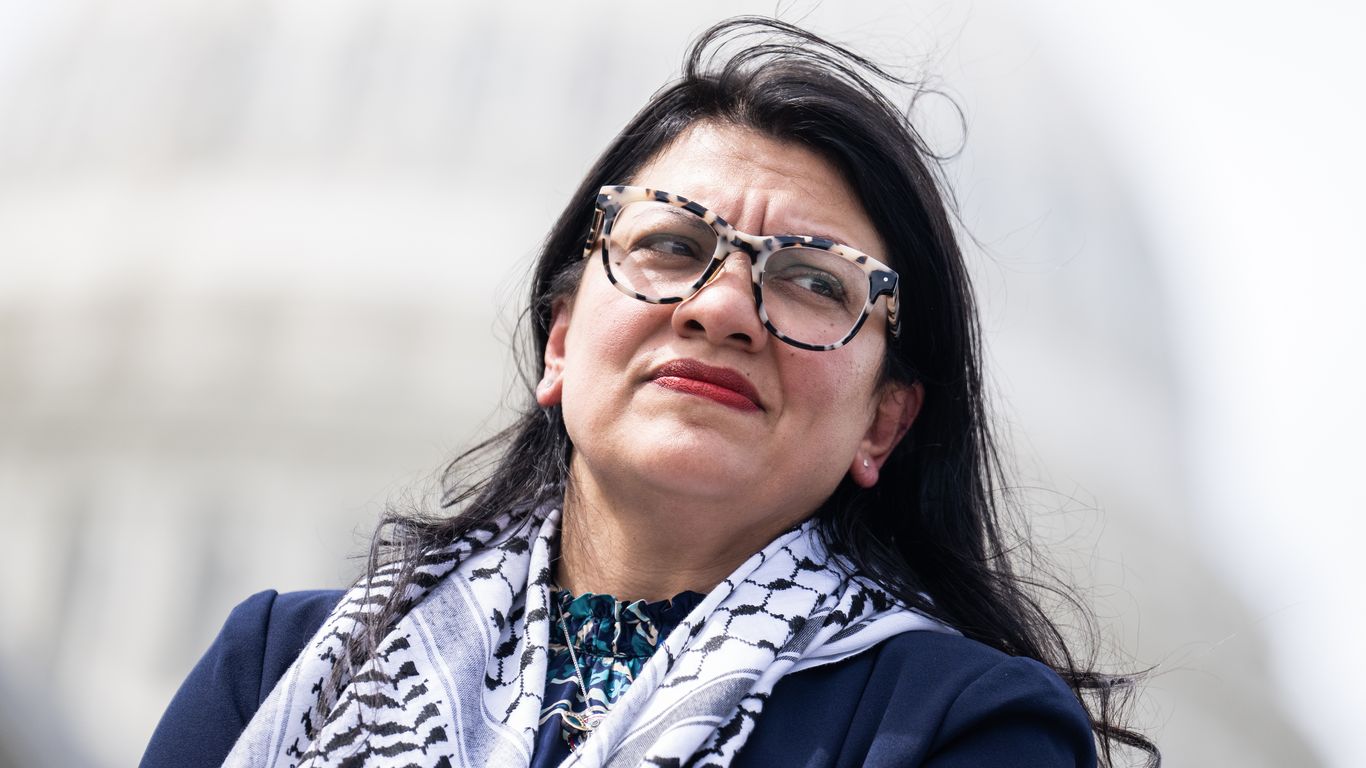
Progressive House members and candidates are taking a stark turn away from what they describe as "performative" efforts to impeach President Trump . Why it matters: This is a drastic shift in tone from Trump's first term, when progressives were some of the loudest voices in favor of impeachment. Rep. Rashida Tlaib (D-Mich.) famously said of Trump in 2019, " We're gonna impeach the motherfucker ," a line Republicans have routinely dredged up to dismiss impeachment efforts against the president as premeditated. On Thursday, she told Axios in a statement: "No matter what happens in November, we'll still have a Trump administration for the next two years to hold accountable." Driving the news: Likely incoming Democratic House members Darializa Avila Chevalier of New York and Melat Kiros of Colorado struck a similar tone in a recent podcast interview when asked about impeaching Trump. "I support accountability, but ... that is something that Trump himself seems to want," Avila Chevalier said. "My question is: Is that actually going to be meaningful accountability for the Trump administration?" Said Kiros: "The accountability has to actually lead to some material changes." What we're hearing: Rep. Delia Ramirez (D-Ill.), who has advocated a day-one impeachment, told Axios in an interview, "Impeachment can't just be a political messaging strategy." "I think what Melat and Darializa are getting to is that people want to see justice and real accountability. ... We can't just tell people things that some would feel like is fluff," Ramirez said. "I think the American people are tired of theater," said Adam Hamawy, another likely Democratic House member from New Jersey. He told Axios any impeachment proceedings need to be "a real process with substance, rather than just getting up there and just making a show of it." Rep. Analilia Mejia (D-N.J.) said Democrats "should investigate the heads of these departments and bad actors across the board," but she is "less inclined to the p
The Trump administration sued Alaska on Thursday to delay certification of election results if incumbent Republican Sen. Dan Sullivan loses. Why it matters: The race between incumbent Sullivan, Democrat Mary Peltola , and retired teacher Dan Sullivan has been marked by controversy, with Republicans accusing Democrats of trying to confuse voters by planting a candidate with the same name. Alaska's use of ranked-choice voting, which eliminates candidates in rounds if no one gets 50% of the initial vote, complicates matters. "An election result may be impacted by voter confusion if: (1) Senator Sullivan does not win the election; and (2) had all votes cast for Daniel J. Sullivan been cast instead for Senator Sullivan and Alaska's rank-choice process played out accordingly, Senator Sullivan would have won the election," the lawsuit , filed in Alaska District Court, states. Zoom in: Because of a previous Alaska Supreme Court decision and Sullivan's name already being on the ballot, the administration contended in the lawsuit that the only means to ensure that the winner of the race is voters' choice "is to ensure that the certification is not impacted" by his candidacy. The lawsuit requests a delay in certification until after an investigation determines "whether votes cast for Daniel J. Sullivan were meant to be cast for Senator Sullivan." What they're saying: "Alaska's Division of Elections determined that Mr. Daniel J. Sullivan's candidacy was intended to mislead voters and compromise the fairness of the ballot," a DOJ spokesperson said in a statement. "Therefore, the Justice Department, consistent with the National Voter Registration Act enacted by Congress, is taking the necessary steps to ensure that this frivolous candidacy does not undermine the integrity of Alaska's election or the will of its voters." The White House referred Axios to the DOJ. President Trump told reporters Friday that he told the DOJ to file the suit against Alaska. He then explained the situa
Democrats in a pair of deep-red states are testing the religious right's dominance by putting their Christian faith at the center of their campaigns — potentially creating a template for the party to compete in similarly forbidding terrain. Why it matters: Upsets by Texas' James Talarico and Kansas' Adam Hamilton would all but ensure that Democrats take the Senate. A recent poll from Pew shows both an opening and an obstacle: White evangelicals still strongly favor Republicans, while many other Christian groups lean Democratic or are more narrowly split. The big picture: Talarico , a Presbyterian seminary student, and Hamilton, a United Methodist pastor, are challenging conservatives' claim to speak for faith. Their bids come after Democrat Raphael Warnock, senior pastor of Ebenezer Baptist Church, was elected to the Senate in 2021. President Trump won both Texas and Kansas by double digits in 2024. Neither state has sent a Democrat to the Senate in the 21st century — the last time Kansas did was in 1932. Both races this year are considered toss-ups . Zoom in: Talarico's "religiosity is a way to soften his liberalism" and potentially win over Christians turned off by his scandal-plagued opponent , says Brandon Rottinghaus, who co-hosts Houston Public Media's "Party Politics." Talarico has also made several visits to Black Baptist churches . Trump made inroads with minority communities in Texas, and Talarico looks to do the same after besting Rep. Jasmine Crockett (D-Texas), who is Black, in a brutal primary. He's harnessed scripture in his pitch against Christian nationalism and for protecting the vulnerable, invoking the biblical campaign slogan, "It's time to start flipping tables." "We're in a populist political moment, and many of the teachings of the social gospel give him an opportunity to link the politics and his faith together," Rottinghaus adds. By the numbers: A September Marist survey of 1,139 Texas registered voters showed Paxton with a 75% to 22% lead
Senate Majority Leader John Thune (R-S.D.) and Minority Leader Chuck Schumer (D-N.Y.) are living out their midterm nightmares — with nominees they didn't want and former colleagues they no longer control. Why it matters: Together, Schumer and Thune are stuck with five Senate races in which their party establishments thought they had a better chance of winning with someone else. 🤠 Texas: Thune's efforts to stop Texas Attorney General Ken Paxton from winning the party's Senate nomination failed. Now Republicans are spending more than $329 million to defeat state Rep. James Talarico— and it's still a nail-biter. 🍑 Georgia: GOP leaders couldn't convince Gov. Brian Kemp to run. The eventual nominee, Rep. Mike Collins, has struggled to keep pace with fundraising juggernaut Sen. Jon Ossoff (D). GOP money is in retreat. 🦞 Maine: Schumer endorsed Gov. Janet Mills, but Graham Platner's implosion left Democrats with backup Troy Jackson against Sen. Susan Collins. ⛴️ Michigan: Abdul El-Sayed defeated Rep. Haley Stevens and made a name for himself nationally. But he won by just one point even though primary polls showed him up by double digits. He's now polling within the margin of error against the GOP nominee, former Rep. Mike Rogers. 🏈 Minnesota: Peggy Flanagan ran as a progressive, said she would not support Schumer as leader and bested establishment-backed Rep. Angie Craig. But Cook Political Report moved her race against former NFL sideline reporter Michele Tafoya toward Republicans even as it shifted other races toward Democrats. To make matters worse, Thune's and Schumer's former colleagues are creating fresh headaches by boosting candidates across the aisle. Former Sen. Joe Manchin, who flipped to independent in 2024 after being elected as a Senate Democrat, is campaigning for Sen. Susan Collins (R-Maine), as Semafor reported. Former Sen. Kyrsten Sinema , who also flipped from Democrat to independent before leaving office, is boosting Republican Jay Feely in her hom
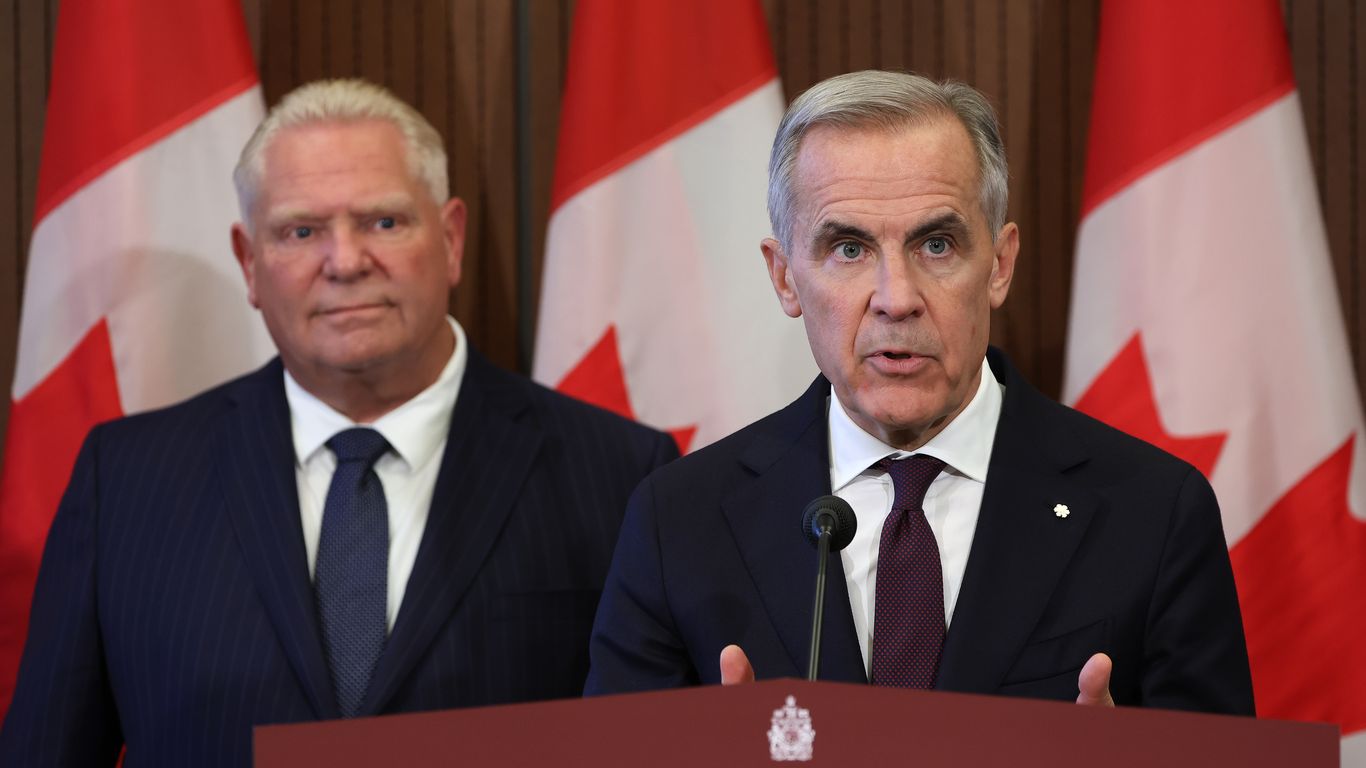
The U.S. Embassy in Canada accused Canadian leaders of "openly" describing plans to "influence American politics," doubling down on Ambassador Pete Hoekstra's claims of potential election interference. Why it matters: The accusation further deteriorates Washington's relationship with its northern neighbor under President Trump's costly trade war that's put political pressure on Republicans. Canada targeted its retaliatory tariffs on politically salient states and products ahead of the U.S. midterms. Driving the news: The embassy cited Canada's targeted tariffs as part of the influence accusations laid out in a Wednesday fact sheet . It cited remarks from Industry Minister Mélanie Joly, including an August press conference where she said Canada was "targeting products that will target states in the U.S." She added, "we're being wise and strategic to put political pressure." Joly has echoed that message throughout the trade tensions. The fact sheet also cited Joly's meeting with Democrats. She recently huddled with Illinois Gov. JB Pritzker. What they're saying: Asked about the accusations during a news conference, Prime Minister Mark Carney said "all of our actions are in the interest of Canadian workers, Canadian families and the future of this economy." Zoom out: The fact sheet also singled out conservative Ontario Premier Doug Ford over a 2025 anti-tariff ad campaign featuring excerpts from a Ronald Reagan speech . It also cited Liberal MP Anthony Housefather's campaigning for Florida Democrat Rep. Debbie Wasserman Schultz. The memo read, "The Canadian government brushes off concerns about potential interference in U.S. elections, even as its ministers and premiers openly describe plans to influence American politics in official documents and public appearances." Catch up quick: Hoekstra said in a recent podcast interview that American officials were "closely watching" Canada for potential election interference. Joly said last week it was "absolutely not" fair to
Data: Harvard Youth Poll, Fall 2026; Chart: Emily Peck/Axios Nearly two in three U.S. adults younger than 30 who plan to vote in next month's congressional midterm elections say their main motivation is to oppose President Trump and his policies, according to a newly released Harvard Youth Poll . The big picture: Seventy-seven percent of respondents disapprove of the president's handling of the economy, including about half of young Republicans. And just 9% say the U.S. is headed in the right direction — the lowest in the survey's history. Why it matters: Economic populism is driving emotions, along with concerns about war, AI, billionaires, deportation tactics, social policies and corruption. Majorities of respondents support Medicare for All, a wealth tax and bans on congressional stock trading. What we're watching: Just one in three Americans ages 18-29 say they'll definitely vote — a substantial drop from 40% who said so in 2022. Notably, most of that drop is driven by Republicans. Only 34% of Republican respondents said they'll definitely vote, down from 46%; 50% of young Democrats say they'll definitely vote, essentially unchanged. Just 22% of independents they'll definitely vote, down from 26%. Data: Harvard Youth Poll; Chart: Emily Peck/Axios Zoom in: Topping the list of what young people consider serious threats to their long-term financial security: rising prices and the cost of living (79%), followed by the power of large corporations (68%) and trade wars (68%). Nearly half said their household is struggling to make ends meet or getting by with limited financial security. By the numbers: 63% say their votes for U.S. House or Senate will be cast in opposition to Trump, while 14% say they're motivated by support of the president and 17% say he's not a factor. Two-thirds disapprove of the job Democrats are doing in Congress; 74% disapprove of congressional Republicans' performance. Stunning stats: For the first time in the poll's history, the share of young
Vice President Vance 's call for fellow Republicans to "stop whining" about Vivek Ramaswamy's controversial attack ad in Ohio's race for governor showed a key part of his political mindset ahead of his expected run for president in 2028: Never back down. Why it matters: Channeling President Trump, Vance has shown contempt for what he sees as the old-guard GOP's reflex to cave under pressure from Democrats and the media. He thinks too many Republicans sacrifice allies to make controversies go away, and that giving critics a political scalp only encourages them to demand another, according to people familiar with his thinking. It's an approach with some risk — namely whether Vance, entering a critical period in his political career, has the political muscle to get away with Trump's no-apologies approach. Driving the news: Vance on Wednesday defended Ramaswamy amid bipartisan outrage over an ad featuring the estranged mother of Ramaswamy's Democratic opponent, Amy Acton . In the deeply personal ad, Acton's mother calls her daughter a liar, and says Ohioans shouldn't vote for her for governor. Not mentioned in the ad: Acton and her brother were removed from the mother's care as children after Acton accused her stepfather of sexual abuse. Her mother sided with the stepfather, leading to an estrangement that has lasted nearly 50 years. Appearing at a campaign stop for Ramaswamy in Ohio, Vance showed little concern about the criticism over the ad. Vance said he was "disgusted" by fellow Republicans criticizing it, telling them to "stop whining." Asked whether the ad was appropriate, Vance said it was "not really my concern," and that politics is tough. The other side: The backlash has included Republicans and Democrats who believe the ad crossed a moral line by exploiting Acton's traumatic childhood. "I would not have run that ad," Ohio Sen. Jon Husted, who appeared alongside Vance and Ramaswamy at a campaign rally Wednesday, told the AP . Former UN ambassador Nikki Haley
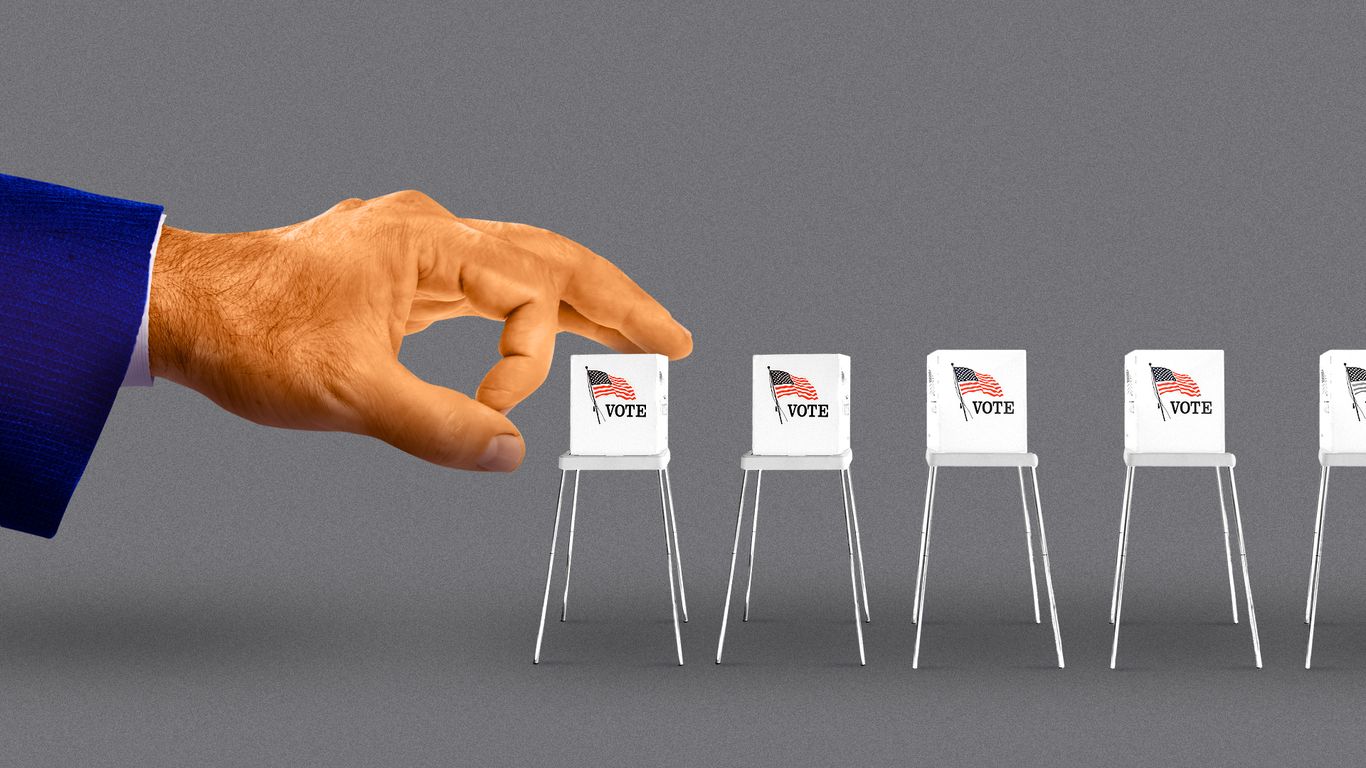
Democratic groups sued the Trump administration Tuesday, accusing it of using unfounded voter fraud claims to muscle its way into how states run elections. Why it matters: The groups say the administration is issuing a stream of threats to intimidate and bully both voters and election officials. They're asking a judge to declare the administration's actions unlawful and block further interference. Driving the news: The lawsuit condemns the administration for targeting state voter rolls by insisting that local officials review federally compiled lists of alleged noncitizens on their voter rolls. The suit also alleges that the administration is improperly demanding that states deny ballots to registered voters based on those federal lists. The Democrat-aligned groups also claim the administration has attempted to intimidate state and local officials by threatening them with jail time or prosecution. Case in point: The lawsuit cites a Department of Homeland Security claim that Nevada had nearly 16,000 noncitizens on its voter rolls. The department later claimed that it had confirmed 185 of those people were noncitizens. State records later indicated that all 185 were citizens. The DOJ also demanded that California deny ballots to more than 20,000 people based on a federal list that flagged them as suspected ineligible voters, the lawsuit says. A preliminary investigation by Los Angeles County investigators found that more than 25% of those flagged listed a U.S. birthplace, and others already had their voter registrations canceled. What they're saying: "Department of Justice and DHS officials have sought to bolster their interference efforts through a persistent stream of threats and intimidation directed towards state and local election officials across the country," the groups' attorneys wrote. "Defendants' coercive threats of legal retaliation against state officials, including even potential imprisonment, for simply following state law and aiding registered voters i
House Democrats' campaign arm is instructing allied super PACs to promote minor candidates in several key House races, Axios has learned. Why it matters: This allows Democrats to steer outside groups toward siphoning votes from Republicans without violating laws against direct coordination. An Axios review of the Democratic Congressional Campaign Committee's "redboxes" — publicly available webpages laying out what PACs should say in ads and which voters to target — found references to minor candidates in five races. The DCCC included language on four of those pages promoting a third-party or independent candidate with language touting their conservative, pro-gun or anti-government bona fides. "Registered Republicans under the age of 55 need to see ads," the redbox for Colorado's 5th District says, "showing that ... Christopher Mitchell, a libertarian, is the true conservative running for Congress." The page for Virginia's 2nd District says white, college-educated men should see that independent J. Matt Baker is "a staunch supporter of the 2nd amendment" who will "defend our constitution." In Virginia's 5th District , the DCCC wants the same group of voters to know that independent Cooke Harvey "will fight for Virginia's farmers against big government." Republican women in Nevada's 2nd District should be informed that American Independent Party candidate Lynn Chapman "has spent decades fighting for conservative values," the DCCC says. Zoom in: In several cases, the redboxes urge super PACs to steer Democratic and left-leaning voters away from minor candidates who could siphon votes from the DCCC's recruit. The redbox for Alaska's at-large district — where Democrats are backing independent Bill Hill — says voters need to know Eric Hafner is a "fake Democrat" despite being listed on the ballot as one, noting he is an inmate in New York with no clear ties to Alaska . The page for Virginia's 2nd District urges PACs to ding the progressive credentials of another independe
Senate Republicans are weighing three last-ditch spending moves that would have been unimaginable six months ago: a cash infusion for Mississippi and even more money for South Carolina and Kansas. Why it matters: It's been 94 years since Kansas elected a Democratic senator, 44 years for Mississippi and 28 for South Carolina. But panic is spreading through the Republican Party. "The wall has broken. The enemy is inside the fort," one national Republican political operative told Axios. "We are now fighting hand to hand." The Senate map, which once looked impregnable for Senate Majority Leader John Thune (R-S.D.), is now full of vulnerabilities. Democratic challengers are polling within the margin of error in more than half a dozen deep-red states, according to internal GOP polls. The other side: "We're nervous about Alaska. We're nervous about Michigan. We're still going to hold the Senate at the end," said another operative. Zoom in: Two weeks ago, when Senate Leadership Fund decided to take out a $5 million "insurance policy" in South Carolina, operatives took a hard look at Idaho, South Dakota and Mississippi. At the time, they concluded they didn't need to spend any money in those states, according to a person familiar with the matter. But Senate Republicans are now reviewing the Mississippi race and may need to spend there to protect Sen. Cindy Hyde-Smith from a surprisingly competitive bid by Democratic district attorney Scott Colom . Senate Majority PAC, the main super PAC for Senate Democrats, announced a $1.2 million investment in the race on Tuesday. Zoom out: In early June, SLF started to reinforce a Midwestern red wall to protect the GOP majority, reserving $28 million in TV advertising in Ohio and $11 million in Iowa . Those investments have ballooned to $93 million in Ohio and $53 million in Iowa. After an initial $5 million buy in South Carolina, SLF's spending has increased to $8.5 million, according to AdImpact. And a super PAC linked to Sen. John Bar