TopNewsOn

Results for “east texas”

For Trump, Musk and Farage, the message is the same: voters don’t want to be hijacked by billionaires | Rafael Behr

A lesson from the US midterms is that electorates are repelled by the arrogant mega-rich buying democracy. This is a fight Labour can afford to pick For most people, $224m (£168m) is a lot of money, especially if you spend it and get nothing in return. But Elon Musk is richer than most people. In fact, there is no one richer. As the wealthiest of the US’s tech oligarchs Musk could afford to blow huge sums on a failed bid to prop up Republican candidates in Texas, his adoptive home state, in last week’s midterm congressional elections. He is reported to have spent a further $250m failing to engineer results in other races. Rafael Behr is a Guardian columnist Continue reading...

The Guardian · 16h ago
"Rome is burning": Incoming House Democrats prove unusually willing to defy leaders

House Democrats' incoming freshman class is barely a week old and already threatening to defy party leaders in ways most of their incumbent colleagues wouldn't dare. Why it matters: It's a dynamic House leaders may have to learn to live with as they integrate a massive group of new members who were swept into office on a wave of populist, anti-establishment anger. "My class is huge not because of ... the Democratic Party and its brand but despite it," said Rep.-elect Don Leonard (D-Ohio). "Many of us are outsiders who didn't come up through the machine, don't buy into the conventions." Congressional Progressive Caucus chair Greg Casar (D-Texas) told Axios: "Any members that are new and have just run their elections are going to be very close to where the voters are, and we know the voters are very upset." State of play: House Minority Leader Hakeem Jeffries (D-N.Y.) is on track to become speaker, in part thanks to his rock-solid support among sitting House Democrats. His supporters include high-profile progressives such as Casar and Reps. Alexandria Ocasio-Cortez (D-N.Y.), Pramila Jayapal (D-Wash.) and Ro Khanna (D-Calif.). "There is one candidate in this race, Hakeem Jeffries, and I think that everyone is far more concerned about what that leadership means, what is it promising," Ocasio-Cortez told reporters on Tuesday. Things get more spotty when gauging Jeffries' support among incoming freshmen, some of whom have openly declined to commit to supporting his leadership. That includes members of the informal progressive "Bloc," including Reps.-elect Darializa Avila Chevalier (D-N.Y.), Melat Kiros (D-Colo.), Claire Valdez (D-N.Y.), Adam Hamawy (D-N.J.) and Chris Rabb (D-Pa.). "As far as I've heard, Jeffries is the only one running," said progressive Rep.-elect Randy Villegas (D-Calif.). "But ... I think we need to see some prioritization of some legislation, particularly around health care, foreign policy and immigration." Some incoming and sitting House Democrats ha

Axios · 22h ago
Trump swung between war and diplomacy — then chose a third way

When Secretary of State Marco Rubio met with his G7 counterparts in Paris on Tuesday, he told them that President Trump had considered resuming the war with Iran or cutting a deal — but chose a third option: strangling the Iranian regime, three people who attended the meeting told Axios. Why it matters: The Iran war has become a political albatross in Trump's second term, costing Republicans dearly in the midterms. For months, the president has alternated between threatening to obliterate Iran and predicting it will capitulate and give him the deal he wants. "He's been searching for the solution, but he wasn't sure what's the best way to go," a U.S. official close to Trump said. This debate over which course to follow has led to strife between several factions within the top echelon of the administration. Each faction had the support of U.S. allies in the Middle East — namely Israel favoring renewed strikes and most Gulf countries opposing them. Driving the news: After meeting with the Qatari Prime Minister Sheikh Mohammed bin Abdulrahman Al Thani on Monday, Trump said that a new round of strikes against Iran is "quite unlikely" and "doesn't seem to be necessary." Trump said he instead favors continuing the economic crackdown and naval blockade against Iran, in addition to a new operation dubbed "Iron Gate" to cut off land routes that Iran uses to move advanced weaponry and other technology. Behind the scenes: Rubio explained the U.S. Iran policy in a closed meeting on Tuesday with the foreign ministers of the G7 countries in Paris. "The President doesn't just have two options. It's not just return to war or sign a ridiculous peace deal.  We won't do a stupid deal. The third option we have is to continue to do what we do now," Rubio said, according to three people in the room. Rubio went on to say that the U.S. is imposing devastating costs on Iran's economy, making it harder for it to fund terrorist organizations or rebuild its military. And there's no end date. "T

Axios · Nov 10
‘The many v the money’ should frame the next US Congress

If Democrats want to keep the blue wave going into 2028, they have to take on the billionaire class Welcome back to How We Win , a Guardian opinion series with leading thinkers, offering bold ideas for America’s political future. Last week, Judd Legum shined a spotlight on the role of dark money in US elections. Today’s edition was written by Naomi Klein , Guardian US columnist and author of End Times Fascism : And the Fight for the Living World, co-written with Astra Taylor. To see the battle lines of the post- midterm era in sharp relief, look to Texas . The oligarchs in this battle seem to have no loyalty to the nations, states and cities that helped them grow their enormous wealth. Continue reading...

The Guardian · Nov 10
The blue wave's tough-on-crime surprise

Democrats swept into power last week as voters also embraced tougher criminal penalties and restrictions on bail. Why it matters: Six years after the George Floyd protests, Democrats won big without promising a return to sweeping 2020-era reforms. Some even adopted border-security rhetoric associated with Republicans. Democrats gained at least 12 state legislative chambers and won governorships in Georgia, Iowa, Nevada, Ohio and Texas. By the numbers: Voters approved all six statewide ballot measures Ballotpedia tracked that proposed tougher sentences, criminal penalties or bail restrictions in 2026. Five passed Nov. 3 in Indiana, Louisiana, Tennessee and Colorado. Alabama approved the sixth in May. Four expanded when courts could deny or restrict bail. Two increased penalties, including for fentanyl offenses and child sex trafficking. The shift: Some Democratic winners embraced tougher border-security language while opposing Trump's immigration crackdown. Texas Sen.-elect James Talarico called himself a "border security Democrat ," criticized former President Biden for failing to secure the border and said there needs to be comprehensive immigration reform. Michigan Sen.-elect Abdul El-Sayed , a progressive, said days before the election : "We needed tougher border security." He also criticized Trump's use of ICE. Zoom in: Colorado voters backed Democrats, tougher penalties and limits on federal immigration enforcement. That included electing Phil Weiser (D) as governor and approving tougher fentanyl penalties and life without parole for child sex trafficking. They rejected a measure requiring police to notify federal immigration authorities in certain cases involving violent crime suspects or people with prior felony convictions whose immigration status was unlawful or uncertain. Weiser and state Democrats are now weighing changes to the fentanyl measure, arguing it falls short on promised addiction treatment. Yes, but: Virginia voters approved automatically resto

Axios · Nov 10
House Dems size up 2028 Senate map after midterm landslide

Current and former House Democrats, flush with victory following their landslide midterm wins , are already looking at potential opportunities to run for Senate in 2028, Axios has learned. Why it matters: Democrats' 2026 romp — with wins in Texas, South Carolina, Kansas and possibly even Mississippi — has some party members reevaluating what were once considered impossible targets. A source close to Rep. Sharice Davids (D-Kan.) — who was reelected by 21 percentage points in a district former Vice President Harris carried by four points in 2024 — did not rule out her running against Sen. Jerry Moran (R-Kan.). "All options are on the table," the source said, adding that Davids' "focus right now is on delivering actual results and overcoming the chaos from these extreme policies we're seeing." Sen. Roger Marshall (R-Kan.) was defeated by Democrat Adam Hamilton last week, marking the first time in nearly a century a Democrat has been elected to the U.S. Senate from Kansas. North Carolina: Rep. Don Davis is "taking a look at" a run against Republican Sen. Ted Budd, a source familiar with his thinking told Axios. Davis won a third term on Tuesday after defeating his GOP opponent in a district President Trump carried by 12 points in 2024. Republicans redrew the district with the express goal of ensuring Davis' loss. Former Rep. Wiley Nickel, who was elected Wake County district attorney on Tuesday, would consider a Senate run if state Attorney General Jeff Jackson doesn't, a source close to him told Axios. The two served together in the House. Democratic former Gov. Roy Cooper won North Carolina's other U.S. Senate seat last week in a nearly 20-percentage-point landslide over Republican Michael Whatley. Pennsylvania: A huge field of Democrats is gearing up to potentially run for the seat held by Democratic Sen. John Fetterman. Fetterman, who has morphed from a populist firebrand to an arch-centrist, has angered much of the party by siding with Republicans on key votes. Rep

Axios · Nov 10
Democrats' 2028 presidential auditions begin in Denver

A who's who of Democratic power players descends on Denver this week to plot the party's future, fresh off its sweeping midterm victories . Why it matters: The gathering gives Democrats' rising stars an early stage to test their 2028 message, and explore whether Colorado's red-to- deep-blue shift could offer a national playbook. Driving the news: The three-day " What's Next " conference, starting Thursday, features dozens of Democratic heavyweights and potential presidential contenders, including House Democratic Leader Hakeem Jeffries , Pennsylvania Gov. Josh Shapiro , Texas Sen.-elect James Talarico and former Transportation Secretary Pete Buttigieg . Colorado's own Gov.-elect Phil Weiser , U.S. Sen. Michael Bennet, U.S. Rep. Joe Neguse and Denver Mayor Mike Johnston round out the lineup. Majority Democrats, a group seeking to shape the party's direction, is organizing the event. The big picture: Colorado's two-decade transformation into a Democratic powerhouse made it a natural host, spokesperson Vidhya Jeyadev told Axios. Organizers want to dissect and pinpoint what worked — and what didn't — in the midterms, and how to turn wins into lasting power. The gathering comes as Democrats debate whether they should double down on progressive policies or tack toward the center heading into 2028. Behind the scenes: Johnston, a Majority Democrats member, told Axios in a phone interview he personally lobbied to bring the conference to Denver after organizers began scouting locations about a year ago. He'll give opening and closing remarks and expects private meetings with most of the national leaders attending. He plans to pitch Denver's approaches to homelessness , housing and public safety as national models. He'll also press for more federal money for affordable housing and his universal child care plan . Between the lines: Colorado Democrats have embraced gun safety , immigration and LGBTQ rights — positions some in the party worry could cost votes elsewhere. Johnston

Axios · Nov 9
Oil prices and bond yields no longer moving together

Data: Axios analysis of FactSet data; Note: Correlation over preceding 30 trading sessions between daily change in West Texas Intermediate crude and change in 10-year U.S. Treasury yield; Chart: Neil Irwin/Axios For much of this year, on any given day, you could look at the price of oil and correctly guess what happened to bond yields. In the last few weeks, that correlation has evaporated. Why it matters: It's a sign that growth risks may be supplanting inflation worries as the dominant economic concern. State of play: It's not obvious whether an energy supply shock should affect inflation or growth more. On the one hand, more expensive fuel can ripple through prices for everything else. On the other, more expensive energy acts like a tax on consumers and businesses that consume it. Since the attack on Iran in late February , markets have treated the former concern as the central dynamic in the global economy. Zoom in: As such, on days when oil futures pointed to higher prices, bonds almost always sold off and their yields — which move in the opposite direction from their prices — rose. Traders were pricing in a world where inflation is higher for longer, and central banks react by raising rates more — and betting, implicitly, that growth would prove resilient despite the energy price headwind. For the 30 trading days ended Sept. 10, the correlation between the one-day move in West Texas Intermediate crude and 10-year U.S. Treasury yield reached a stunning 77%. The Financial Times noted in late September that the correlation was the highest it had been since the Persian Gulf War of the early 1990s. Yes, but: Now, that correlation has collapsed — and is about negative 10% over the last 30 trading days. In other words, on days when oil rises, it's more likely than not that bond yields fall. Between the lines: It's probably not a coincidence that this shift has occurred at the same time cracks have appeared in the debt market that's financing the AI buildout. As long

Axios · Nov 9
Diversity, decency and a new south: who were the real winners in the US midterms? |

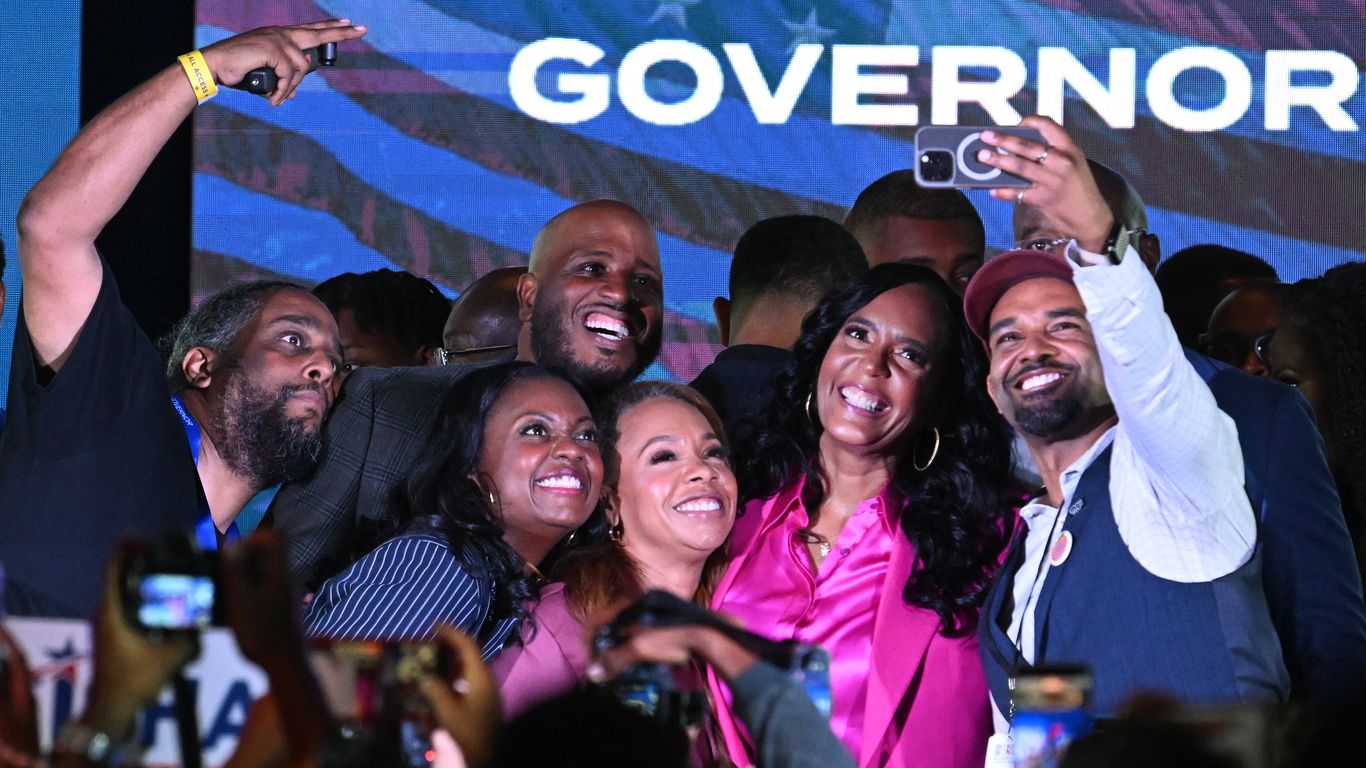
Tuesday was a victory for equity and inclusivity and a rejection of hate and fear. The biggest losers? Megadonors and Super Pacs Rather than regurgitate the particular wins and losses that occurred on Tuesday, I thought it more useful, at this point, to look at the big picture and identify the largest overall winners and losers for the country as a whole. Biggest winner: a diverse, equitable and inclusive America. It’s Donald Trump’s DEI nightmare. Georgia voters elected Keisha Lance Bottoms, the first Black female governor in the country. Texas chose Gina Hinojosa, the state’s first Latina governor and first Democratic governor in more than 30 years. California elected Xavier Becerra, the state’s first Latino governor. New Mexico chose Deb Haaland, the country’s first female Native American governor. Florida elected Byron Donalds, the first Black governor in Florida’s history (a Republican). Continue reading...

The Guardian · Nov 9
Elon Musk's empire braces for Democratic crackdown

Elon Musk's sprawling empire — from rockets to robots, electric cars to AI — is facing a political onslaught with few parallels in modern corporate history. Why it matters: The world's richest man confronts a constellation of risks spanning the halls of Congress, his Texas industrial empire, Wall Street and his vision for AI supremacy. 💰 Political: To Democrats, Musk embodies corrosive forces of the MAGA era — extreme wealth, billionaire influence over government, the gutting of federal institutions, the poisoning of social media and the unchecked power of AI. Musk spent at least $475 million on the midterms, becoming the election's largest individual donor — only to see more than 99% of his traceable spending go to losing candidates, according to WIRED . Musk's most humiliating defeat came in Texas, where a $160 million bet on Ken Paxton ended in a Democratic sweep of the Senate seat, governorship and attorney general's office. In a hint of a possible détente, Sen.-elect James Talarico praised the billionaire as a "great business leader and entrepreneur," and offered to work with him on technology and innovation. Musk, who said last month that Talarico "hates Texas," responded : "Nice of him to say that." ⚖️ Congressional: Armed with subpoena power, Democrats are preparing to investigate Musk's DOGE operation, its access to sensitive government data and whether his companies benefited from his extraordinary influence over the Trump administration. Musk is already downplaying his dependence on Washington, claiming government contracts will account for less than 5% of SpaceX revenue a year from now. "Happy to cancel any that the government doesn't want," he posted Friday . The scrutiny also extends to national security: Lawmakers are demanding answers about Musk's reported communications with Vladimir Putin and his role in the October slowdown of Starshield that disrupted Ukraine's drone operations. Elon Musk responds to reporting about his vulnerabilities in Texas.

Axios · Nov 9
Ramla Ali wins first world titles at 36 with highly controversial split decision

British-Somali boxer claims first world titles in Texas Kreps outlands Ali but loses disputed split decision Baumgardner wins 135lb belt as Dubois feud heats up British-Somali boxer Ramla Ali became a world champion for the first time at the age of 36 on Sunday night after winning a highly controversial 10-round split decision over former sparring partner Mikiah Kreps to claim the vacant WBO and IBF women’s junior featherweight titles in Arlington, Texas. Ali, who grew up in east London after fleeing Somalia’s civil war with her family and went on to become the first boxer to represent the African country at the Olympics, completed her remarkable journey to the top of the 122lb division at College Park Center on her second attempt at a world championship – but only after a verdict rewarding her for a fight that appeared to be largely controlled by her opponent. Continue reading...

The Guardian · Nov 9
Nature: Fall colors in Texas

We leave you this Sunday in the peace and quiet of the Lost Maples State Natural Area in Vanderpool, Texas. Videographer: Scot Miller.

CBS News · Nov 8
Behind the Curtain: Texas is the #1 story of America

No state looms larger, more dominant or more instructive about the future of American politics, governance and AI than Texas . Why it matters: Texas is suddenly — and unexpectedly — the American story. It's the battleground and proving ground for immigration policy, AI, data center growth, Hispanic voting patterns, and the direction of the Democratic Party. Put simply, it seems nearly impossible for Republicans to retain the presidency in 2028 without the Lone Star State. And it seems nearly impossible for AI to keep growing so fast if Texas rejects or dramatically slows it. Texas is so populous, so wealthy, so Hispanic, so energy-rich — and now so top-to-bottom blue — that both parties see it as a de facto nation-state capable of reordering ... everything. "Texas is everything," Steve Bannon, one of the top voices of MAGA, told us. Bannon has been so Texas-obsessed all year that he took his influential podcast, " War Room, " on the road to the " forward lines " of Texas for months at a time. Bannon said Texas needs to be an early focus for Stephen Miller, the new White House chief of staff. Houston Mayor John Whitmire on Friday directed police to limit cooperation with ICE, saying : "Elections matter." Bannon said he expects many more such actions, with Texas becoming a sanctuary state "quickly unless dramatic action is taken." "Trump is going to be forced to federalize the border," Bannon said, either with National Guard troops or federal law-enforcement agents. The big picture: Texas was red as blood on Nov. 2, the day before midterms. Now it'll have a Democratic governor ... lieutenant governor ... attorney general ... comptroller ... land commissioner ... agriculture commissioner ... Texas House ... and U.S. senator, 37-year-old James Talarico. Talarico won by double digits over state Attorney General Ken Paxton, and Gina Hinojosa — who'll be Texas' first Latina governor — upset three-term Gov. Greg Abbott. Democrats won all four state Supreme Court seats on th

Axios · Nov 8

Centrism did not win the Democratic party the election

The blue wave, while a rebuke of Trump’s policies, was also a referendum on the party’s status quo On election night I stood in a crowd at Harlem Tavern, a restaurant in New York City, at the electoral party for Darializa Avila Chevalier, the Democratic Socialists of America (DSA) member and congresswoman-elect from New York’s 13th congressional district. The crowd cheered as what came to be called the “blunami” rolled in: Iowa blue, Kansas blue, Talarico in Texas, Abdul El-Sayed in Michigan, House, Senate, gubernatorial races overwhelmingly going for the Democratic party. The victories were a clear rebuke of Trump’s politics, but also a referendum on the Democratic party’s own centrism that is complicit in the violence of masked men hunting immigrants, the funding of a genocide and the denial of healthcare to citizens of the world’s wealthiest country. Heba Gowayed is an associate professor of sociology at CUNY Hunter College and Graduate Center and author of the book Refuge: How the State Shapes Human Potential . Continue reading...

The Guardian · Nov 8
Judge to appoint special master to determine whether Trump lawyers purposely misled her over golf course

Ana Reyes wants to know whether federal officials lied about extent of renovation plans at East Potomac golf course A federal judge said on Saturday that she intended to appoint an ex-top federal prosecutor who served during Donald Trump’s first term to investigate whether she was purposely misled by lawyers and administration officials over changes to a historic public golf course in Washington DC. Jessie Liu, a former US attorney for the District of Columbia, would examine whether officials with the interior department and the National Park Service and attorneys with the Department of Justice violated ethics or misled US district judge Ana Reyes during the course of the civil case that was initiated with a lawsuit in February by the DC Preservation League and two golfers. Continue reading...

The Guardian · Nov 7
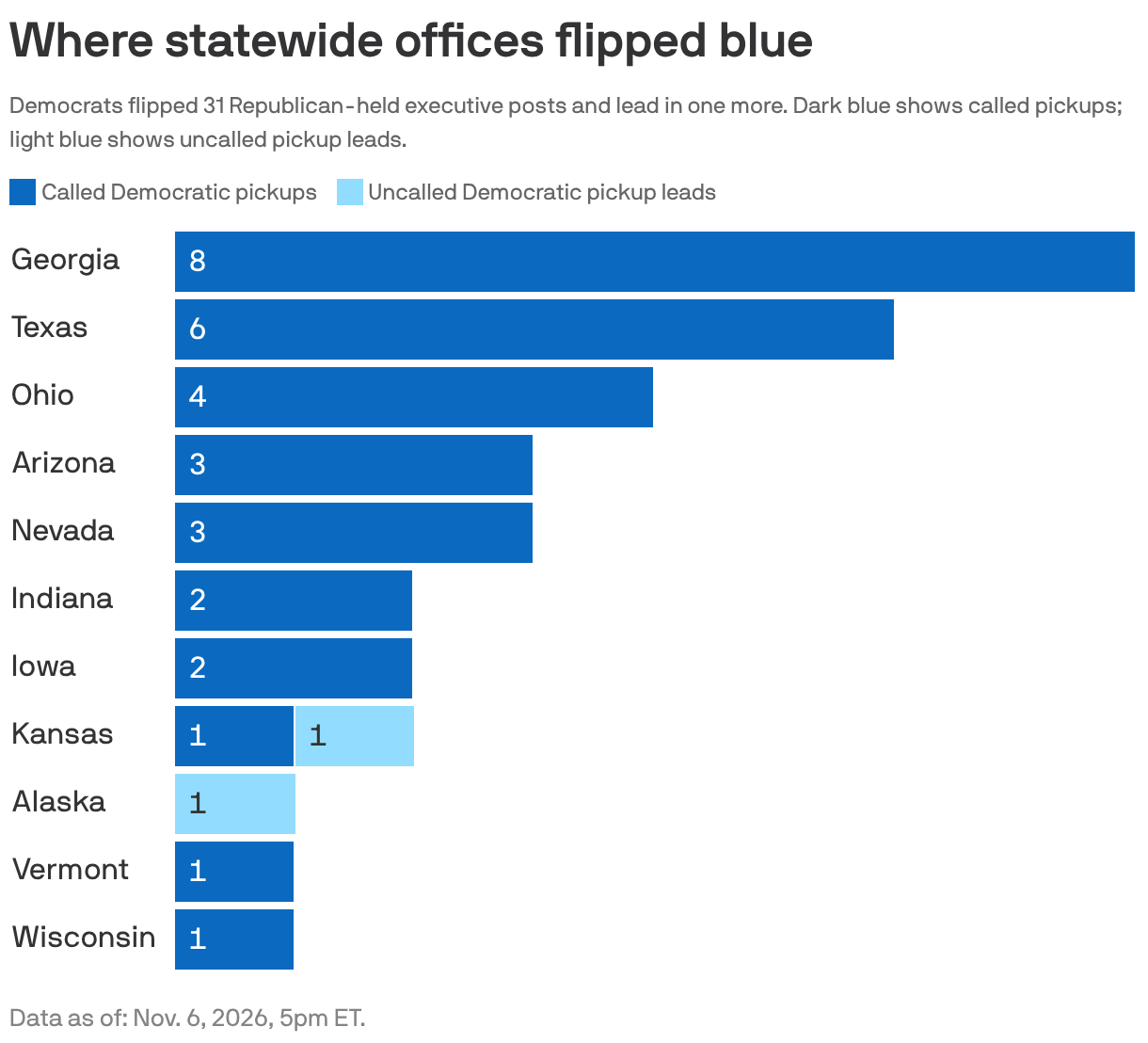
In 5 states, Republicans may lose every statewide executive race on the ballot

Single-holder executive offices only; excludes courts, commissions and federal offices. Data: Associated Press; Axios analysis; Chart: Andrew Pantazi/Axios Democrats' midterm gains extended deep into the machinery of state government: They swept every statewide executive office on the ballot in Texas, Georgia, Nevada, Wisconsin and Arizona. Why it matters: These low-profile victories will shape what millions of Americans pay for electricity, what their kids read in class and which party runs the 2028 presidential election in key states. The big picture: Democrats captured five Republican governorships, in Texas, Georgia, Ohio, Iowa and Nevada. But the scale of their gains becomes clearer farther down the ballot. Georgia: Democrats wrested all eight statewide executive offices on the ballot, including governor, attorney general, secretary of state and school superintendent. Texas: They flipped all six posts, defeating Gov. Greg Abbott and Lt. Gov. Dan Patrick in a state that hadn't elected a Democrat to statewide office in 32 years. Nevada: Democrats won all six executive offices, flipping governor, lieutenant governor and controller. Wisconsin: Democrats completed their Badger State domination, picking up the office of treasurer, the sole statewide office still held by a Republican. Arizona: Democrats held governor, attorney general and secretary of state. They lead in the three other executive races: treasurer, school superintendent and mine inspector. Data: Associated Press; Axios analysis Between the lines: The Democratic gains reach offices that decide which policies advance, which don't and which get challenged in court. Attorneys general: Nathan Johnson in Texas and Tanya Miller in Georgia will decide when their states sue the Trump administration and what corporations they investigate. Secretaries of state: Democrats flipped these offices in Georgia, Ohio and Indiana, putting new officials in charge of running the 2028 presidential election there. Texas' lieu

Axios · Nov 7
Flip voters discovered that Trump’s racism and xenophobia are expensive

Maga’s regret voters were all-in for Trump’s racism. Then they found out they couldn’t afford it For the first time in a decade, election predictions far exceeded public expectations. What pollsters anticipated as a blue wave billowed into a blue tsunami . Wins that held ground for already blue seats eased nerves, and the flips of swing states like Michigan, Georgia, North Carolina and Ohio energized the blue base. But red-belt-busting wins in Republican strongholds like Texas, South Carolina and Kansas alongside pending races in Alaska and Mississippi left mouths agape. The explanation was that Democrats turned out far more supporters than their regulars, and that the “ regret voter ” (both swing voters and partisan Republicans) expanded the wave across districts Trump previously won . Elation and sighs of relief rolled over consistently Democratic voters who suffered multiple sucker punches from recent years of Republican upsets. Regret voters, who run the gamut from gen Z men to Latinos , farmers and the white working class , hope a different party can deliver on the economy Trump promised them. Blue voters look at the dismantling of democracy, multiple wars, mass deportations and Trump’s unchecked power in these last two years and see how it all could have been avoided. Regret voters, however, either co-signed or conceded to Trump’s naked racism and brutish bullying of marginalized people, but switched their votes as soon as the consequences hit their pockets. While some of the president’s backers may have been turned away by Immigration and Customs Enforcement (ICE) gunning down American citizens, the final straw for most wasn’t ICE’s brutality , but rather the price of eggs. Some may have been upset by the Tomahawk missile assault that killed 120 schoolgirls in Iran, but most fumed at the rocketing costs at the gas pump that followed. Few demanded answers for the nearly 60 deaths of innocent people detained in DHS detention centers since the start of 2024, but

The Guardian · Nov 7
Black voter turnout surges in US south despite Republican redistricting drive: ‘They could not stop the momentum’

The GOP tried to dilute their power, but Black voters helped Democrats get elected in Alabama, Texas and Florida Black voter turnout surged across US southern states where Republicans were accused of redrawing electoral maps to “diminish Black political power” in the wake of a seismic supreme court ruling. Democrats flipped or held seats in Alabama, Texas and Florida with the support of this voting bloc, building on a decades-long, dedicated movement to protect and build Black political power in the region. Continue reading...

The Guardian · Nov 7
Texas v Musk: how southern state Democrats won against the billionaire – explainer

Democrat James Talarico won a Senate seat in Texas, breaking a 38-year drought for his party in the Republican stronghold and delivering a stunning blow to Donald Trump. The race became one of the most expensive Senate contests in US history, with advertising spending topping $500m, according to estimates. GOP-aligned groups poured hundreds of millions of dollars into efforts to elect Ken Paxton, including substantial funding linked to multibillionaire Elon Musk, whom Talarico accused of trying to buy a Senate seat. Elon Musk’s nearly half a billion dollars in midterms spending was a flop Five dimensional chess: inside James Talarico’s extraordinary bid to break Texas Democrats’ losing streak Continue reading...

The Guardian · Nov 6
The most diverse, anti-establishment Congress in history is cause for optimism

After years of outrage or numbness being the main options for dealing with politics, Tuesday’s results were permission to be optimistic This was originally published in the Stakes 2026, a newsletter about the midterm elections. Sign up to get it in your inbox We shed some tears this midterm cycle. US politics always makes people emotional, but I heard from friends and colleagues many times this year that speeches, campaigns and underdog success stories moved people in unexpected ways, whether it was this ad of Michigan senator-elect Abdul El-Sayed doing bedtime , a photo of newly elected Texas Democrats James Talarico and Gina Hinojosa at a Whataburger, or Georgia’s Keisha Lance Bottoms becoming the first Black female governor in the entire country. Continue reading...

The Guardian · Nov 6
Democrats' blue wave leaves climate behind

Democrats have made climate change a centerpiece of their campaigns for years — but this year they barely mentioned it. Why it matters: The midterms showed just how far the topic has fallen down the political priority list, even within the party most committed to addressing it — and suggest affordability will shape how Democrats govern next year. Driving the news: Democrats up and down the ballot campaigned overwhelmingly on affordability, including fuel prices surging amid President Trump's Iran war and rising electricity bills, accentuated by the AI boom. The big picture: The relative absence of climate change is striking considering that Democrats of all political stripes won big. Zoom in: Even some of the party's most prominent climate advocates emphasized affordability over climate change — or reconsidered ambitious climate policies in response to rising costs. New York Gov. Kathy Hochul, who previously championed the state's ambitious climate agenda, pushed to weaken parts of its landmark climate law this year, citing affordability concerns. Sen. Ed Markey (D-Mass.), who co-authored the Green New Deal, played down the proposal during his reelection campaign, emphasizing affordability and other priorities instead. Texas Sen.-elect James Talarico, who has previously warned about fossil fuels' impact on the planet, campaigned on protecting oil and gas jobs alongside expanding renewable energy and lowering electricity bills. Flashback: The political shift has been underway since the 2024 presidential election, when even climate-focused groups began de-emphasizing climate change in their political advertising, a trend that persisted through the midterms. State of play: On a call with reporters the day after the election, leading environmental groups celebrated Democrats' victories as a rejection of Trump's energy policies, arguing that his attacks on clean energy contributed to higher electricity bills. "Trump's energy agenda was an economic disaster for families a

Axios · Nov 6
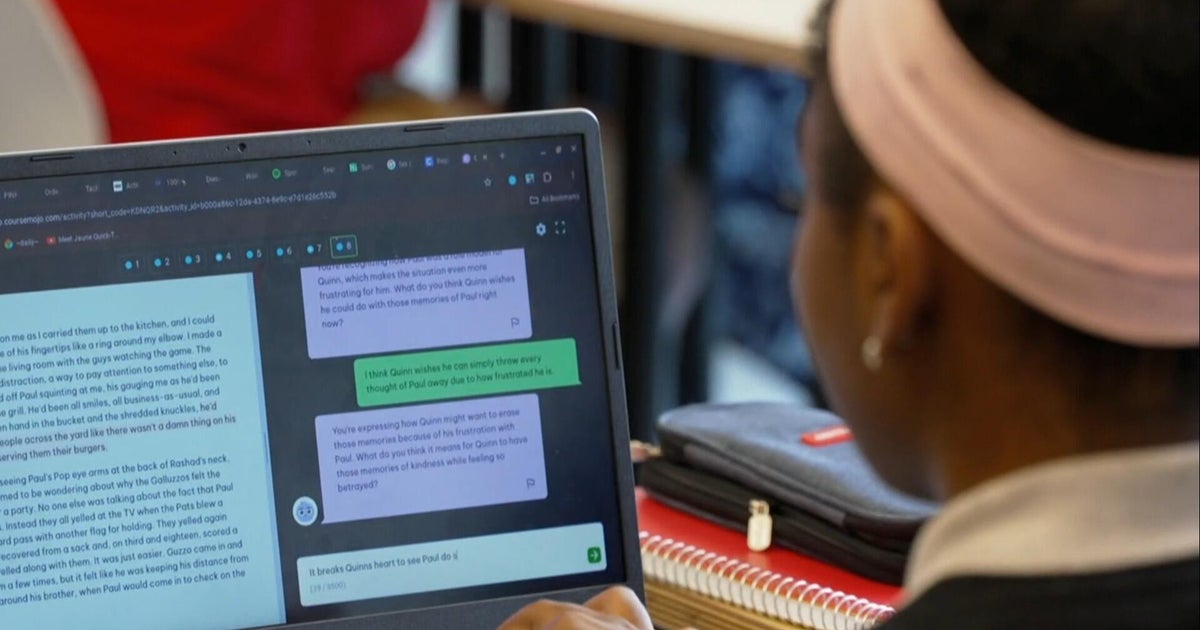
English teacher on how she uses AI to help students learn

Many schools are pushing artificial intelligence out of the classroom, worried that students will use AI instead of thinking for themselves. But some educators are embracing the technology and say it is helping students learn. Meg Oliver reports from DREAM East Harlem Middle School in New York City.

CBS News · Nov 6
US midterm voters responded in a thunderous voice. This is just the beginning | Betsy Reed

A note from our US editor: A reckoning is coming, but make no mistake: Trump is still president – we’ll need a free press in 2027 as much as we did in darker days. Please help today if you are able Betsy Reed is US editor of the Guardian Over the past two years, millions of people all over the world have watched Donald Trump’s destructive reign unfold with one question in their minds: Is there no check on his power? This week, voters deciding who controls Congress responded in a thunderous voice: there must be a check on the president’s power. From Texas to Ohio to South Carolina, Americans surged to the polls to register their opposition to Donald Trump – and to show their support for the kind of leaders who will look out for the interests of everyday people rather than those of a corrupt ruling elite. And now many people are looking at politics with a new and unfamiliar feeling of hope. Continue reading...

The Guardian · Nov 5
The Guardian view on the midterms and foreign policy: American voters spoke, and now the world waits anxiously | Editorial

The Democrats have gained new powers to constrain Donald Trump. But the drubbing that Republicans received could yet prompt him to new excesses Donald Trump is a president without parallel, but history can still be instructive. Lame duck presidents often focus on foreign policy to escape domestic discontent and establish a legacy in an area where a hostile Congress offers less of an obstacle. Mr Trump, who was stunningly rebuffed by voters in Tuesday’s midterms , might seek satisfaction in construction projects, the 2028 presidential race and his family’s future. Or, amid the humiliation and with Republican critics growing louder, he could distract attention with fresh adventurism – perhaps escalating against Cuba – or more likely a vengeful new offensive against Iran. Mr Trump won’t put in the legwork or attention to detail demanded by, say, Bill Clinton’s push for lasting peace in the Middle East. But he loves the glitz of state visits, spectacular military action, hobnobbing with strongmen and (unearned) credit for dubious “peace deals”. With a potential three-way meeting with Vladimir Putin and Xi Jinping mooted for the Apec summit in China this month, Ukraine, Taiwan and others have reason to be nervous. Do you have an opinion on the issues raised in this article? If you would like to submit a response of up to 300 words by email to be considered for publication in our letters section, please click here . Continue reading...

The Guardian · Nov 5
Black voters deliver a GOP reckoning

President Trump won historic levels of support from Black men in 2024. Two years later, those gains appeared to evaporate as Republicans suffered their worst midterm defeat in 50 years. Why it matters: Democrats feared the Supreme Court's decision weakening the Voting Rights Act would threaten their political future in the South. Instead, Black voters helped deliver historic Democratic victories in Texas and Georgia, with a potential upset brewing in Mississippi. By the numbers: Roughly nine in 10 Black voters backed Democratic House candidates Tuesday, according to the AP Voter Poll . Only about one in 10 Black men backed Republicans. Roughly one-quarter supported Trump in the 2024 presidential election, according to AP's analysis. For context, a separate 2024 national House exit poll found Black voters favored Democrats 84%–14%. Black men split 75%–24%, while Black women backed Democrats 90%–8%. State of play: Two Democrats who faced questions about their support among Black voters won crucial Senate races. Michigan: Progressive Democrat Abdul El-Sayed defeated Republican Mike Rogers , becoming the nation's first Muslim senator. A late-October poll showed El-Sayed drawing 87% support among likely Black voters. Texas: Democrat James Talarico defeated Republican Ken Paxton after courting Black voters who overwhelmingly backed Rep. Jasmine Crockett in the Democratic primary. An August Texas Southern University poll showed Talarico leading Paxton 79%–12% among likely Black voters. Zoom in: Talarico built commanding margins in Harris County, home to Houston, and Dallas County, both home to large Black electorates, according to AP county-level returns . Zoom out: Black voters helped elect former Atlanta Mayor Keisha Lance Bottoms as the first Black woman governor in U.S. history . About nine in 10 Black men voted for Bottoms, compared with roughly three-quarters who supported Kamala Harris in Georgia in 2024, according to the AP Voter Poll . Black women's support remain

Axios · Nov 5
Exit polls show young voters swinging back to Democrats after Trump's 2024 gains

Young voters swung so hard toward Democrats in Tuesday's midterms that it raises new doubts about whether Republicans can build a lasting coalition among Americans under 30. Why it matters: Trump's success with Gen Z voters, especially young men , fueled talk of a generational shift toward Republicans. Tuesday's results tell a different story. By the numbers: An estimated 66% of voters ages 18–29 backed Democratic House candidates Tuesday, compared with 31% for Republicans, according to Tufts University's CIRCLE , which analyzed preliminary data from the NORC Civic Health & Elections Project. That's a 35-point Democratic advantage, compared with 14 points in the 2024 national House exit poll , when young voters favored Democrats 56%–42%. Democratic support among men under 30 rose from 51% in 2024 to 59% in 2026. Among young women, it climbed from 61% to 70%, according to 2024 exit polling by Edison Research and CIRCLE's updated 2026 analysis of NORC data. Young white voters favored Democrats 63%–34% in the SSRS survey, after splitting 50%–48% in 2024. State of play: Polls flashed warning signs for Republicans in the final weeks before Election Day. An October Harvard Youth Poll found voters ages 18–29 who said they would definitely vote favored Democrats 63%–26%. Just 9% of young Americans said the country was headed in the right direction. Zoom in: Democrats drew overwhelming support from young voters in major statewide races, according to preliminary SSRS polling. In Texas, 76% of voters under 30 supported Democratic Senate candidate James Talarico, while 73% backed Democratic gubernatorial candidate Gina Hinojosa, according to CIRCLE's state analysis . In Georgia, 70% backed Democratic gubernatorial candidate Keisha Lance Bottoms. More than 60% favored Democratic candidates for Senate and governor in Ohio. In Iowa, where young voters backed Trump in 2024, Republican Senate candidate Ashley Hinson lost significant ground with the group, according to AP Voter Poll

Axios · Nov 5