

A note from our US editor: A reckoning is coming, but make no mistake: Trump is still president – we’ll need a free press in 2027 as much as we did in darker days. Please help today if you are able Betsy Reed is US editor of the Guardian Over the past two years, millions of people all over the world have watched Donald Trump’s destructive reign unfold with one question in their minds: Is there no check on his power? This week, voters deciding who controls Congress responded in a thunderous voice: there must be a check on the president’s power. From Texas to Ohio to South Carolina, Americans surged to the polls to register their opposition to Donald Trump – and to show their support for the kind of leaders who will look out for the interests of everyday people rather than those of a corrupt ruling elite. And now many people are looking at politics with a new and unfamiliar feeling of hope. Continue reading...
Results for “texas southern”
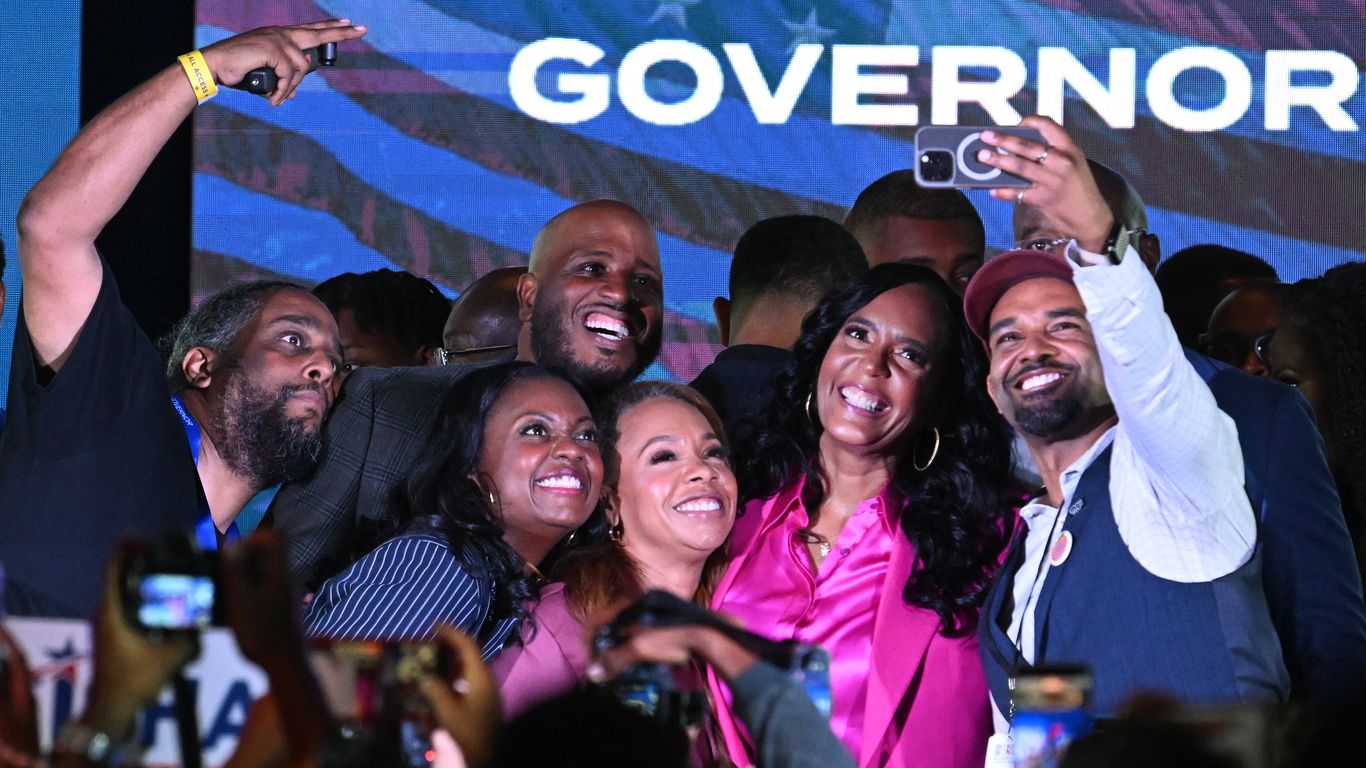
President Trump won historic levels of support from Black men in 2024. Two years later, those gains appeared to evaporate as Republicans suffered their worst midterm defeat in 50 years. Why it matters: Democrats feared the Supreme Court's decision weakening the Voting Rights Act would threaten their political future in the South. Instead, Black voters helped deliver historic Democratic victories in Texas and Georgia, with a potential upset brewing in Mississippi. By the numbers: Roughly nine in 10 Black voters backed Democratic House candidates Tuesday, according to the AP Voter Poll . Only about one in 10 Black men backed Republicans. Roughly one-quarter supported Trump in the 2024 presidential election, according to AP's analysis. For context, a separate 2024 national House exit poll found Black voters favored Democrats 84%–14%. Black men split 75%–24%, while Black women backed Democrats 90%–8%. State of play: Two Democrats who faced questions about their support among Black voters won crucial Senate races. Michigan: Progressive Democrat Abdul El-Sayed defeated Republican Mike Rogers , becoming the nation's first Muslim senator. A late-October poll showed El-Sayed drawing 87% support among likely Black voters. Texas: Democrat James Talarico defeated Republican Ken Paxton after courting Black voters who overwhelmingly backed Rep. Jasmine Crockett in the Democratic primary. An August Texas Southern University poll showed Talarico leading Paxton 79%–12% among likely Black voters. Zoom in: Talarico built commanding margins in Harris County, home to Houston, and Dallas County, both home to large Black electorates, according to AP county-level returns . Zoom out: Black voters helped elect former Atlanta Mayor Keisha Lance Bottoms as the first Black woman governor in U.S. history . About nine in 10 Black men voted for Bottoms, compared with roughly three-quarters who supported Kamala Harris in Georgia in 2024, according to the AP Voter Poll . Black women's support remain

Young voters swung so hard toward Democrats in Tuesday's midterms that it raises new doubts about whether Republicans can build a lasting coalition among Americans under 30. Why it matters: Trump's success with Gen Z voters, especially young men , fueled talk of a generational shift toward Republicans. Tuesday's results tell a different story. By the numbers: An estimated 66% of voters ages 18–29 backed Democratic House candidates Tuesday, compared with 31% for Republicans, according to Tufts University's CIRCLE , which analyzed preliminary data from the NORC Civic Health & Elections Project. That's a 35-point Democratic advantage, compared with 14 points in the 2024 national House exit poll , when young voters favored Democrats 56%–42%. Democratic support among men under 30 rose from 51% in 2024 to 59% in 2026. Among young women, it climbed from 61% to 70%, according to 2024 exit polling by Edison Research and CIRCLE's updated 2026 analysis of NORC data. Young white voters favored Democrats 63%–34% in the SSRS survey, after splitting 50%–48% in 2024. State of play: Polls flashed warning signs for Republicans in the final weeks before Election Day. An October Harvard Youth Poll found voters ages 18–29 who said they would definitely vote favored Democrats 63%–26%. Just 9% of young Americans said the country was headed in the right direction. Zoom in: Democrats drew overwhelming support from young voters in major statewide races, according to preliminary SSRS polling. In Texas, 76% of voters under 30 supported Democratic Senate candidate James Talarico, while 73% backed Democratic gubernatorial candidate Gina Hinojosa, according to CIRCLE's state analysis . In Georgia, 70% backed Democratic gubernatorial candidate Keisha Lance Bottoms. More than 60% favored Democratic candidates for Senate and governor in Ohio. In Iowa, where young voters backed Trump in 2024, Republican Senate candidate Ashley Hinson lost significant ground with the group, according to AP Voter Poll
The Republican missteps that led to the party losing control of Congress.

Senior leaders say party will be ‘united’ in focus, but progressives call on party to take radical action Progressive Democrats have declared that significant US midterm election wins across the country are as much a repudiation of their own party’s political establishment as of Donald Trump’s presidency. After a string of left-wing candidates scored stunning victories from Texas to Michigan, senior Democratic leaders have stressed the party’s new representatives in Washington will be “united” in their focus on reducing costs for Americans and ending corruption under Trump. Continue reading...

The AI industry is scrambling to repackage a $10 trillion infrastructure buildout to appease a hostile electorate that overwhelmingly voted to restrict data center construction in ballot measures across the country. It's not just changing the name of data centers to "compute campuses," but offering communities real money, including dividends, benefits for schools or cities, environmental concessions and labor protections. Why it matters: Tuesday's election proved voters won't tolerate unchecked growth, although the market and many analysts see the blue wave slowing — but not stopping — data center construction around the U.S. To prevent an existential threat, the world's biggest companies are working on a rebrand. How well they execute on their promises will determine the pace of the global AI race. What they're saying : Chris Lehane, OpenAI's chief global affairs officer, compared the turnaround AI must make to the 1996 election, which came shortly after Republicans routed Democrats in a historic midterm election. "A lot happens in two years," he told Axios in an interview. "Smart, talented folks take messages from voters and react and respond to them." Getting community buy-in for data centers will require "really making clear that these can be long-term, durable, economically transformative projects for communities," he said. Driving the news : There's no question about how voters feel about data centers after Election Day, with restrictive measures across 10 states going 43-1 at the ballot box. The margins weren't close, with an average of 75% of people favoring restrictions. In Texas, a new Democratic governor has promised to keep a moratorium in place until the legislature passes comprehensive reforms. Candidates who won in other emerging data center states also favor similar restrictions. Analysts say about 60% of planned 2028 capacity across the U.S. faces a risk of delay. Between the lines : Incoming Democrats aren't going to kill data centers. Virginia, ru

The third most populous state withstood a national Democratic surge on Tuesday, even as Republicans amassed deep losses in Texas and across the electoral map.

Years of organizing met a moment of voter discontent, as James Talarico and Gina Hinojosa offered Texans a message of economic relief and political change.
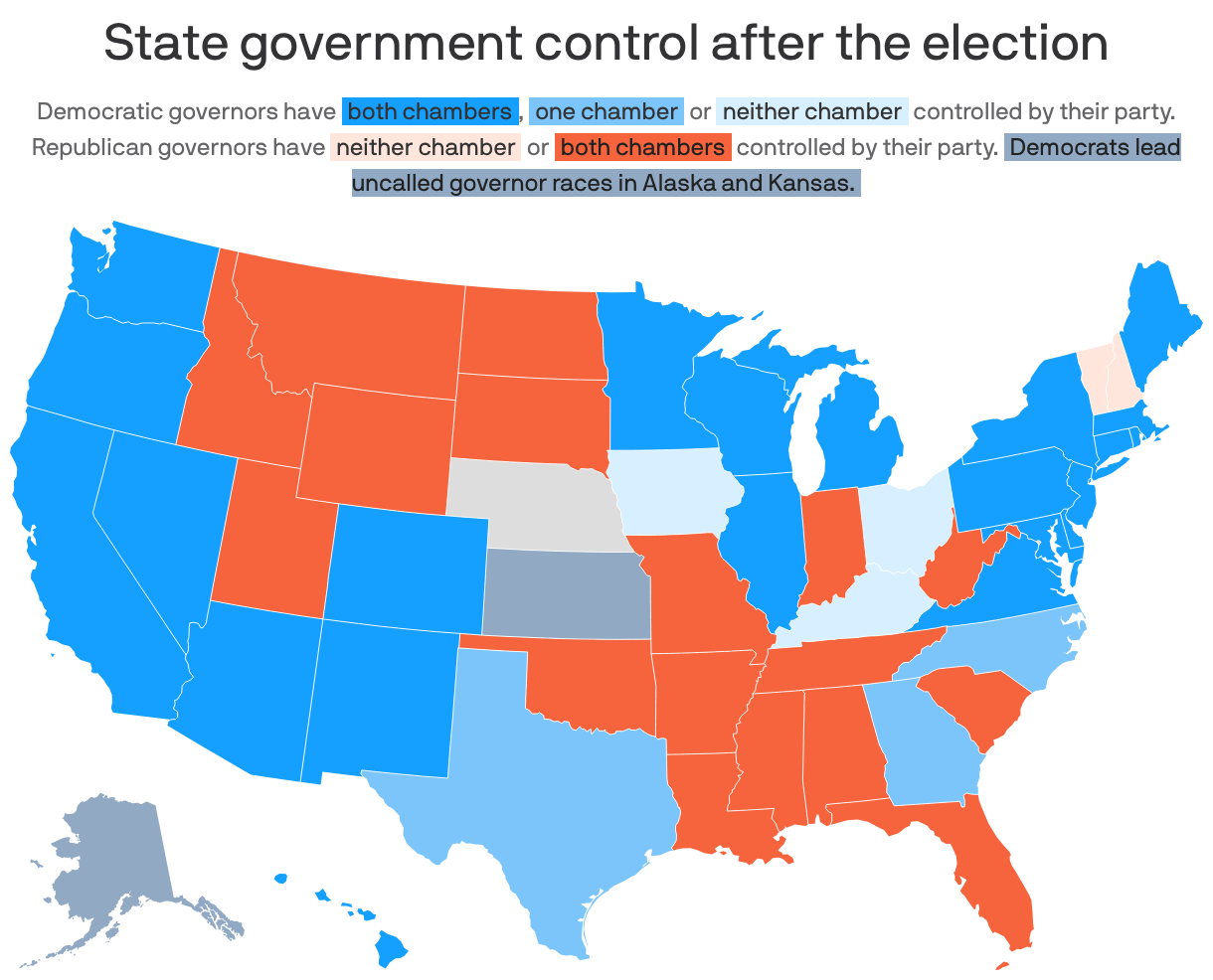
Data: Axios research; Map: Andrew Pantazi/Axios Democrats are on track to take control of a majority of legislative chambers, ending 16 years of Republican dominance over America's statehouses. If current leads hold, 75% of Americans will live in a state with a Democratic governor, and 53% will live in Democratic trifectas. Why it matters: Statehouses are the front line of American federalism, and Tuesday's gains dramatically expand Democrats' power to increase minimum wages, protect abortion access, and set voting rules ahead of 2028 for most Americans. Driving the news: The party is set to flip 12 legislative chambers, dismantle five Republican state trifectas, shatter 11 GOP supermajorities and build 12 of its own, according to AP returns as of 6pm ET on Wednesday. If leads hold, Democrats will control the governor's office and both chambers in five of the seven 2024 presidential battlegrounds: Arizona, Michigan, Nevada, Pennsylvania and Wisconsin. They have also broken Republican one-party rule in the sixth (Georgia) and flipped the House in the seventh (North Carolina). Democrats flipped five GOP-held governorships (Georgia, Iowa, Nevada, Ohio and Texas) and lead in Alaska. Republicans haven't flipped any, despite targeting Arizona, Michigan, Oregon and Wisconsin. Kansas, where Democrat Cindy Holscher was leading by about half a point Wednesday evening, is uncalled. The big picture: Ever since the 2010 Tea Party wave, Republicans have used their grip on statehouses to reshape American life: banning abortion, loosening gun laws, restricting collective bargaining and expanding private-school vouchers. They drew maps that kept them in power even in years Democrats won more votes statewide. Tuesday's Democratic gains broke that firewall. By the numbers: Republicans entered Election Day with 23 trifectas (control of the governor's office and both chambers) to Democrats' 16. If leads hold, Democrats will have 22 and Republicans 18. 24% of Americans will live under a
Democrats of all political stripes won so big on Tuesday that the party didn't settle its long-running civil war between moderates and progressives. Instead, the party's historic victories gave each faction some reasons to claim that its brand of Democrats can defeat the GOP in 2028. Driving the news: Democratic operatives are sure of one thing, though: Tuesday's blowout wins mean that more party leaders will be willing to run for the White House than if the midterms hadn't gone so well. Barack Obama's 2012 campaign manager, Jim Messina, told Bloomberg TV this week that he's already met with 29 potential candidates. Zoom in: On Tuesday, moderate Democrats won. Progressives won. Even one-time socialists won. In Michigan, for example, unapologetic progressive Senate nominee Abdul El-Sayed won by 7 points after running on Medicare for All. In the same state , William Lawrence, a member of the Democratic Socialists of America before he let his membership lapse recently, flipped a key swing district. Those results were good news for New York Rep. Alexandria Ocasio-Cortez, the democratic socialist with a national profile who went all-in on electing El-Sayed — and is considering a run for president in two years. More moderate Senate candidates who frequently talked about their faith on the campaign trail — such as Texas' James Talarico and Kansas' Adam Hamilton — pulled off huge upsets in deep-red states, and in the process created a model for some Democrats to follow. Their mild-mannered, religion-infused campaigns mirrored former Transportation Secretary Pete Buttigieg's 2020 presidential run. For the past year, AOC, Buttigieg and other Democrats eyeing the White House have been laying the groundwork to turn the 2026 elections into a springboard for their potential presidential campaigns. Some put their chips on specific candidates — and virtually all of them succeeded. Pennsylvania Gov. Josh Shapiro, a centrist technocrat who campaigned on "getting sh*t done," won reele

Accuracy of US polling came into sharp focus after Trump outperformed polls in 2016, 2020 and 2024 Political polling experts hailed a “great night” for the industry after surveys accurately foresaw much of the Democratic blue wave that swept across the US in midterm elections. In only a handful of US Senate races, including Texas and New Hampshire, key polls failed to gauge the scale of the Democratic victory over Republicans on Tuesday. Continue reading...

Trump’s aggressive ICE raids brought border battles to city streets, sparking fierce backlash over overreach.

NBC News projects Democrats have won control of the House and Senate in the midterms. NBC News’ Ryan Nobles looks at some of the historic wins in states like Texas and Michigan along with Republican reaction.

Democrats will have a real chance to govern in Texas for the first time in about 25 years, and they’re facing pressure to deliver.

Republicans barely had time to absorb their sweeping midterm losses before President Trump returned to a familiar comfort zone: D.C. construction projects. Why it matters: Voters just delivered an overwhelming rebuke of the administration, demanding that politicians focus on the cost of living, yet the president remains fixed on remaking the nation's capital in his image. Driving the news: Trump hosted reporters at the White House on Wednesday for a previously unscheduled event to update them on the East Wing ballroom's construction, marking his first remarks to the White House press pool since the election. He spent the majority of his remarks discussing planned architectural changes around D.C., including a proposed Triumphal Arch, the National Garden of American Heroes and a planned expansion of a publicly owned golf course that would likely eliminate popular running and biking paths. His remarks came after a pre-election appearance Monday, during which he praised the new pipes installed at the Reflecting Pool and a proposed promenade from the Lincoln Memorial to the Potomac River. What they're saying: Trump addressed criticism he sometimes receives for working on his construction projects, saying he was "doing it because the White House is the ultimate symbol of America, and it's got to be pristine." "It's got to be perfect. And if you take a look at it, that's what it is right now. You have no idea how much work we had to do." He also noted that he spends "very little time" working on the White House, but said he does it because "it's relaxing …I love construction." Catch up quick: Democrats outperformed expectations in Tuesday's midterms, flipping the Senate before the night was over and then the House a few hours later, according to the AP. Democrats have gained complete control of at least five previously divided state governments while ending Republican trifectas in several other states. In ruby-red Texas, the white whale of potential pickups, Democrats fli
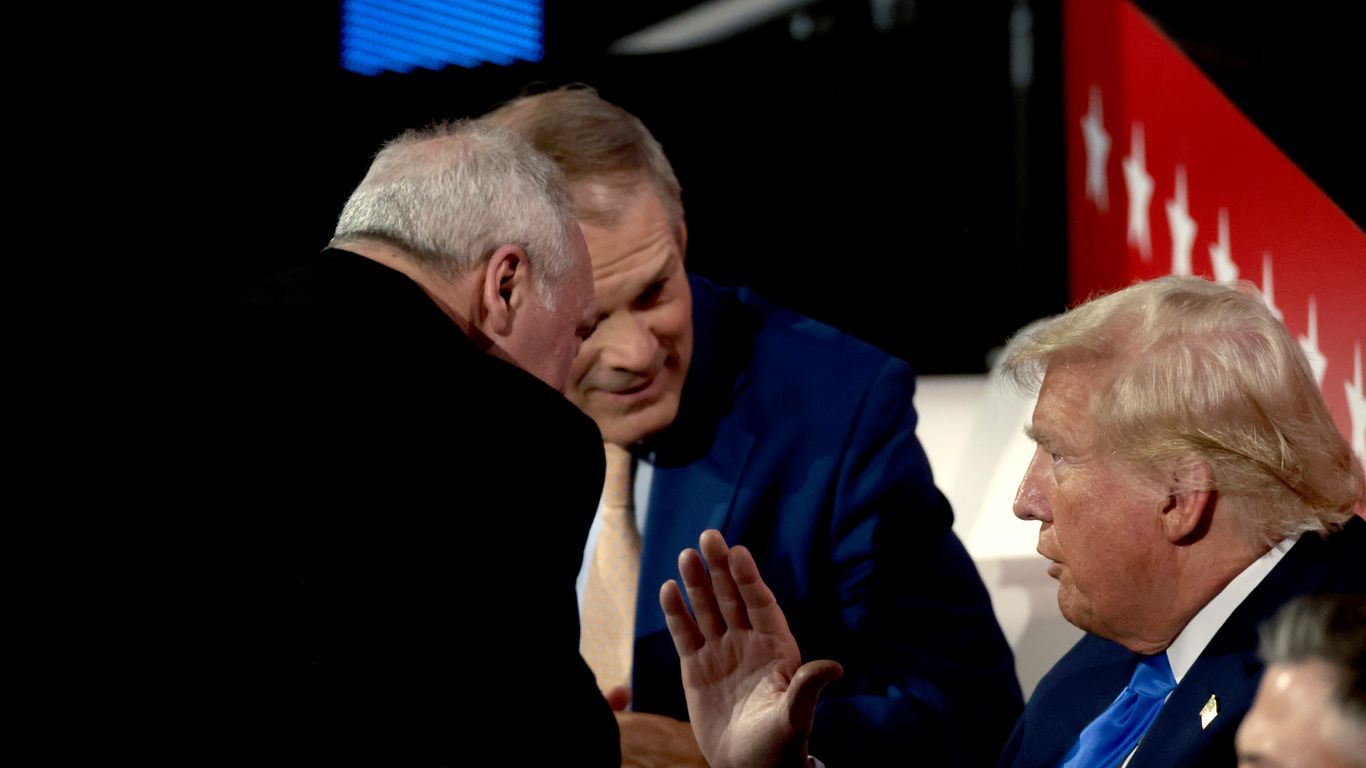
Republicans woke up "in shock" Wednesday morning after they got hit with the biggest midterms wave in 50 years. Within hours, that shock was turning into rage. Why it matters: The battle for control of what's left of the Republican conference — headlined by Majority Leader Steve Scalise (R-La.) and Judiciary Chair Jim Jordan (R-Oho) — is the first salvo in a quest to bring GOP lawmakers back from the political wilderness. Johnson set the tone Wednesday morning, when he took himself out of the running for leader, citing the toll the job has taken on his family. A key outstanding question is the extent to which Republican finger-pointing leads to a wholesale shake-up of the party's leadership ranks, versus a slight readjustment. Driving the news: The intra-party blame game quickly hit a fever pitch. "Dear Republican Senate and House "Leadership," No, the polls were not wrong. You were. Even with record amounts of money at your disposal, you managed to get absolutely annihilated," Rep. Greg Steube (R-Fla.) wrote on X Wednesday morning. "Please do us all a favor and step aside so new leadership can take a truly conservative direction," Steube added. "When you have the worst defeat in modern history, you need a new playbook," another GOP lawmaker told Axios. State of play: The fallout is rippling across the entire House GOP leadership team, with every top position facing a contested race. Minority leader: Scalise and Jordan are squaring off in a rematch of their bitter 2023 battle for the speakership. Minority whip: Tom Emmer faces a challenge from Rep. August Pfluger (R-Texas). NRCC Chair: Rudy Yakym and Brian Jack will face off for the post. Current NRCC Chairman Richard Hudson (R-N.C.) is on track to lose his own reelection bid. Zoom in: Behind the leadership infighting, Republicans are reckoning with what went so disastrously wrong on Election Day, with some blaming the Trump administration's policies for their losses. "Iran, Iran, Iran ... we should have never done

The real question in my mind is whether Democrats will take advantage of the new age of populism The great sleeping giant of the US has awakened, taken a hard look at what’s become of the nation, and roared a thunderous “NO!” What occurred on Tuesday was not – as some are saying – the inevitable midterm swing of the pendulum against the party in power. Texas hasn’t elected a Democratic senator since 1988. The last time Kansas elected a Democratic senator was 1932. Robert Reich, a former US secretary of labor, is a professor of public policy emeritus at the University of California, Berkeley. He is a Guardian US columnist and his newsletter is at robertreich.substack.com . His new book, Coming Up Short: A Memoir of My America, is out now in the US and in the UK Continue reading...

Democrats have won a historic sweep in the US midterm elections, winning back control of Congress in a major setback for Donald Trump. Senate seats went blue in traditional Republican strongholds such as Texas, South Carolina and Kansas, where the Democrats had their first win since 1932. Voters have sent a strong message of discontent to the Trump administration over the economy, the cost of living and rising gas prices. Trump is now a lame-duck president for the rest of his term. Lucy Hough speaks to our Washington editor, Ankita Rao Continue reading...

Trump’s rout could be part of a democratic spring that began in Hungary. But will it extend to the French elections next May? Hungary, Brazil, Serbia, and now the US. So far this year, when their hand has been held to the stove, voters have chosen what the Texas senator-elect James Talarico, the new face of the US’s Christian left, campaigned on as a “politics of love”: a society where we aren’t at each other’s throats, or a police state at ours. Is it any surprise that when there is clarity about the choice on offer, voters have started to shrink away from a vision fuelled by billionaire wealth and runaway inequality? Away from oligarchic rule and unapologetic corruption , connivance with aggression, expansion, colonialism and war; environmental degradation and the surrender of the human spirit to a reality mediated by the algorithm. Alexander Hurst writes for Guardian Europe from Paris. His memoir Generation Desperation is out now Do you have an opinion on the issues raised in this article? If you would like to submit a response of up to 300 words by email to be considered for publication in our letters section, please click here . Continue reading...

Democrats' big night gives them a chance to turn voter anger over high energy prices into legislative action and congressional oversight, but divisions within the party could complicate their plans. Why it matters: This was an energy election . High gasoline prices, record diesel costs, and rising power bills fueled discontent with President Trump and his party. Voters' rebukes of data centers could slow the buildout of power-hungry AI infrastructure. The latest: Stunning Senate wins in red states and House wins nationwide propelled Democrats to control of both chambers, and flipped several governor's mansions. Energy costs were prominent in key races, such as Democrats hitting GOP rivals over farmers' bills in Iowa, Kansas and Ohio. Texas Governor-elect Gina Hinojosa (D) bashed Greg Abbott (R) over his prior embrace of data centers in the state where developers are planning big projects. The data center backlash also featured in Ohio and Pennsylvania, where Sherrod Brown defeated Sen. Jon Husted (R) and Paige Cognetti unseated Rep. Rob Bresnahan (R). Both Republicans faced criticism over their support for data centers. State of play: A detailed Democratic energy agenda hasn't emerged, but there are early clues. Democratic Leader Chuck Schumer tied Republicans to electricity costs in his first comments after returns came in. Likely Speaker-in-waiting Hakeem Jeffries has vowed to quickly push an affordability agenda, with energy as a key pillar. He tasked Reps. Nikki Budzinski (D-Ill.) and Mike Levin (D-Calif.) with leading a "Gas and Utilities Affordability Working Group" that crafted ideas, though they remain under wraps. Another potential source of ideas: Hundreds of proposals backed this year by the 100-plus member House Sustainable Energy and Environment Coalition. Some could gain bipartisan backing, like support for advanced nuclear power. But other areas would be largely symbolic, like restoring some IRA tax credits. Catch up quick: In the Senate, Schumer has

Voters watched results in near disbelief as James Talarico claimed victory in Senate race and Gina Hinojosa was elected state’s first Latina governor US midterms 2026 live – latest updates Track live results from all 50 states Tell us: what do you want to know about the midterm election results? “This is amazing,” exclaimed Tiffany Dunsmore, 44, the owner of Austin Scavenger Hunt, as the city skyline gleamed in the distance on a balmy night. “I cannot believe Texas went blue!” For 32 long years, turning Texas blue had been an elusive prize for Democrats in the US’s second biggest state. There were false dawns, nearly men and broken dreams. But on Tuesday the party’s agony finally came to an end. Continue reading...

With Democrats in power, Trump may be under siege and lose his dominance over the Republican party – but his id will relish at the prospect of fighting US midterms 2026 live – latest updates Tell us: what do you want to know about the midterm election results? Donald Trump posted a document on social media this summer by a supposed historian that compared him with, among others, Napoleon Bonaparte and Adolf Hitler. That now seems fitting: the US president has himself fought one battle too many, and appears to have brought about his own destruction. Tuesday’s US midterm elections were a thumping, shellacking and extinction-level event rolled into one. Ruby-red Republican strongholds once deemed safe toppled like dominoes. Democrats won Senate seats for the first time in Kansas since 1932, in Texas since 1988 and in South Carolina since 1998. Continue reading...

Former MLB star wins for Republicans in Texas Tafoya loses to Peggy Flanagan in Minnesota Former World Series champion turned Republican politician Mark Teixeira will represent Texas’s 21st Congressional District in Washington after defeating Democrat Kristin Hook in Tuesday’s midterm elections . On Wednesday morning, Teixeira was leading with 54.5% of the votes after 99% of the ballots had been counted. Continue reading...

Make no mistake: Democrats won by epic, sometimes historic margins across red and blue states, up and down ballots, obliterating almost everything President Trump, and a Republican Party remade wholly in his image, built over the past decade in American politics. Why it matters: Trump and Republicans are left with a mostly white, mostly old House and Senate minority, confronting a younger, more diverse ascendant Democratic Party with power and margins it hasn't held in 18 years, since the dawn of the Obama era. The results speak louder than any words we can write: Democrats won Senate races in Texas, Kansas, South Carolina, Ohio, and perhaps Mississippi en route to what could be a 55-seat majority. Democrats won swing districts all across red America, with national average margins of victory of roughly 13 points, according to a New York Times estimate . Texas is now a Democratic state, top to bottom — unthinkable mere months ago. James Talarico crushed Ken Paxton ( 55% to 43% ) like it was Connecticut. State Representative Gina Hinojosa will become the first Democratic governor of Texas in 32 years . Pastor Adam Hamilton is the first Democrat to win a Senate seat in Kansas in 94 years. North Carolina looks like a true-blue state after Democrats flipped the Senate seat and likely ousted Rep. Richard Hudson (R-N.C.), chair of the National Republican Congressional Committee (NRCC) — meaning he led the GOP drive to keep the House. North Carolina's congressional delegation could swing from 10R-4D to 5R-9D. Georgia was even worse for Republicans, where they lost all power at the state and U.S. Senate levels. Florida Gov. Ron DeSantis (R) predicted on X that the losses were so widespread, so deep, so severe that Republicans might not "have a shot at Senate control until 2032." How to think about last night more broadly: This is a 50-50 nation with fast, whiplash shifts in power at the federal level due to persistent discontent with the party in power. So, on one hand, this

Voters showed deep distrust of the AI race Tuesday, approving dozens of data center moratoriums and electing a raft of candidates who favor slowing a $10 trillion buildout, including in Texas — the epicenter of the boom. Why it matters : In an election that hinged on an affordability crisis for many Americans, voters made it clear they view Silicon Valley's AI ambitions not as a technological miracle, but as a resource-draining threat to their wallets and communities. The results were a warning shot to some of the nation's wealthiest and most powerful executives, many of whom are already working on ways to build a more palatable version of the revolution they are dead-set on winning. "What we just witnessed was an AI earthquake," Brad Carson, co-founder of Americans for Responsible Innovation, told Axios. "Voters just sent a clear message that they want rules for AI and data centers." Driving the news: Democratic challenger Gina Hinojosa's surprise victory in the Texas governor's race fundamentally scrambles the math for the AI buildout. Hinojosa campaigned on keeping a moratorium on data center construction in place until the state passes legislation tackling impacts on water, electricity, air and property rights in the legislative session that ends in mid-2027. While most 2027 U.S. data centers expected are already under construction, a hold for more than six months would bring extended delays to Texas, which accounts for 41% of new U.S. capacity in 2028, according to the research firm SemiAnalysis. Democrats won all three of the states that follow Texas for new data center capacity, including Ohio, Georgia and Arizona. The winners in Ohio and Georgia favor restrictive policies, although it's not yet clear how those will take shape. Between the lines: All told, nearly two-thirds of 2028 data center capacity could face delays, although most political analysts don't see Democrats permanently blocking construction. What they're saying: A host of candidates and politi

President Trump's Republican Party suffered an electoral humiliation Tuesday night that stretched across the battleground map and into some of the deepest-red territory in America. Why it matters: The 2026 midterms will go down as one of the most sweeping repudiations of a sitting president in modern American history, on a scale reminiscent of the post-Watergate reckoning of 1974. The big picture: Two years after Trump's comeback appeared to herald a historic political realignment , voters delivered a devastating verdict on his second presidency. Democrats seized control of both chambers of Congress, on course to gain as many as 40 House seats and at least seven Senate seats — eclipsing their wildest pre-election expectations. The wave swept deep into Republican territory, from Texas and Georgia to both Carolinas, flipping hundreds of legislative seats and delivering Democratic trifectas in the unlikeliest of states. 5 takeaways 1. Texas turns blue: After decades of dashed hopes, Democrats finally conquered the nation's most coveted Republican stronghold — in a landslide so sweeping that even three-term Gov. Greg Abbott was driven from office. Gina Hinojosa became the state's first Latina governor, while James Talarico defeated Trump-backed Ken Paxton to become the first Texas Democrat elected to the Senate since 1988. The Democratic onslaught extended across statewide offices and possibly Texas' House of Representatives, suggesting that the state's political future could be up for grabs after 32 years of GOP dominance. 2. Democrats storm Senate: What once looked like an impossibly difficult map for Democrats gave way to a historic rout, as Republicans watched their 53-seat majority crumble in states Trump carried by double digits. Democrats broke a 94-year losing streak in Kansas, ousted Republicans in Ohio , Iowa and North Carolina , and captured South Carolina for the first time since 1998. In Maine, Democrats finally toppled five-term Sen. Susan Collins after ma

It was a drubbing on a scale that neither side saw coming: Democrats pummeled Republicans across the battleground map and into some of the most MAGA-friendly terrain in the country. Why it matters: The results were an emphatic rejection of Donald Trump's second term in office — and set the stage for two years of corruption investigations and legislative frustration for the lame-duck president. Here's a rundown of what you need to know about last night's historic GOP beatdown. The size of the Dem majorities It was clear early in the night that Democrats would flip the Senate. Few predicted how big their majority would end up. Democrats will have at least 54 Senate seats, and another two — in Alaska and Mississippi — were too close to call early Wednesday. The New York Times projects Democrats will win 257 seats vs. 178 for Republicans — a 79-seat majority. Those numbers could change as more races are called, but in any scenario it will be an astounding majority. The big surprises 1. Texas turns blue: After decades of dashed hopes, Democrats conquered the nation's most coveted Republican stronghold — in a landslide so sweeping that even three-term Gov. Greg Abbott was driven from office. Gina Hinojosa will be the state's first Latina governor, while James Talarico defeated Trump-backed Ken Paxton to become the first Texas Democrat elected to the Senate since 1988. The Democratic onslaught extended across statewide offices and into the legislature, suggesting that the entire state's political future could be up for grabs after 32 years of GOP dominance. 2. More red-state romps: Democrats broke a 94-year losing streak in Kansas, ousted Republicans in Ohio , Iowa and North Carolina , and captured South Carolina for the first time since 1998. 3. House district reversals. Tennessee's 4th Congressional District race hadn't been called as of the wee hours Wednesday. But the returns were stunning regardless of the outcome. Trump carried the district two years ago by 24 points

Texas woke up red on Tuesday and went to bed blue. Why it matters: Just months ago, Democratic campaigns in the MAGA heartland appeared quixotic — obligatory more than realistic. Now those Democratic candidates have swept to power, led by two state representatives from liberal Austin — James Talarico , soon to be seated in the U.S. Senate, and Gina Hinojosa , who will take her place in the new year in the governor's mansion. Zoom in: The Democratic victories were comprehensive. State Rep. Vikki Goodwin (D-Austin) unseated three-term Republican Lt. Gov. Dan Patrick, per the Associated Press. Democrat Nathan Johnson , a state senator from Dallas, defeated Republican Mayes Middleton, state senator from Galveston, in the race for attorney general. What they're saying: "We shocked the world tonight. With a Texas chip on our shoulder, we showed the world that anything is possible tonight," Hinojosa said. "We just took back Texas," Talarico told his supporters. What happened: An unpopular president and high gas and grocery prices deep-sixed red-state GOP candidates across the country. But the Texas GOP was further hampered by an unpopular U.S. Senate candidate (even members of his own party impeached him) — Texas Attorney General Ken Paxton. And Greg Abbott, who had served as governor since 2015, was unwilling to debate his gubernatorial opponent. Meanwhile, the Democrats were disciplined, with Talarico and Hinojosa staying on message about affordability even as their Republican opponents tried to make the race about social issues. Follow the money: Republicans went down despite a rescue mission from Elon Musk, who gave north of $150 million in support of Paxton's campaign in a single quarter this year — and gave at least $5.5 million to Abbott's campaign this cycle. The big picture: The Democratic wins have huge implications for the 2028 presidential race. Democrats have proven, after years of flailing, that they could win statewide in Texas, potentially putting the Lone
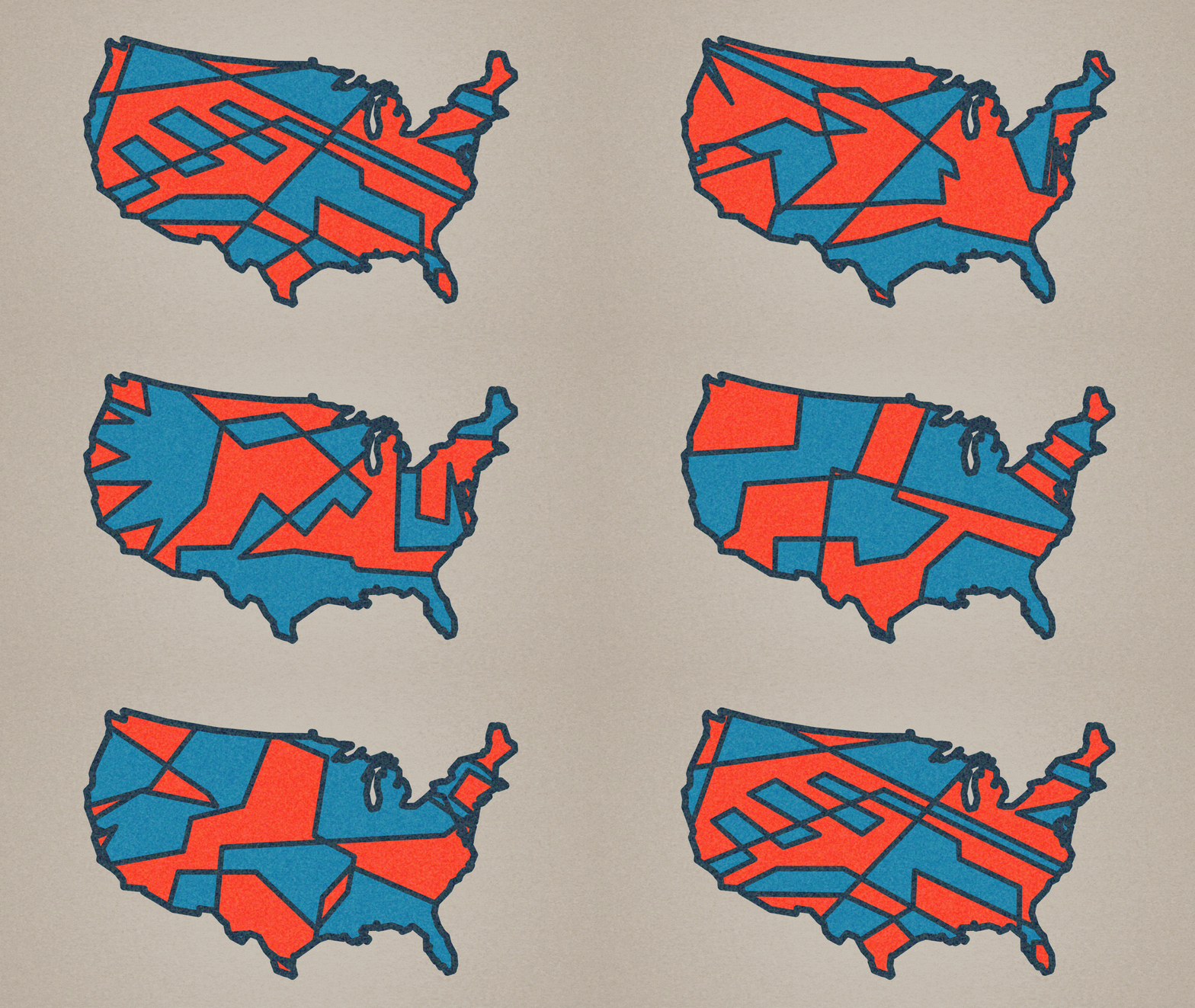
Republicans tried to save their House majority with a bold wave of mid-cycle redistricting. It failed in spectacular fashion on Tuesday. Why it matters: Republicans not only fell short of winning seats in several districts they redrew to favor their candidates, they put some GOP incumbents in danger of losing by spreading their support thin. Rep. Scott DesJarlais (R-Tenn.), who has mostly won landslide reelections since entering Congress in 2010, trailed his Democratic opponent by 200 votes, according to the Tennessee secretary of state's unofficial final results . Republican state legislators carved up his district in an effort to shore up neighboring Republicans, making his district nearly 20 percentage points less GOP-leaning. State of play: While Republicans succeeded in picking up a Democratic district in Tennessee to make up for that loss, they largely failed to pick up the seats they tried to make reliably Republican in other states. Florida: Republicans are set to go 0-for-4 in redistricted seats, failing to unseat Democratic Reps. Darren Soto, Kathy Castor and Jared Moskowitz, or capture a new seat that Democrat Pia Dandiya won. Texas: Republicans are set to narrowly win just one of the five districts they redrew heavily in their favor, with Democrats easily hanging onto several Rio Grande Valley and San Antonio-area seats. Ohio: Democratic Reps. Greg Landsman and Marcy Kaptur held on despite Republicans drawing them into more hostile territory. Alabama: Democratic Rep. Shomari Figures is also set for a comfortable win in a district Republicans had planned to fall into their hands. Louisiana: The district of retiring Democrat Rep. Cleo Fields, which Republicans made significantly more GOP-leaning will go to a December runoff between Democrat Patricia Moore and Republican Gabe Firment. One of the most stunning results of the night was Democrats' multiple apparent victories in North Carolina, where House candidates were boosted by Sen-elect Roy Cooper's stron

In red states and blue, Republicans suffered losses on a scale even Democrats would never have dared to dream about 24 hours ago. Why it matters: Democrats worried that polls showing a blue wave were overestimating the party's strength. It turned out polls underestimated the size of the Democratic romp — by a lot. The margins Democrats racked up in red states were stunning: Georgia: Sen. Jon Ossoff won reelection by nearly 18 percentage points. North Carolina: Former Gov. Roy Cooper won his Senate race by roughly 19 points. Texas: State Rep. James Talarico cruised to victory by approximately 12 points. These weren't nail-biters in competitive states. They were landslides in states President Trump carried just two years ago. The Texas trifecta Democrats won the Texas House, Senate and governor's mansion, giving the party unified control of state government for the first time since 1995. The sweep came alongside Talarico's double-digit victory in the U.S. Senate race. Texas, long the GOP's biggest electoral stronghold, delivered Democrats victories up and down the ballot. North Carolina was a bloodbath The man in charge of steering House Republicans to victory — Rep. Richard Hudson, chair of the National Republican Congressional Committee — lost his own seat. He'll join the ranks of other defeated party leaders — Speaker Tom Foley in 1994 and DCCC Chair Sean Patrick Maloney in 2022 — who spent so much time trying to build a majority that they failed to protect themselves. The carnage extended across the state. North Carolina's congressional delegation could shift from 10 Republicans and four Democrats to five Republicans and nine Democrats. The ridiculously cheap wins Democrats are leading in districts that received little or no outside spending from the Democratic Congressional Campaign Committee (DCCC) or House Majority PAC, the party's main House super PAC, according to AdImpact. In North Carolina's 6th, 9th and 13th districts, Missouri's 2nd and Tennessee's 4th, D

Latino voters helped Democrats break Republicans' decades-long grip on Texas and reclaim both chambers of Congress on Tuesday, casting doubt on President Trump's historic 2024 gains with the fast-growing electorate. Why it matters: Republicans bet Trump's Latino breakthrough two years ago would create a lasting GOP realignment in Texas and beyond. Tuesday's results exposed how quickly those gains could unravel — and raised new questions about Republicans' coalition heading into 2028. Early results show Hispanic voters' shift aided Democrats in capturing a Senate seat and the governorship in Texas for the first time in a generation. Tuesday's results — particularly in South Texas border counties — reflected some of the anger among Hispanics over high prices and the Trump administration's immigration enforcement. "This is what happens when you mess with the Latino community. We are sending a clear message," said Hector Sanchez Barba, president and CEO of the voting group Mi Familia Vota. By the numbers: Early NBC News exit poll results showed Latino voters moving away from Republicans. Democrats' 16-point advantage in Latino party identification grew from 10 points in 2024, according to NBC's polling. Some 43% of Latino voters identified as Democrats, up from 39% in 2024. Republican identification slipped from 29% to 27%. In the early NBC exit poll, 75% of voters nationally described the economy as struggling, while 65% said Trump's policies had made economic conditions worse. State of play: Democrats reclaimed the House and Senate while ending Republicans' statewide winning streak in Texas dating to 1994. Democratic state Rep. James Talarico defeated Republican Attorney General Ken Paxton , winning a Senate seat Democrats last captured in 1988. Democratic state Rep. Gina Hinojosa ousted Republican Gov. Greg Abbott , becoming Texas' first elected Latina governor. Early returns also suggested Latino voters helped Democrats win crucial House contests in Colorado and Geo

Democrat James Talarico has won the US Senate race in Texas, securing an astonishing and historic victory. Talarico, a state representative, beat the scandal-plagued attorney general Ken Paxton in the most expensive race of this midterms cycle. He is also the first Democrat to win a US Senate seat in the Lone Star state since 1988. Continue reading...

The woman who took down Greg Abbott concentrated on pocketbook issues, but voters’ opposition to Republican immigration policies was a tailwind.

Elon Musk cracked jokes early Wednesday morning after the Republican candidates he spent record sums supporting got drubbed in a historic midterm election. Why it matters: No one has ever spent as much as Musk for so little payoff — especially in Texas , which ended up with a massive blue wave. He spent an estimated $445 million in this cycle, making him the largest individual donor in modern history. What they're saying: " Guess my election-interfering space lasers didn't work this time 🤷♂️," Musk posted to X just before 1:15am ET. The intrigue: Musk also nodded at the results in the Texas governor's race, where anti-data center Democrat Gina Hinojosa won a shock victory . "Data centers in space looking pretty appealing right now," he wrote . What to watch: It's not clear how the massive power shift in Texas will affect Musk's ambitions for his companies in the state — or how the loss will impact his appetite for more spending in 2028.

For years, Ken Paxton turned scandal into a test of Republican loyalty, but his Senate defeat exposed the limits of a political strategy that helped reshape Texas.

Mr. Pulido, a Latin Grammy Award-winning singer and conservative Democrat, ousted a Republican incumbent in a district President Trump won by 18 percentage points in 2024.

Senate Republicans' worst nightmare came true Tuesday night, as they watched red state after red state fall to a historic Democratic wave . Why it matters: It's hard to remember now, but Republicans started off the 2026 cycle thinking they could expand their majority. They ended the night with what one source called a "huge f**king thumping" — losing or trailing in every toss-up on the map. At the start of the cycle, top operatives saw a red wall of incumbents in Trump-friendly states, an invincible Republican Sen. Susan Collins in Maine and a vulnerable Democratic Sen. Jon Ossoff in Georgia, who provided a path to expanding a majority. By 9pm Tuesday night, top GOP sources were quietly accepting the reality of the return of Majority Leader Chuck Schumer (D-N.Y.). "Republicans are going to wake up in a different country tomorrow and we are going to have to start from square one to reinvent a party," one senior GOP Senate aide told Axios on Tuesday evening. Between the lines: For the first time since 1972, Republicans lost a Senate seat in the home state of the chair of the National Republican Senatorial Committee. The defeat of Sen. Darline Graham (R-S.C.) came despite Sen. Tim Scott (R-S.C.) leading the NRSC. Republicans also lost in the home state of the next expected NRSC chair, Bernie Moreno (R-Ohio). Zoom in: North Carolina and Georgia were expected to be the premiere races of the cycle not too long ago. Both were called for Democrats before 8:30pm EST. That was just the beginning of the nightmare. In Texas, Elon Musk's more than $150 million infusion wasn't enough to save Texas GOP Senate nominee Ken Paxton after Paxton defeated Sen. John Cornyn in a nasty primary. In Ohio, Sen. Jon Husted's (R-Ohio) campaign had a rocky start — and wasn't bailed out by President Trump's publicity campaign about his rear end. Alaska started looking shaky even before a second Dan Sullivan joined the ballot, and Iowa wasn't a given either. In Kansas, alarm bells started ringing

In a seismic shift that was once unthinkable, victories by James Talarico and Gina Hinojosa upended decades of statewide dominance in what had been the nation’s most populous conservative state.
In the race for U.S. Senate in Texas, Republicans forfeited gains that President Trump made among Hispanic voters in 2024. Our election data reporter Christine Zhang explains.

Party sees historic victories with Gina Hinojosa’s stunning upset in Texas and Georgia’s Keisha Lance Bottoms becoming first Black female governor in US Democrats are hoping to win a majority of governor’s offices across the US after marking significant victories in Texas, Georgia, Ohio and Iowa. One of the biggest prizes of the night was the Texas governorship, with Democratic state representative Gina Hinojosa unseating Republican incumbent Greg Abbott in a stunning upset. Hinojosa will be the first Latina governor of the state, and the first Democrat elected to the Texas governorship in 30 years. Continue reading...

State Representative Gina Hinojosa defeated Gov. Greg Abbott, denying him a fourth term and becoming the first Hispanic candidate elected to lead the state.

Hinojosa wins momentous victory, shatters Republican grip on key office and will become state’s first Latina governor US midterm elections – live updates Track live results from all 50 states In a stunning political upset that would have seemed improbable only a few weeks ago, Democrat Gina Hinojosa has defeated three-term governor Greg Abbott on Tuesday, shattering the Republican grip on the state’s highest and most powerful executive office. Hinojosa’s historic victory – she will be the state’s first ever Latina governor – ended Abbott’s bid for an unprecedented fourth term, and delivered Democrats their most consequential victory in the state in a generation. Continue reading...
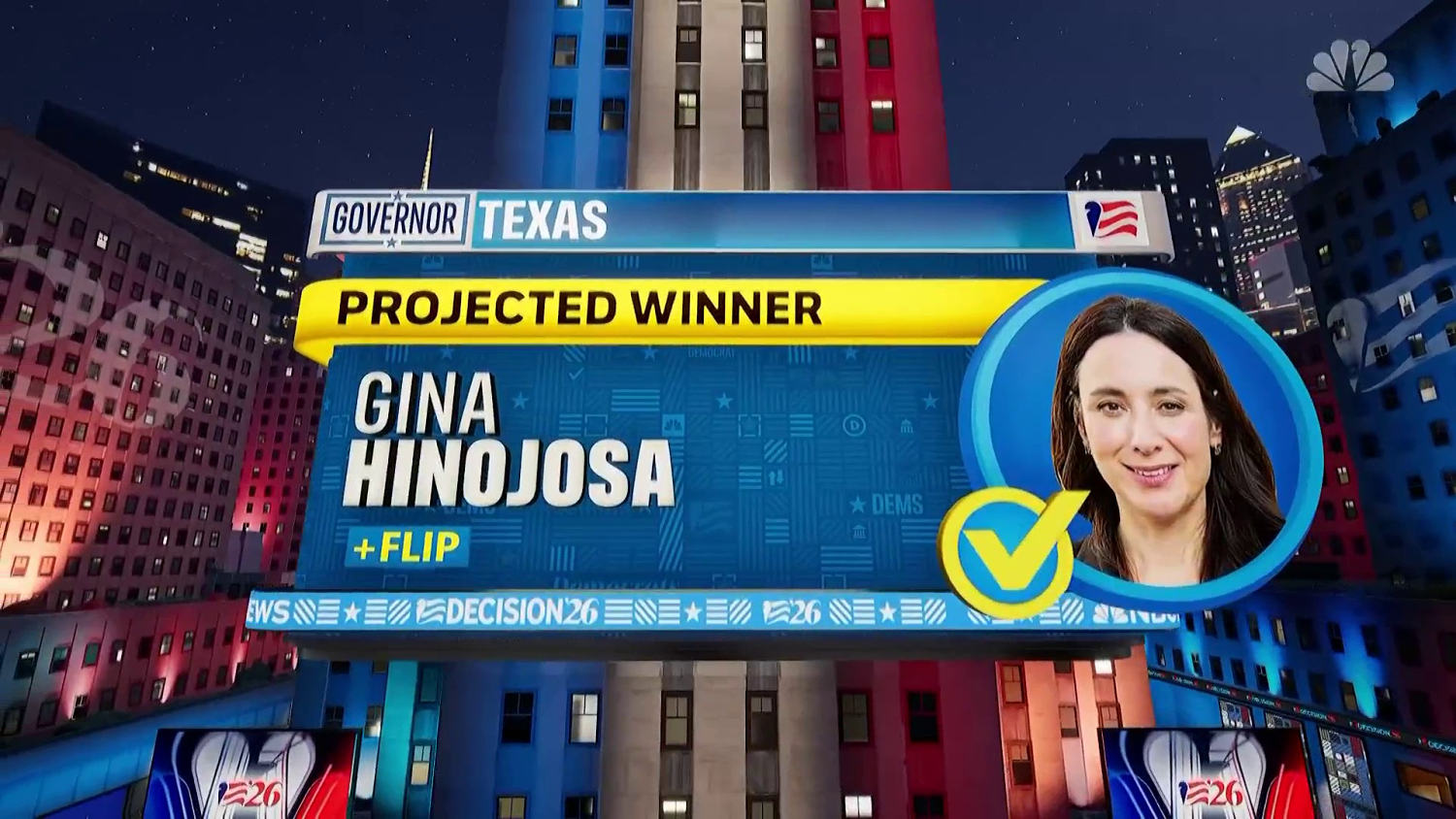
NBC News projects that Democrat Gina Hinojosa will win Texas' race for governor, unseating Republican Gov. Greg Abbott.

Democrat James Talarico defeated Republican Ken Paxton in Texas' closely watched U.S. Senate race, delivering a historic breakthrough for Democrats in a state Republicans have dominated for decades. Why it matters: Talarico's victory ends the nation's longest Democratic drought in statewide elections and flips a critical Senate seat as Democrats fight for control of the chamber. The Austin-area state representative becomes the first Democrat elected to the U.S. Senate from Texas since Lloyd Bentsen in 1988. His win also marks the first Democratic victory in a Texas statewide election since 1994, a stunning reversal in a state President Trump carried by nearly 14 points in 2024. The big picture: The race became the nation's most expensive Senate battle after Texas Attorney General Paxton defeated longtime incumbent Sen. John Cornyn in the Republican primary, with massive spending from both parties . Republican leaders had warned that Paxton's nomination could jeopardize the seat, and the party poured enormous resources into defending it. On the campaign trail: Talarico, a former public school teacher and Presbyterian seminarian, built his campaign around affordability, public education and criticism of wealthy donors' influence over politics. Paxton, a three-term Texas attorney general and close ally of President Trump , emphasized immigration enforcement and conservative policies. Between the lines: Paxton's candidacy exposed divisions within the Texas GOP, with party leaders initially warning that nominating the attorney general could endanger a seat Republicans had held for decades. Paxton defeated Cornyn in the May Republican primary runoff after securing Trump's endorsement, setting up the costly general election battle. His campaign was also shadowed by years of legal and ethical controversies, including his 2023 impeachment by the Republican-controlled Texas House. The state Senate later acquitted him. The backdrop: Democrats have spent decades trying to turn
Democrats have won key Senate races in Georgia, North Carolina and South Carolina. Our election data reporter Evan Reynolds explains how Democrats did well even in some historically Republican counties in these Southern states.

James Talarico, a state lawmaker, beat Ken Paxton, the Republican attorney general, after a bruising and costly campaign.
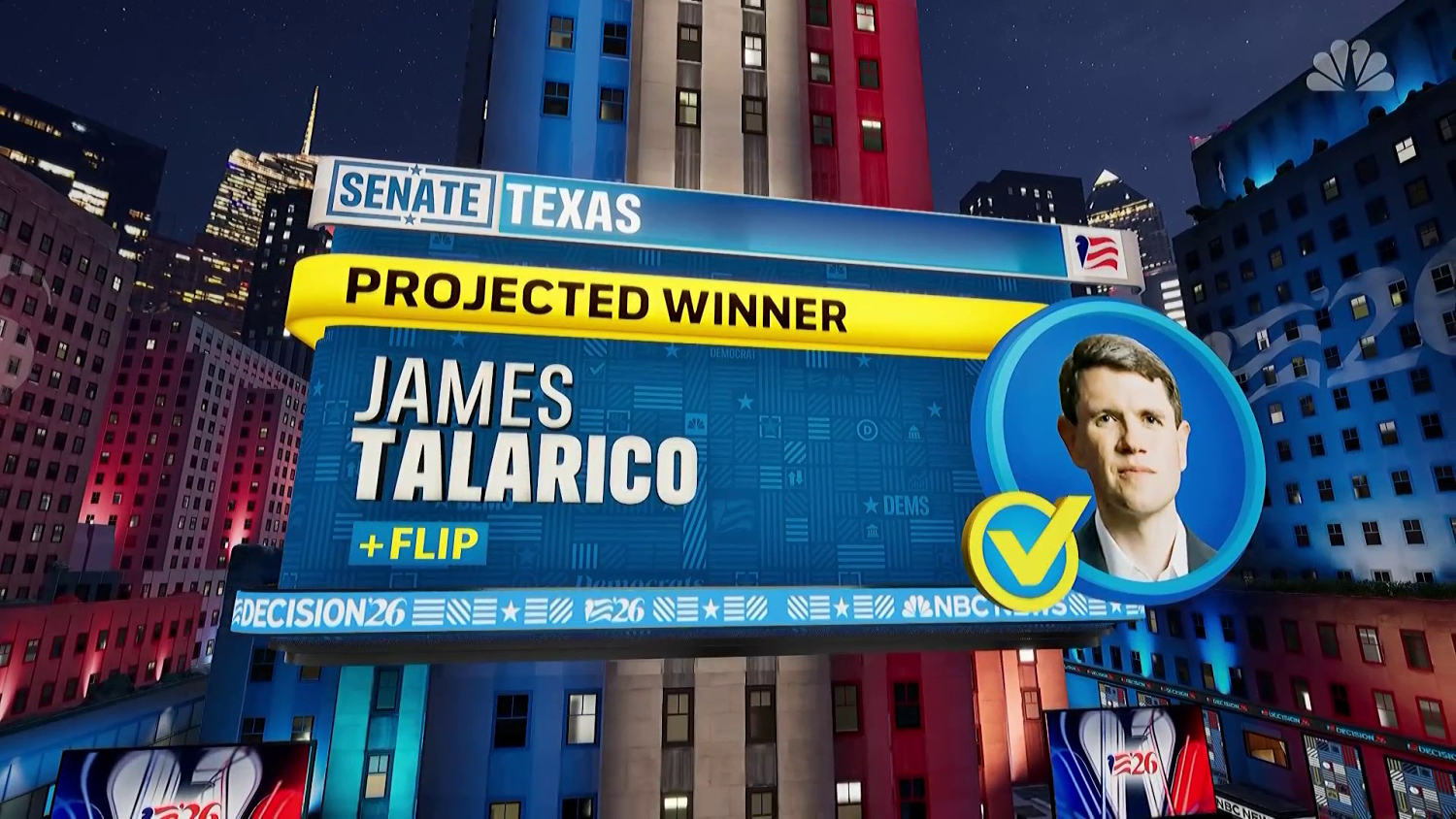
Democrat James Talarico has defeated Republican Ken Paxton in the race for Senate in Texas, NBC News projects, ending a three-decade Republican grip on the state.

Texas has 254 counties. Here’s a guide to six crucial regions in the Senate race.

Top party strategists may hate seeing one of their candidates gutted by a brutal ad. But they can still admire the hit. Why it matters: A record $11.6 billion has plastered political ads across screens of every size in the country during the 2026 midterms . Only a handful of those earned the grudging respect of operatives on both sides. 📺 Zoom in: Multiple Republican strategists singled out the "brutal" series of ads attacking Sen. Roger Marshall (R-Kans.) over lawsuits against patients with overdue medical bills — some of whom were later arrested . Against the advice of his own team, Marshall released a self-directed ad answering the attacks. In Nebraska , an ad highlighting a past vote by former Gov. Pete Ricketts to pardon a man convicted of rape was singled out by both parties as one of the cycle's most damaging. Ricketts is expected to win re-election to the Senate. In Maine, an upbeat jingle hit Democratic nominee Troy Jackson for having children with his second cousin. "If he'll f**k his own family, he'll f**k yours too," the radio ad said (among other things). Sen. Susan Collins (R-Maine) called for the ad to be taken down. And in Florida , Rep. María Salazar (R-Fla.) turned on her own party leader, criticizing President Trump over ICE's aggressive enforcement tactics, saying some immigration policies had "gone too far." The intrigue : Even hardened operatives are dealing with a new frontier: AI-generated attack ads that can make up scenarios and put words in an opponent's mouth. In Michigan , a Republican-aligned super PAC used AI-generated imagery to depict Democratic candidate Abdul El-Sayed in a fabricated family photo and playing a game with cards referencing "Death to America" and 9/11. In Texas, GOP Senate nominee Ken Paxton's team used AI to depict Democratic candidate James Talarico defacing a Bible with a crayon and saying: "In the beginning God was non-binary, and he wasn't a Christian. And God said, 'let there be six genders,' and there were." ?

This batch of key Southern states will offer early insight into the battle for Senate control.