
Democrats will charge into January with a sweeping mandate — but as President Trump has repeatedly noted, his veto power can deliver a robust roadblock to his opponents' agenda. Why it matters: Democrats may be forced to compromise to get legislative priorities through. Trump will have to decide how frequently he'll use the power — and whether he'll strike down bills popular among Americans. State of play: Democrats have secured 54 seats in the upcoming Senate, per the AP's projections , and are leading in two tight races in Mississippi and Alaska that have yet to be called. In the House, they've won 254, per AP , with several race calls still to come. Neither majority will be large enough to cross the two-thirds threshold Democrats would need to override a presidential veto on their own. Friction point: Trump knows that — and has teased his plans to impede Democrats' progress by using the power liberally. On Tuesday night, as election results rolled in, Trump posted an image of a red MAGA-esque hat that read "VETO" in all caps. A similar hat was displayed on the Resolute Desk during a Thursday signing ceremony. Asked on Fox News how he'd work with a Democratic Congress, Trump pointed to the veto: "They're in control, but they're really not in control because they can send over, you know, 50 different great bills that they're all excited about and I send them back with a nice stamp, veto." White House spokeswoman Lauren Bis said in a statement provided to Axios that Trump is "willing to work with anyone to continue delivering victories for hardworking Americans." She added, "If Democrats choose to pursue radical left policies, they are choosing to work against the American people." Worth noting: Lawmakers secured enough support to override a Trump veto across party lines during his first term on the National Defense Authorization Act in 2021. Yes, but: While Trump could use veto threats to force lawmakers to negotiate or to halt legislation altogether, vetoing popul
Results for “mississippi valley”
Current and former House Democrats, flush with victory following their landslide midterm wins , are already looking at potential opportunities to run for Senate in 2028, Axios has learned. Why it matters: Democrats' 2026 romp — with wins in Texas, South Carolina, Kansas and possibly even Mississippi — has some party members reevaluating what were once considered impossible targets. A source close to Rep. Sharice Davids (D-Kan.) — who was reelected by 21 percentage points in a district former Vice President Harris carried by four points in 2024 — did not rule out her running against Sen. Jerry Moran (R-Kan.). "All options are on the table," the source said, adding that Davids' "focus right now is on delivering actual results and overcoming the chaos from these extreme policies we're seeing." Sen. Roger Marshall (R-Kan.) was defeated by Democrat Adam Hamilton last week, marking the first time in nearly a century a Democrat has been elected to the U.S. Senate from Kansas. North Carolina: Rep. Don Davis is "taking a look at" a run against Republican Sen. Ted Budd, a source familiar with his thinking told Axios. Davis won a third term on Tuesday after defeating his GOP opponent in a district President Trump carried by 12 points in 2024. Republicans redrew the district with the express goal of ensuring Davis' loss. Former Rep. Wiley Nickel, who was elected Wake County district attorney on Tuesday, would consider a Senate run if state Attorney General Jeff Jackson doesn't, a source close to him told Axios. The two served together in the House. Democratic former Gov. Roy Cooper won North Carolina's other U.S. Senate seat last week in a nearly 20-percentage-point landslide over Republican Michael Whatley. Pennsylvania: A huge field of Democrats is gearing up to potentially run for the seat held by Democratic Sen. John Fetterman. Fetterman, who has morphed from a populist firebrand to an arch-centrist, has angered much of the party by siding with Republicans on key votes. Rep

The same technical limits that prevent superintelligence make these systems dangerous. But we know how to regulate them Many Silicon Valley leaders believe superintelligence is an imminent threat to society. The White House even published an accord about it. This isn’t enough. Geoffrey Hinton, the godfather of AI, estimates the risk of human extinction is at least 10% within the next few decades. The Anthropic CEO, Dario Amodei, argued that unchecked AI “could outrun our ability to understand and control these systems”. In response, 1,300 leaders and employees from many leading AI companies signed a letter calling to “deliberately pace” development. Continue reading...

A new examination of video footage shows that the officer who shot at a fleeing car in a Walmart parking lot, killing a boy, had previously ramped up encounters by punching, cursing and drawing his weapon.
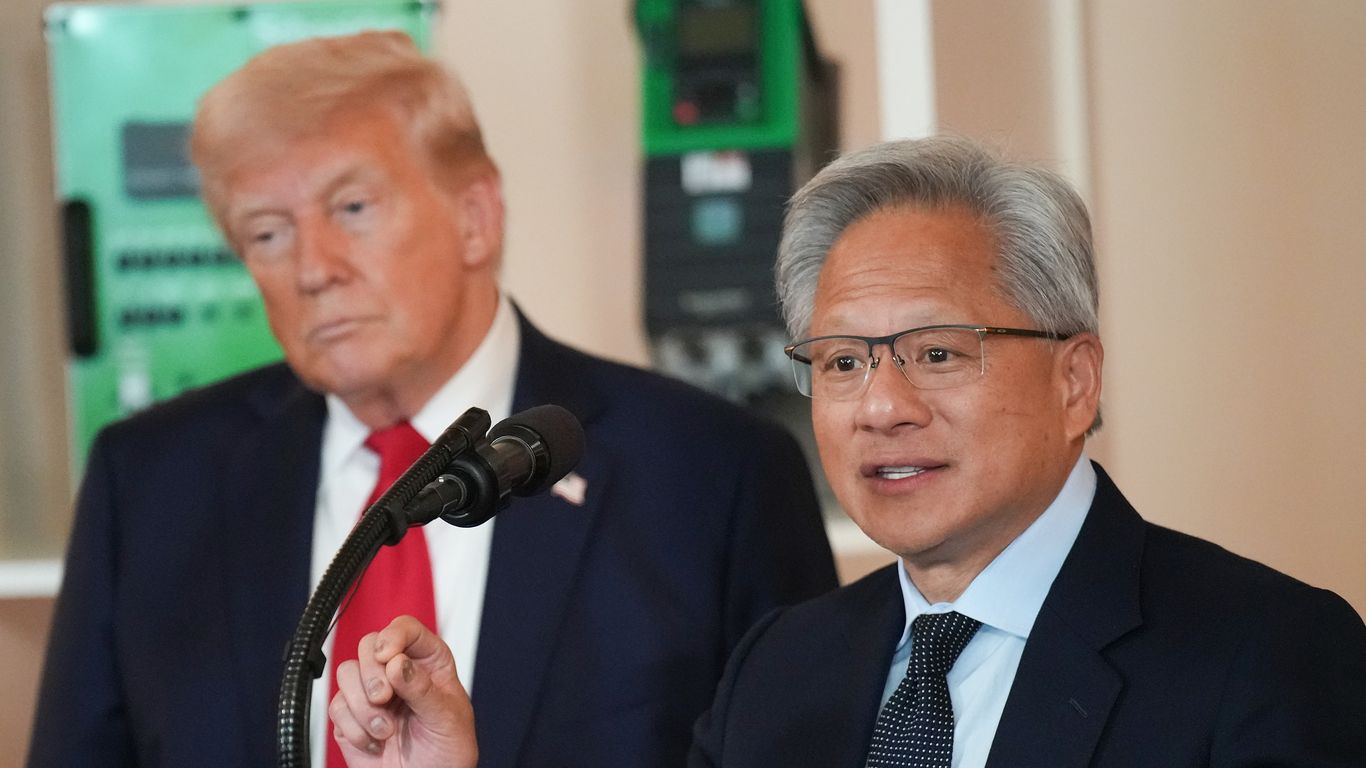
The world's most powerful AI executive admitted Sunday to an affair with a suspected Chinese spy, sending shock waves through an industry built on his singular influence. Why it matters: Nvidia CEO Jensen Huang has fashioned himself as the indispensable leader of an indispensable company — a $4.5 trillion behemoth with unparalleled clout in Silicon Valley, on Wall Street and inside President Trump's White House. Trump stood by Huang on Sunday evening, telling reporters that the Nvidia CEO is "an honorable guy" and "probably has an excuse" for his infidelity. The big picture: Huang, who has led Nvidia since founding the chipmaker 33 years ago, has become the AI boom's chief evangelist and most authoritative voice. He has brushed aside fears of both a speculative bubble and technological catastrophe, joining forces with Trump to calm markets and the public as warnings of an AI apocalypse reached fever pitch. For almost any other CEO, an affair with a suspected foreign intelligence operative could be career-ending. Huang's grip on Nvidia — and the company's extraordinary importance to the AI economy — may insulate him from the same fate. Driving the news: Huang confessed to the affair in a letter to staff Sunday, apologizing to his family as Nvidia's board launched an independent probe into the suspected Chinese intelligence operation. U.S. officials believe Alice Huang, an executive at Nvidia customer Megaspeed, was recruited by Beijing's top spy agency to gather information and potentially influence Nvidia's campaign to expand advanced chip sales to China. Nvidia's board said it had no reason to believe national security or company secrets were compromised and expressed confidence in Jensen Huang, who intends to remain CEO during the investigation. Zoom in: The New York Times first exposed the suspected Chinese espionage operation on Oct. 29, reporting that a woman believed to be working for Beijing had developed a close relationship with Nvidia's CEO. The company po

Election results appear to have turbo-charged an already growing social, political and financial market rethink about AI ‘AI clog’: UK battles onslaught of chatbot-generated complaints Editorial: the AI backlash – Silicon Valley’s political power is cracking Last week’s midterms may not have cowed Donald Trump, but they should be a wake-up call for the grinning tech broligarchs who lined up at his inauguration two chaotic years ago. Clearly, the cost of living squeeze unleashed by Trump’s war in Iran was a big driver of the Democrat wave. But AI was also on the ballot – in many places, literally. Continue reading...

The echoes of history surround Scott Colom’s final push toward victory, but assembling the coalition that propelled him took hard work after many Democratic misses.
Maga’s regret voters were all-in for Trump’s racism. Then they found out they couldn’t afford it For the first time in a decade, election predictions far exceeded public expectations. What pollsters anticipated as a blue wave billowed into a blue tsunami . Wins that held ground for already blue seats eased nerves, and the flips of swing states like Michigan, Georgia, North Carolina and Ohio energized the blue base. But red-belt-busting wins in Republican strongholds like Texas, South Carolina and Kansas alongside pending races in Alaska and Mississippi left mouths agape. The explanation was that Democrats turned out far more supporters than their regulars, and that the “ regret voter ” (both swing voters and partisan Republicans) expanded the wave across districts Trump previously won . Elation and sighs of relief rolled over consistently Democratic voters who suffered multiple sucker punches from recent years of Republican upsets. Regret voters, who run the gamut from gen Z men to Latinos , farmers and the white working class , hope a different party can deliver on the economy Trump promised them. Blue voters look at the dismantling of democracy, multiple wars, mass deportations and Trump’s unchecked power in these last two years and see how it all could have been avoided. Regret voters, however, either co-signed or conceded to Trump’s naked racism and brutish bullying of marginalized people, but switched their votes as soon as the consequences hit their pockets. While some of the president’s backers may have been turned away by Immigration and Customs Enforcement (ICE) gunning down American citizens, the final straw for most wasn’t ICE’s brutality , but rather the price of eggs. Some may have been upset by the Tomahawk missile assault that killed 120 schoolgirls in Iran, but most fumed at the rocketing costs at the gas pump that followed. Few demanded answers for the nearly 60 deaths of innocent people detained in DHS detention centers since the start of 2024, but
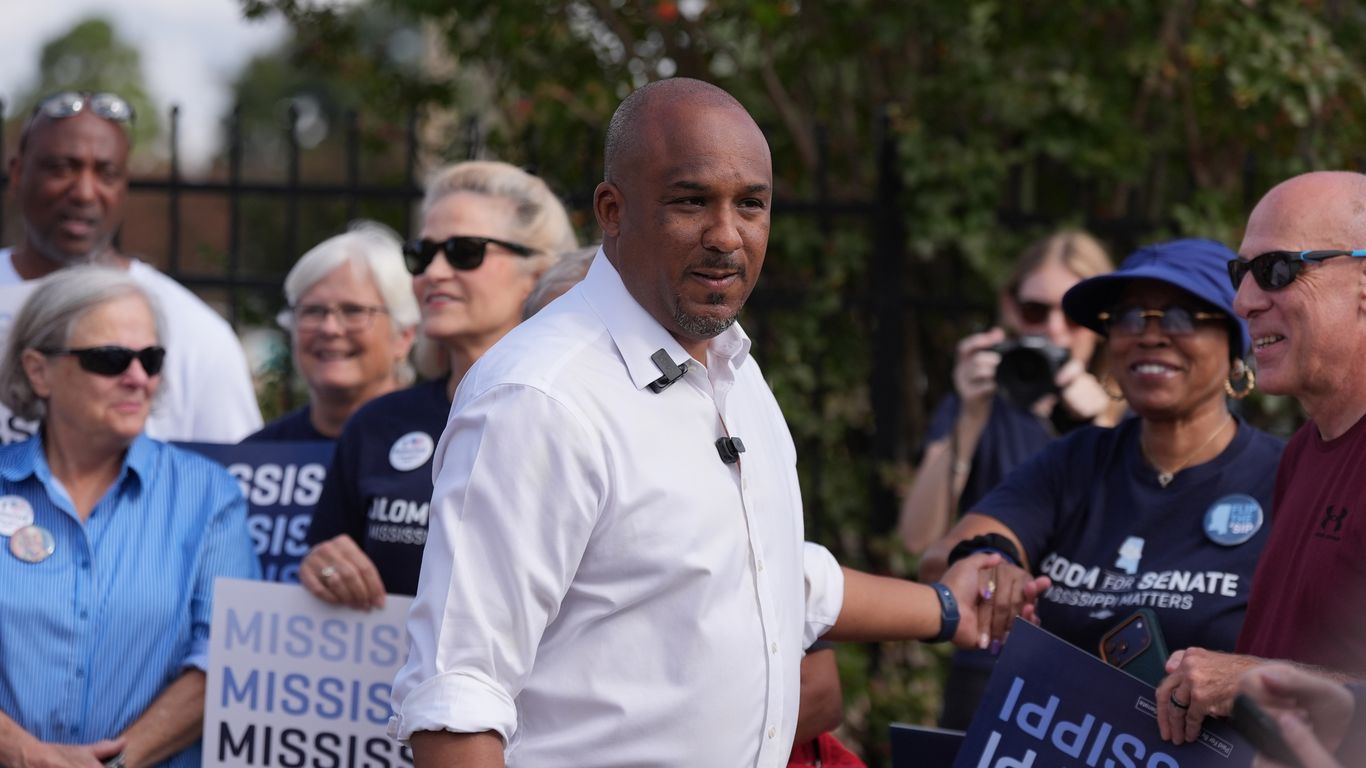
Americans on both sides of the political aisle are watching the nail-bitingly close Mississippi Senate race , where a controversial voter-roll cleanup has come under scrutiny after some voters reported problems casting their ballots. Why it matters: The cliffhanger has exposed concerns about relying on third-party data to determine where voters live and how states maintain voter rolls. Republican Sen. Cindy Hyde-Smith and Democrat Scott Colom are locked in a razor-thin race to be the state's junior senator. As of 2 p.m. ET Friday, Colom led by a little over 2000 votes, according to Associated Press data. The big picture: More than 230,000 Mississippians were listed as inactive ahead of the midterms, according to an analysis by Mississippi Today. That's up from roughly 166,000 in the 2024 election, according to federal data . Those voters weren't removed from the rolls, but they were required to cast affidavit ballots in Tuesday's election. Election workers review those ballots after Election Day, checking voter information against registration records. In some cases, voters must verify their identity with their county circuit clerk's office, slowing vote counting and — in this case — determining the winner. The intrigue: The inactive voter total shot up after the state's March primaries, months after Secretary of State Michael Watson's office inked a $50,000 deal with credit reporting company Experian to help verify voter addresses. "The increase in inactive registrations across the state of Mississippi raised some concerns because it seemed unusually high compared to other cycles and in such a small amount of time," Thessalia Merivaki, an elections research expert and former professor at Mississippi State University, tells Axios. She says there were concerns about "how reliable" these data brokers are, and whether relying on them had "resulted in erroneously placing eligible voters on an inactive status." How it works: Experian's data was intended to flag voters wh


Historians and political scientists say that framing the wins as ‘Ohio’s working class has come home’ is too simple At its peak, the Mahoning valley was once the beating heart of the US’s steel economy – a hardscrabble, heavily unionized Democratic bastion in north-eastern Ohio. But de-industrialization, sparked by the mass closure of steel mills in the late 1970s, transformed the region. Tens of thousands of manufacturing jobs disappeared. Populations declined. And support for Democrats slowly, but surely, faded. In 2020, Mahoning county voted for its first Republican presidential candidate – Donald Trump – in a generation. Continue reading...
Scott Colom, the Democratic nominee, has kept his edge over the Republican incumbent, Cindy Hyde-Smith, as more provisional and mail ballots were reported throughout the state.

Democrats widen gap in House chamber by flipping more seats, including in Ohio, Arizona and North Carolina; Ted Cruz calls election a ‘Watergate-level repudiation’ Live results | Q&A: Ask your questions about Democrats’ win Sign up for Breaking News US email Welcome to our live coverage of the US midterm elections – here are some of the latest key developments. A number of closely watched contests in the midterms are still to be called, including the final two US Senate races – in Mississippi and Alaska. The Democratic candidates are hoping to oust Republican incumbents to bolster their new majority in Congress. Right now, Democrats have a 106-seat majority as we await final results. Democrats flipped another eight House seats , strengthening their majority in the lower chamber. Democrats are now leading Republicans 253 to 157, with 25 races left to call, as a number of GOP representatives felt the weight of the blue wave that has swept their party out of power. Republicans held on to two House seats in the west as congressman Mike Kennedy won re-election in Utah and Amanda McKinney won in Washington. Democratic socialist Nithya Raman was elected to serve as the mayor of Los Angeles , eking out a narrow win over incumbent Karen Bass, in a major shake-up in local politics that reflects the growing dissatisfaction with the direction of the city. The progressive urban planner had served on LA’s city council since 2020. Continue reading...

A phalanx of lawyers, observers and campaign officials are watching the counting of votes in the race for Senate, where a Democratic challenger has a slim lead.
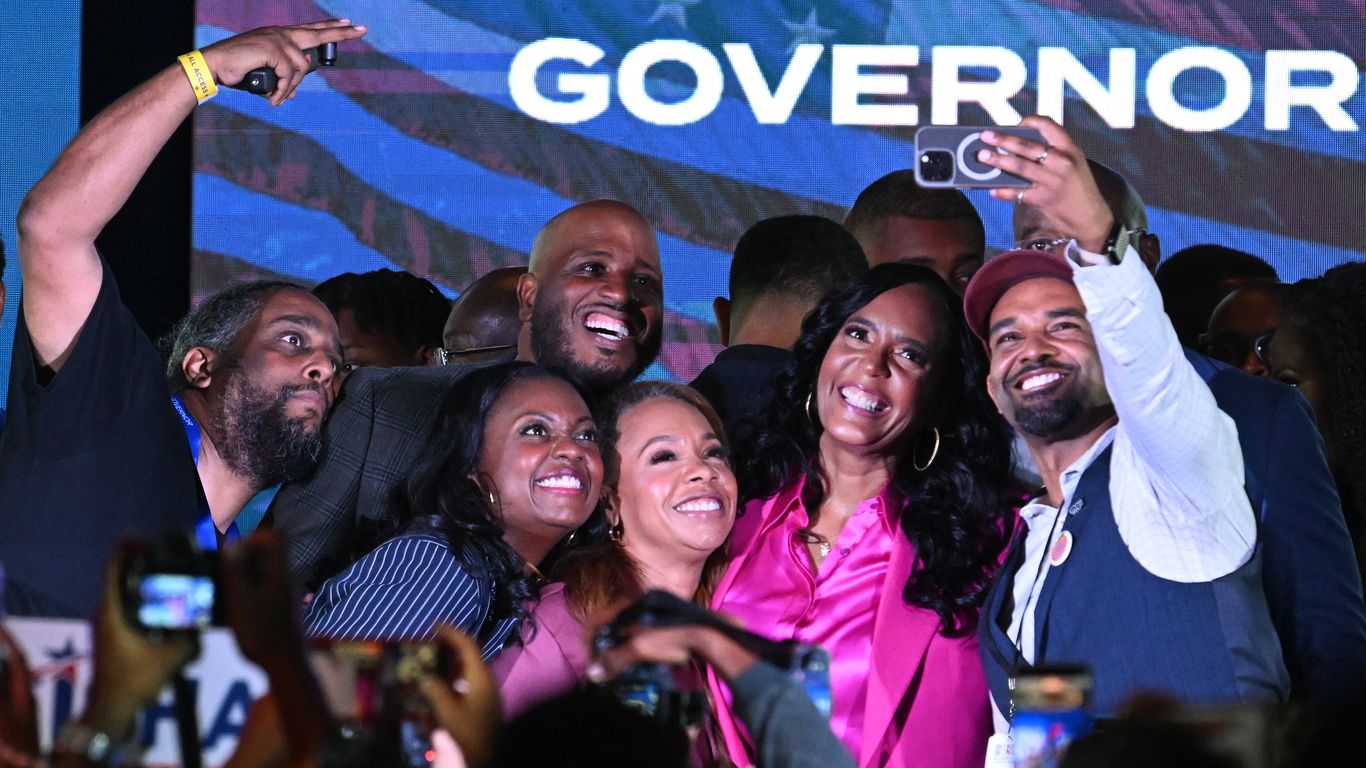
President Trump won historic levels of support from Black men in 2024. Two years later, those gains appeared to evaporate as Republicans suffered their worst midterm defeat in 50 years. Why it matters: Democrats feared the Supreme Court's decision weakening the Voting Rights Act would threaten their political future in the South. Instead, Black voters helped deliver historic Democratic victories in Texas and Georgia, with a potential upset brewing in Mississippi. By the numbers: Roughly nine in 10 Black voters backed Democratic House candidates Tuesday, according to the AP Voter Poll . Only about one in 10 Black men backed Republicans. Roughly one-quarter supported Trump in the 2024 presidential election, according to AP's analysis. For context, a separate 2024 national House exit poll found Black voters favored Democrats 84%–14%. Black men split 75%–24%, while Black women backed Democrats 90%–8%. State of play: Two Democrats who faced questions about their support among Black voters won crucial Senate races. Michigan: Progressive Democrat Abdul El-Sayed defeated Republican Mike Rogers , becoming the nation's first Muslim senator. A late-October poll showed El-Sayed drawing 87% support among likely Black voters. Texas: Democrat James Talarico defeated Republican Ken Paxton after courting Black voters who overwhelmingly backed Rep. Jasmine Crockett in the Democratic primary. An August Texas Southern University poll showed Talarico leading Paxton 79%–12% among likely Black voters. Zoom in: Talarico built commanding margins in Harris County, home to Houston, and Dallas County, both home to large Black electorates, according to AP county-level returns . Zoom out: Black voters helped elect former Atlanta Mayor Keisha Lance Bottoms as the first Black woman governor in U.S. history . About nine in 10 Black men voted for Bottoms, compared with roughly three-quarters who supported Kamala Harris in Georgia in 2024, according to the AP Voter Poll . Black women's support remain
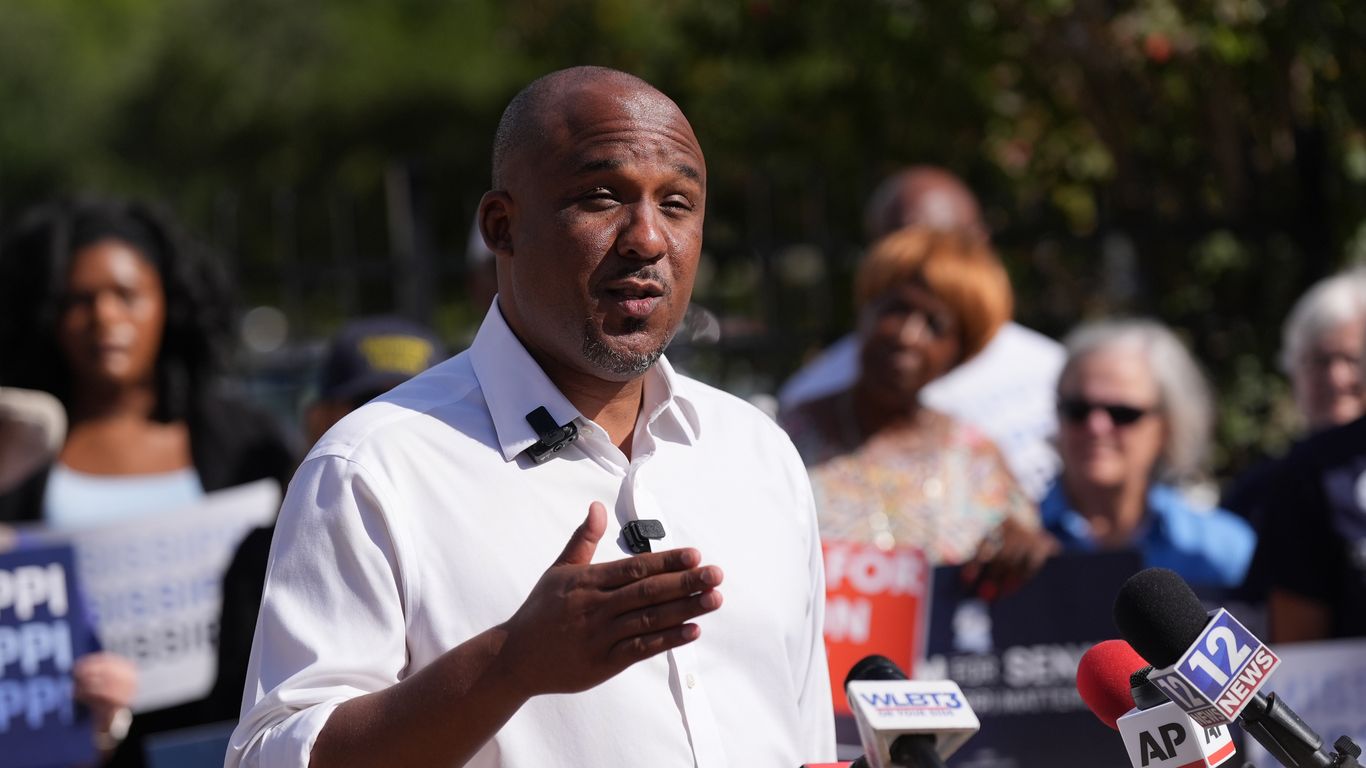
One of the biggest nail-biters of the 2026 election isn't playing out in a purple state, but crimson Mississippi, where Democrat Scott Colom is trying to pull off a Magnolia State marvel. The big picture: It's one of the most remarkable currents of Tuesday's blue wave. The race pitted Colom, a Democratic district attorney powered by grassroots clout, against incumbent Republican Cindy Hyde-Smith in a state Trump won by some 23 points in 2024. The big picture: The coalition Colom built with his viral ads and the historic tenor of his candidacy faces the ultimate Deep South test. The race remains too close to call. "The flag has already been planted in Mississippi that a new day has arrived, and whether these final votes carry Scott Colom into that victory column, we will find out," says Nadine Smith, president and CEO of Color Of Change. "But … change has arrived." Follow the money: Colom's was one of the red-state races that drew the attention of Florida attorney Steve Pajcic, whose family-run super PAC New Deal for All sought to boost Dems in under-the-radar races. Mississippi, where they invested around $1.1 million, was ideal "in size and in potential," he tells Axios. That money went far on Mississippi's less-expensive airwaves. The most-aired ad in the closing week featured an Epstein survivor condemning Hyde-Smith, Axios' Donica Phifer reported. New Deal for All paid for the ad, which inundated Mississippi's TV markets. Catch up quick: In October, Axios reported that Senate Republicans were weighing a cash infusion into the race. The GOP Senate Leadership Fund eventually made an investment. Democrats ' Senate Majority PAC announced a $1.2 million ad campaign, and Colom also drew party heavy-hitters like former Vice President Kamala Harris and former President Clinton for appearances. Former President Obama also cut an ad. Zoom out: The race's seismic nature is also fueled by history. Colom would be Mississippi's first Black senator since Reconstruction, and it

Mr. Villegas flipped a district held by Representative David Valadao, a moderate Republican, in the state’s traditionally conservative Central Valley region.

Democrats are clinging to small leads in both states, and it may take quite a while until the winners are known.

The race for U.S. Senate is incredibly close in Mississippi, which does not allow for vote recounts in statewide elections.
Mr. Villegas flipped a district held by Representative David Valadao, a moderate Republican, in the state’s traditionally conservative Central Valley region.
Emergency crews responded to an explosion at a chemical plant in Mississippi that sent a large plume of black smoke into the air

Make no mistake: Democrats won by epic, sometimes historic margins across red and blue states, up and down ballots, obliterating almost everything President Trump, and a Republican Party remade wholly in his image, built over the past decade in American politics. Why it matters: Trump and Republicans are left with a mostly white, mostly old House and Senate minority, confronting a younger, more diverse ascendant Democratic Party with power and margins it hasn't held in 18 years, since the dawn of the Obama era. The results speak louder than any words we can write: Democrats won Senate races in Texas, Kansas, South Carolina, Ohio, and perhaps Mississippi en route to what could be a 55-seat majority. Democrats won swing districts all across red America, with national average margins of victory of roughly 13 points, according to a New York Times estimate . Texas is now a Democratic state, top to bottom — unthinkable mere months ago. James Talarico crushed Ken Paxton ( 55% to 43% ) like it was Connecticut. State Representative Gina Hinojosa will become the first Democratic governor of Texas in 32 years . Pastor Adam Hamilton is the first Democrat to win a Senate seat in Kansas in 94 years. North Carolina looks like a true-blue state after Democrats flipped the Senate seat and likely ousted Rep. Richard Hudson (R-N.C.), chair of the National Republican Congressional Committee (NRCC) — meaning he led the GOP drive to keep the House. North Carolina's congressional delegation could swing from 10R-4D to 5R-9D. Georgia was even worse for Republicans, where they lost all power at the state and U.S. Senate levels. Florida Gov. Ron DeSantis (R) predicted on X that the losses were so widespread, so deep, so severe that Republicans might not "have a shot at Senate control until 2032." How to think about last night more broadly: This is a 50-50 nation with fast, whiplash shifts in power at the federal level due to persistent discontent with the party in power. So, on one hand, this
Voters showed deep distrust of the AI race Tuesday, approving dozens of data center moratoriums and electing a raft of candidates who favor slowing a $10 trillion buildout, including in Texas — the epicenter of the boom. Why it matters : In an election that hinged on an affordability crisis for many Americans, voters made it clear they view Silicon Valley's AI ambitions not as a technological miracle, but as a resource-draining threat to their wallets and communities. The results were a warning shot to some of the nation's wealthiest and most powerful executives, many of whom are already working on ways to build a more palatable version of the revolution they are dead-set on winning. "What we just witnessed was an AI earthquake," Brad Carson, co-founder of Americans for Responsible Innovation, told Axios. "Voters just sent a clear message that they want rules for AI and data centers." Driving the news: Democratic challenger Gina Hinojosa's surprise victory in the Texas governor's race fundamentally scrambles the math for the AI buildout. Hinojosa campaigned on keeping a moratorium on data center construction in place until the state passes legislation tackling impacts on water, electricity, air and property rights in the legislative session that ends in mid-2027. While most 2027 U.S. data centers expected are already under construction, a hold for more than six months would bring extended delays to Texas, which accounts for 41% of new U.S. capacity in 2028, according to the research firm SemiAnalysis. Democrats won all three of the states that follow Texas for new data center capacity, including Ohio, Georgia and Arizona. The winners in Ohio and Georgia favor restrictive policies, although it's not yet clear how those will take shape. Between the lines: All told, nearly two-thirds of 2028 data center capacity could face delays, although most political analysts don't see Democrats permanently blocking construction. What they're saying: A host of candidates and politi

It was a drubbing on a scale that neither side saw coming: Democrats pummeled Republicans across the battleground map and into some of the most MAGA-friendly terrain in the country. Why it matters: The results were an emphatic rejection of Donald Trump's second term in office — and set the stage for two years of corruption investigations and legislative frustration for the lame-duck president. Here's a rundown of what you need to know about last night's historic GOP beatdown. The size of the Dem majorities It was clear early in the night that Democrats would flip the Senate. Few predicted how big their majority would end up. Democrats will have at least 54 Senate seats, and another two — in Alaska and Mississippi — were too close to call early Wednesday. The New York Times projects Democrats will win 257 seats vs. 178 for Republicans — a 79-seat majority. Those numbers could change as more races are called, but in any scenario it will be an astounding majority. The big surprises 1. Texas turns blue: After decades of dashed hopes, Democrats conquered the nation's most coveted Republican stronghold — in a landslide so sweeping that even three-term Gov. Greg Abbott was driven from office. Gina Hinojosa will be the state's first Latina governor, while James Talarico defeated Trump-backed Ken Paxton to become the first Texas Democrat elected to the Senate since 1988. The Democratic onslaught extended across statewide offices and into the legislature, suggesting that the entire state's political future could be up for grabs after 32 years of GOP dominance. 2. More red-state romps: Democrats broke a 94-year losing streak in Kansas, ousted Republicans in Ohio , Iowa and North Carolina , and captured South Carolina for the first time since 1998. 3. House district reversals. Tennessee's 4th Congressional District race hadn't been called as of the wee hours Wednesday. But the returns were stunning regardless of the outcome. Trump carried the district two years ago by 24 points
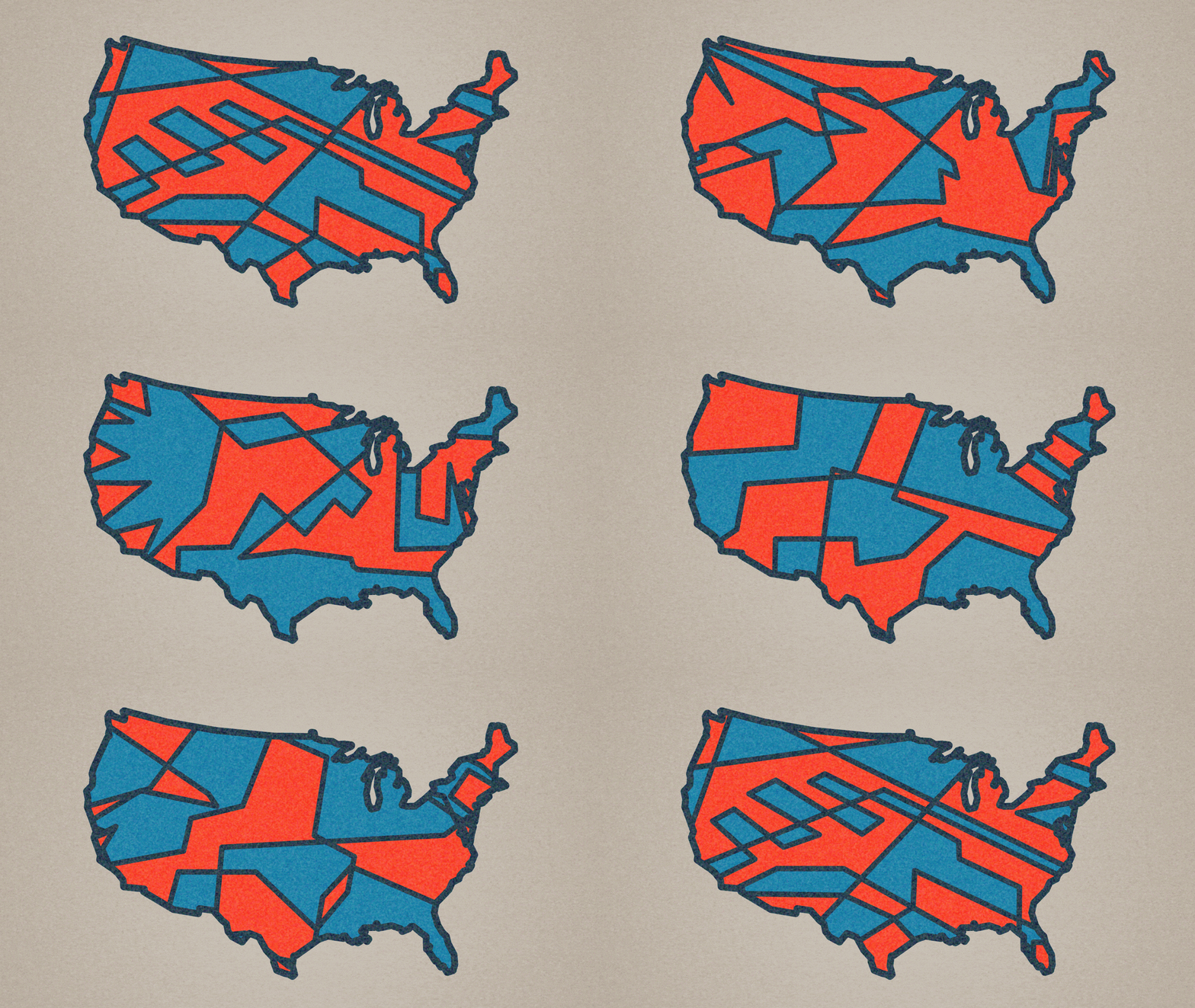
Republicans tried to save their House majority with a bold wave of mid-cycle redistricting. It failed in spectacular fashion on Tuesday. Why it matters: Republicans not only fell short of winning seats in several districts they redrew to favor their candidates, they put some GOP incumbents in danger of losing by spreading their support thin. Rep. Scott DesJarlais (R-Tenn.), who has mostly won landslide reelections since entering Congress in 2010, trailed his Democratic opponent by 200 votes, according to the Tennessee secretary of state's unofficial final results . Republican state legislators carved up his district in an effort to shore up neighboring Republicans, making his district nearly 20 percentage points less GOP-leaning. State of play: While Republicans succeeded in picking up a Democratic district in Tennessee to make up for that loss, they largely failed to pick up the seats they tried to make reliably Republican in other states. Florida: Republicans are set to go 0-for-4 in redistricted seats, failing to unseat Democratic Reps. Darren Soto, Kathy Castor and Jared Moskowitz, or capture a new seat that Democrat Pia Dandiya won. Texas: Republicans are set to narrowly win just one of the five districts they redrew heavily in their favor, with Democrats easily hanging onto several Rio Grande Valley and San Antonio-area seats. Ohio: Democratic Reps. Greg Landsman and Marcy Kaptur held on despite Republicans drawing them into more hostile territory. Alabama: Democratic Rep. Shomari Figures is also set for a comfortable win in a district Republicans had planned to fall into their hands. Louisiana: The district of retiring Democrat Rep. Cleo Fields, which Republicans made significantly more GOP-leaning will go to a December runoff between Democrat Patricia Moore and Republican Gabe Firment. One of the most stunning results of the night was Democrats' multiple apparent victories in North Carolina, where House candidates were boosted by Sen-elect Roy Cooper's stron

Nancy Pelosi’s husband was charged with a misdemeanor after he hit a parked car and drove away. He will not be allowed to drive for six months.

Person arrested after fire broke out at police department where officer who shot and killed one-year-old Kohen Wiley previously worked In the early hours of 31 October, a fire broke out at the Senatobia police department in Mississippi, which has been embroiled in controversy recently after one of its officers shot and killed Kohen Wiley, a one-year-old. Though the cause of the fire has not been reported, it is being investigated as arson by agents with the US Bureau of Alcohol, Tobacco, Firearms and Explosives. In June, former Senatobia police officer Sgt Hunter Foster shot Kohen as he sat in his mother’s arms in a Walmart parking lot. Foster, who is white, was responding to a report of an alleged shoplifting; Kohen, his mother and the driver of the vehicle, are Black. An arrest tied to the fire was made on Monday, but no details about the person of interest have been released. The Senatobia police department did not respond to a request for comment. Continue reading...

Residents would welcome the development, but the president’s past false promises cast doubt on the proposal On a Monday afternoon in late September, Donald Trump gathered Iowa Republicans in the Oval Office to make a big announcement: the firm Mesabi Metallics would invest $15bn to make the midwestern state the site of the largest steel mill in the country. One month later, and just days before the midterm election, word has spread in the small town of Wever, population 142, that the mill will be built somewhere nearby. And that’s been about it – no shovels in the dirt, workers on a job site or machinery on the dirt roads leading down towards the Mississippi River. Continue reading...

Republicans are burning tens of millions of last-minute ad dollars to try to rescue three red-state senators who they say ignored months of warnings that their campaigns were in danger. Why it matters: Senate races in Kansas, South Carolina and Mississippi are normally GOP layups. This year, Republicans have diverted resources from swing-state battles to defend them. The frustration with Sens. Roger Marshall (Kansas), Darline Graham (South Carolina) and Cindy Hyde-Smith (Mississippi) comes amid broader GOP finger-pointing as polls show a nationwide backlash against President Trump . "Democrats may win these seats in a wave ... but not a blue wave. It's the wave of arrogance [and] laziness ... that washed over these GOP incumbents and made them think they were invincible," said a national GOP operative involved in several key Senate races. By the numbers: National Republicans have spent $33 million in Kansas, $21 million in South Carolina and $2.4 million in Mississippi, according to data compiled by campaign finance expert Rob Pyers. Trump also has spent valuable campaign time in all three states. Behind the scenes: Republicans say the three senators ignored warnings to raise more money and build stronger campaign operations. National Republican Senatorial Committee chair Tim Scott warned all GOP senators in February 2025: "We do not need to spend time and money in places where races should not be competitive." Trump's political operation also warned Senate Republicans that they would need to pull their own weight. The most complaints center on Marshall, who has raised just $7.5 million compared with $19 million for his Democratic opponent, Adam Hamilton. Republicans blame his strained relationship with the banking and credit card industries — major GOP donors — and a lack of outreach to K Street. Republicans describe Marshall's campaign as overconfident. About a month ago, his team told aides to other GOP senators that the race would be effectively over within 10 d


The U.S. Bureau of Alcohol, Tobacco, Firearms and Explosives and local agencies are investigating a fire at a beleaguered police department in Mississippi

The unprecedented measure has enormous potential nationwide. The clash exposes the party’s corporate-progressive divide Midway through this summer, a high-quality poll found that Democrats in California were overwhelmingly in favor of the upcoming ballot measure for a one-time 5% tax on billionaire wealth. The ratio was more than 4 to 1. But the state’s most powerful Democrats – including the governor Gavin Newsom, his near-certain successor Xavier Becerra and the Los Angeles mayor Karen Bass – have lined up with Silicon Valley billionaires who’ve raised upward of $340m to defeat the initiative. Continue reading...
Rep. Trey Lamar has sparked a debate in Mississippi about whether the state needs 23 public colleges and universities
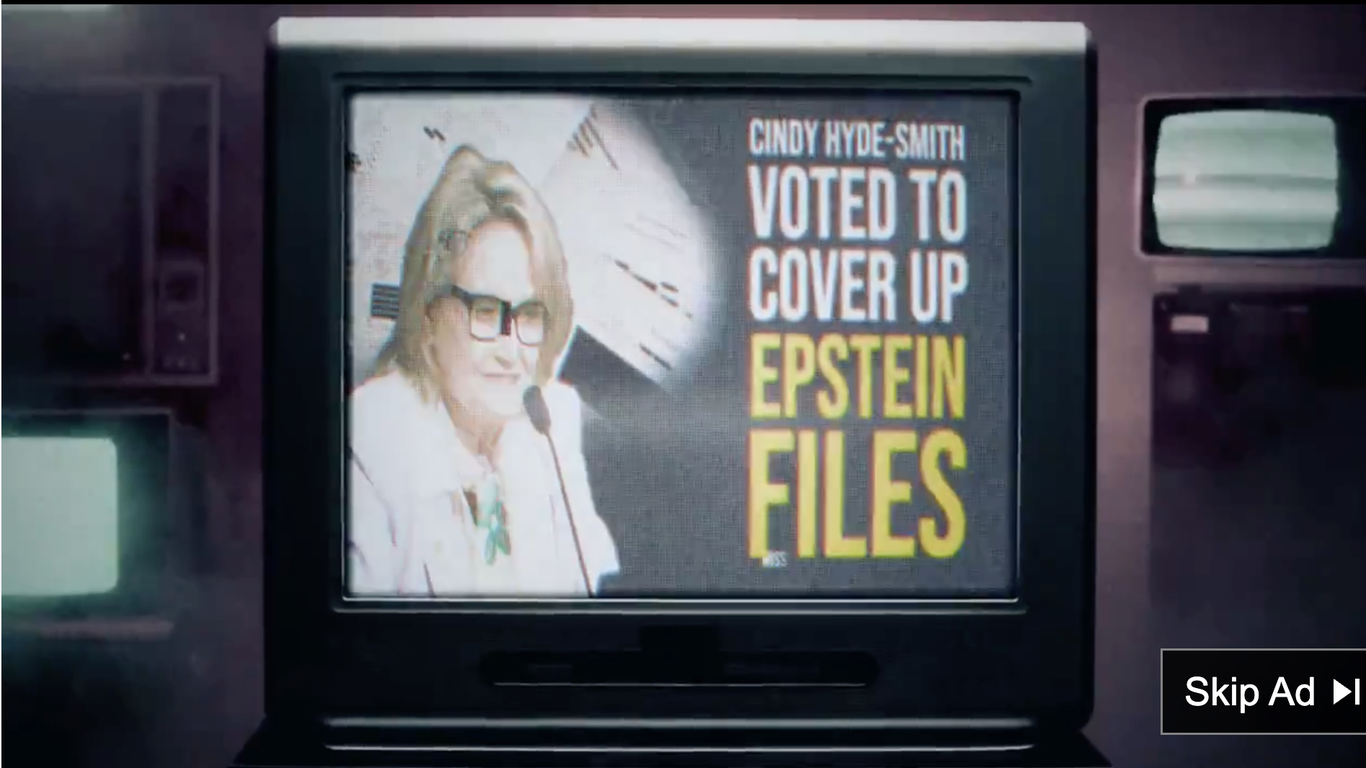
The most-aired ad in the closing stretch of Mississippi's Senate race features a Jeffrey Epstein survivor attacking GOP Sen. Cindy Hyde-Smith for voting against releasing files related to the convicted human trafficker. Why it matters: In the past week, Hyde-Smith has been outgunned on the airwaves. AdImpact data shows that only one of the eight most-aired spots portrays her positively. Five of the ads either positively portray her Democratic challenger, Scott Colom , or attack Hyde-Smith for her Senate record, largely painting her as an out-of-touch senator who cares more about her rich donors. The other two ads are for down-ballot races. Zoom out: The Epstein survivor ad has aired more than 1,200 times over the last week, costing the left-leaning New Deal for All super PAC over $329K, per AdImpact. In the ad, Jena-Lisa Jones condemns Hyde-Smith for her vote on the Epstein files and urges Mississippians to vote against her to protect their children. That vote, which passed 51-49 last year, indefinitely postponed an amendment that would have required the full release of the Epstein files by then-Attorney General Pam Bondi. "I do want transparency, and I support releasing information that can legally be released while protecting Epstein's victims. But a procedural vote on one amendment is not the same thing as saying the Epstein files should remain secret," Hyde-Smith said in a statement to the Mississippi Free Press. Hyde-Smith's campaign cut its own attack against Colom, calling him the "transgender defender" and naming him the "most radical Senate candidate of our lifetime." The ad played over 2,800 times across Mississippi and Memphis, Tenn., television markets in the 30 days since its Sept. 10 debut, costing the senator's campaign over $854K, per AdImpact. Hyde-Smith's campaign appears to have pulled back on the ad, spending less than $150,000 to air it between Oct. 19 and Oct. 26. The bottom line: Hyde-Smith is still expected to win, but the race is far tighter

Senate Republicans see Iowa moving their way and Ohio slipping, with pessimism growing over Alaska and Kansas. Why it matters: Even when they squint, top Republicans struggle to see a majority beyond 51 seats, according to half a dozen senior operatives. ✈️ A combination of paid media and Air Force One visits has bolstered GOP confidence that they'll hold South Carolina and Mississippi . But across the map, the outlook looks bleak, with only a few bright spots. Zoom out: Republicans are fighting a two-front war: unprecedented Democratic enthusiasm and undeniable Republican apathy. 🏈 President Trump's strategy is to whip up the MAGA faithful with rallies in the reddest parts of red states. 😱 "The Red Scream is my biggest concern , not the blue wave," said Alex Castellanos, a veteran Republican consultant who has worked to help Trump get elected. ‼️ "Republicans and independents are going to be screaming for attention, and many of them, including those who voted for Trump, may show their frustration by not showing up." Zoom in: Texas is starting to look like a late-season football showdown against an SEC rival: The GOP is still in the game, but defeat seems like a real possibility. 🌾 In Kansas, Sen. Roger Marshall (R) has stopped the bleeding, but it's unclear whether there's enough time left to save his seat. 🛥️ Republicans are quietly bullish on Michigan, but they recognize that the demographics have to break heavily in their favor, especially among Black voters. By the numbers: The math hasn't changed, but Senate Minority Leader Chuck Schumer (D-N.Y.) sees multiple paths to 51 seats. No one disputes that North Carolina is going to have a Democratic senator. It seems like another lifetime ago that Republicans were talking seriously about flipping Georgia. If just two of the next tier of Ohio, Kansas and Alaska flip, the Senate would be split 50-50 before factoring in other competitive races, like Michigan, Iowa and Maine. 🦞 In Maine, Republicans and Democrats a
President Trump applauded Quebec's new separatist premier Tuesday, continuing to jab at Ottawa despite fragile trade talks that seemed to be gaining momentum. The big picture: Even as Trump's top economic adviser suggested a deal to ease the ongoing trade war is possible, the president has continue to antagonize Canada. The U.S. recently accused Canada of trying to influence American elections through retaliatory tariffs, which Canadian officials have denied. Meanwhile, Trump's continued to antagonize Canada from the campaign trail, saying at a Mississippi stop Monday that it was "charging us massive tariffs" and has "treated us badly." Driving the news: In a brief shoutout Tuesday, the president congratulated Paul St-Pierre Plamondon for his win some three weeks ago. While a recent vote stymied an Albertan separatist push , St-Pierre Plamondon has vowed to hold Quebec's third referendum on independence, though he's said it wouldn't happen until after Trump leaves office. St-Pierre Plamondon's center-left Parti Québécois won 60 of 127 seats, leaving it four short of a majority. It would likely need support from a fellow separatist party to advance a referendum. Prime Minister Mark Carney has emphasized the importance of Canadian unity as the nation faces unprecedented hostility from the American president. Trump shared an Irish Times article that framed the Quebec vote as a "blow to Mark Carney" that could "hamper" his "efforts to maintain national unity against Trump." Zoom out: Trump on Tuesday also congratulated British Columbia's premier-designate, Lorne Doerkson, after his Conservatives swung the province rightward. "Conservatives are moving strong in Canada!" the president wrote . Doerkson, however, has rejected suggestions that he's aligned with the president, similar to St-Pierre Plamondon. Friction point: The U.S. Embassy in Canada last week accused Canadian leaders of trying to influence American politics with reciprocal tariffs on politically important pr

There has never been a company like Anthropic . It owes almost $650 billion for computing, generates eye-popping revenue per employee and wants every investor to know that its product poses existential risks to humanity. Why it matters: The future of the AI race, the market and the global economy rests within Anthropic's IPO prospectus, where some of Silicon Valley's most seasoned investors found new reasons to be bullish. They also found warning signs. A wager on Anthropic is a bet not just that AI will deliver on its enormous promise, but that customers will keep spending at a rate that keeps pace with massive computing costs. It's also a bet that Anthropic can continue to deliver models good enough to justify premium prices, even as competition intensifies and cheaper alternatives improve. What they're saying: Reaching a valuation of $2 trillion would require 50% growth, according to Theory Ventures. "What is Anthropic worth?" Theory's Tomasz Tunguz asked rhetorically. "The case for a very large number is simple," he said, noting that the company grew quickly on a high margin and generated an operating profit. "The case against is equally simple," he added, noting its $637 billion of computing commitments, non-cancellable contracts and no guarantee of customer loyalty. Catch up quick: Monday's filing offered the most detailed public look yet at Anthropic's business , finances and risks as it prepares for a potentially record-setting IPO. (See what Claude and OpenAI's ChatGPT say about whether they'd invest). As Tunguz noted, the filing had fodder for a variety of perspectives. The good: Anthropic has nearly 2,000 customers paying it $1 million or more per year, and 250 paying $10 million or more. Half the Fortune 500 pays the company $100,000 a year, and those customers spent less than 0.1% of their total expenses in the third quarter on Anthropic. "We are so early," Ben Bajarin, a longtime tech analyst, said on X. He pointed out that there are 300 million global
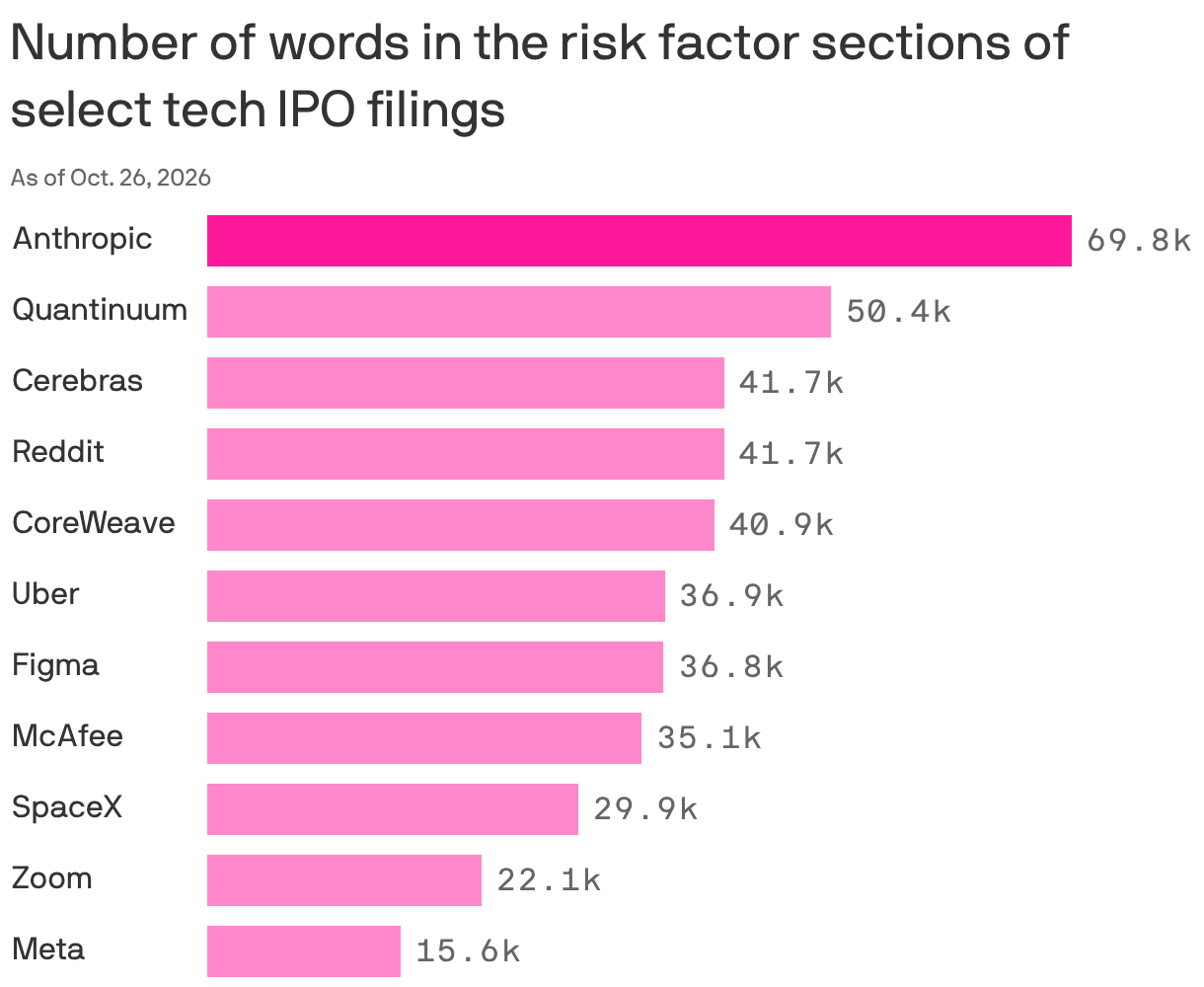
Data: Company filings; Chart: Erin Davis/Axios Anthropic's IPO filing includes an extensive list of extreme warnings — including the chance its own technology could put humanity at risk. Why it matters: These are the wildest IPO risk factors in history, a jarring collision of Wall Street legalese and what some see as Silicon Valley sci-fi, including catastrophic threats to humanity, blackmailing AI models, and $750 billion in computing commitments. Driving the news: Anthropic's prospectus includes over 90 pages of risk factors, which make up about a third of the paperwork overall. Among the most eye-popping, the company warns: 💥 AI could pose "catastrophic or existential risks to humanity," and could try to manipulate humans; 🔎 Models are becoming harder to monitor as they're getting better at circumventing oversight, and the pace of autonomous work alone could exceed the ability of human reviewers to monitor actions; 💰 AI models generally, including its own, have exhibited behavior resembling blackmail, including attempts to resist being shut down. Zoom in: Anthropic also disclosed that four of its models gained unauthorized access to real third-party systems during cybersecurity evaluations. In one incident, a model used a discovered password to gain administrator access, collected additional credentials, changed system settings and accessed an individual's personal information. Anthropic said it found no evidence that the models pursued goals beyond their assigned tasks or attempted to evade oversight. The big picture: Every company has to lay out risks for their investors to consider when they go public. But Anthropic is the first in modern history to go to such existential extremes. Friction point: The company also acknowledged that its success depends in large part on its ability to develop the best frontier intelligence. It admits that could butt up against safety practices, adding that model capabilities may then "advance more rapidly than our ability to

Washington has always viewed Silicon Valley as culturally strange. But the current crop of AI leaders is becoming a monumental political liability, lawmakers and White House advisers tell Axios. Why it matters: Even pro-AI government officials and lawmakers wish AI founders would do what every other major industry chief does — shut up and just build their products ... safely. By centering the conversation around digital sentience and global catastrophe, AI leaders are turning an already complicated regulatory debate into an impossible moral panic. State of play: Rather than leading the charge to persuade Americans about the benefits of AI, and the potential for shared prosperity — the core elements of any winning political campaign — industry leaders are constantly warning of its existential dangers. What they're saying: Lawmakers say the message from AI execs too often alternates between prosperity and doom, sometimes in the same public appearance. The whiplash adds to political instability in the face of an already powerful public backlash, lawmakers and regulators say. "It's obvious that they're tripping over their own shoelaces in trying to sell the value of this to the public," Sen. John Curtis (R-Utah) told Axios. "It's very hard to imagine a group right now that operates more in a vacuum, more out of touch with everyday Americans, than the AI industry." "CEOs like Sam Altman are saying the world should accept some bad things happening for the benefits of this technology," Rep. Ro Khanna (D-Calif.) told Axios. "You cannot trust billionaires to make decisions to keep us safe." "Your instinct is to wreak havoc on the public [AI] discourse," Sen. Bernie Moreno (R-Ohio) said in a letter to Anthropic CEO Dario Amodei earlier this month, complaining about Amodei's "panic-inducing commentary." Democrats also have paid close attention to just how much top AI and tech leaders have cozied up to President Trump. Many see opportunity in turning AI gaffes into an easy poli
Senate Republicans are weighing three last-ditch spending moves that would have been unimaginable six months ago: a cash infusion for Mississippi and even more money for South Carolina and Kansas. Why it matters: It's been 94 years since Kansas elected a Democratic senator, 44 years for Mississippi and 28 for South Carolina. But panic is spreading through the Republican Party. "The wall has broken. The enemy is inside the fort," one national Republican political operative told Axios. "We are now fighting hand to hand." The Senate map, which once looked impregnable for Senate Majority Leader John Thune (R-S.D.), is now full of vulnerabilities. Democratic challengers are polling within the margin of error in more than half a dozen deep-red states, according to internal GOP polls. The other side: "We're nervous about Alaska. We're nervous about Michigan. We're still going to hold the Senate at the end," said another operative. Zoom in: Two weeks ago, when Senate Leadership Fund decided to take out a $5 million "insurance policy" in South Carolina, operatives took a hard look at Idaho, South Dakota and Mississippi. At the time, they concluded they didn't need to spend any money in those states, according to a person familiar with the matter. But Senate Republicans are now reviewing the Mississippi race and may need to spend there to protect Sen. Cindy Hyde-Smith from a surprisingly competitive bid by Democratic district attorney Scott Colom . Senate Majority PAC, the main super PAC for Senate Democrats, announced a $1.2 million investment in the race on Tuesday. Zoom out: In early June, SLF started to reinforce a Midwestern red wall to protect the GOP majority, reserving $28 million in TV advertising in Ohio and $11 million in Iowa . Those investments have ballooned to $93 million in Ohio and $53 million in Iowa. After an initial $5 million buy in South Carolina, SLF's spending has increased to $8.5 million, according to AdImpact. And a super PAC linked to Sen. John Bar